

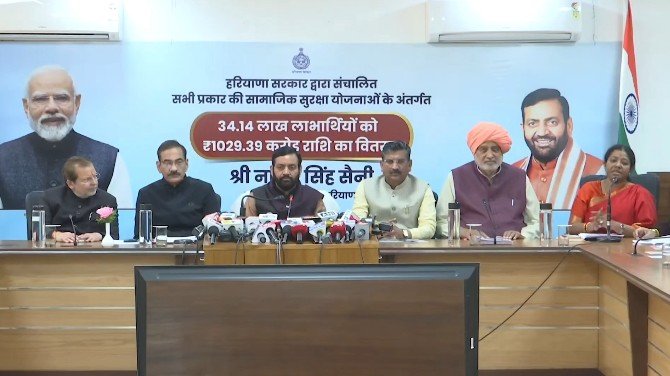
Haryana Chief Minister Nayab Singh Saini on Monday unveiled a sharper, time-bound governance framework aimed at strengthening social justice, accelerating accountability, and reinforcing grassroots empowerment, particularly for Scheduled Castes and Scheduled Tribes. Chairing the State Level Vigilance and Monitoring Committee meeting in Chandigarh, the Chief Minister announced that the incentive grant for outstanding Panchayats working for the welfare of Scheduled Castes will be doubled from ₹50,000 to ₹1 lakh, signalling a clear policy shift that rewards performance, inclusion, and social responsibility at the village level.
The meeting reviewed the implementation of the Scheduled Castes (Prevention of Atrocities) Act, 1989 and the Protection of Civil Rights Act, 1955. Development and Panchayat Minister Krishan Lal Panwar and Social Justice and Empowerment Minister Krishan Kumar Bedi were present, along with senior administrative and police officials.
Positioning Panchayats as the frontline of social reform, Chief Minister Saini outlined a wider definition of “excellent Panchayats.” These include villages with zero incidents of atrocities against Scheduled Castes, full utilisation of SC component funds, sustained anti-drug campaigns, elimination of stubble burning, and effective resolution of drinking water issues. To institutionalise this approach, incentives have been structured at the state, district, and subdivision levels, embedding accountability across governance tiers.
In a decisive move to curb delays and procedural laxity, the Chief Minister directed that charge sheets in all SC and ST-related cases must be presented before courts within 60 days. He underlined that the newly implemented criminal laws also mandate the same timeline, making delay unacceptable. To ensure efficiency, he ordered the appointment of separate investigating officers for such cases and announced the establishment of a dedicated investigation wing in every police station so that probes are not diluted or obstructed.
Chief Minister Saini adopted a zero-tolerance stance on caste-based harassment, stating unequivocally that atrocities against Scheduled Castes will not be tolerated at any level of administration or society. He instructed officials to take immediate action in genuine cases, while also stressing that false complaints should invite strict legal consequences. In cases settled through compromise, he directed authorities to verify whether consent was obtained under pressure or inducement, reinforcing the principle that justice cannot be negotiated under coercion.
Presenting data-driven governance as a cornerstone of his administration, Saini noted that since 2021, Haryana has witnessed a decline in crimes against Scheduled Castes and women, along with a reduction in robbery, property damage, and criminal intimidation cases. For the year 2025–26, the state has already disbursed ₹8.84 crore as financial assistance for the relief and rehabilitation of 796 victims of atrocities, reflecting a responsive welfare mechanism beyond mere legal compliance.
The Chief Minister also highlighted the role of social integration in long-term harmony. Under the Social Harmony Inter-Caste Marriage Shagun Scheme, financial assistance amounting to ₹31.62 crore has been provided to 1,265 beneficiaries during the current financial year, including 807 women and 458 men. He described the scheme as a powerful instrument to dismantle social barriers and promote dignity through state support.
To deepen awareness and prevention, Saini said the government is actively organising debates, seminars, speech contests, and writing competitions in schools and colleges on issues related to social equality and prevention of atrocities. He further directed that enlightened citizens be included in district and subdivision-level vigilance meetings, and mandated that Deputy Commissioners convene at least four such review meetings annually to monitor the implementation of the SC Act.
Senior officials including Chief Principal Secretary Rajesh Khullar, Additional Chief Secretary Sudhir Rajpal, Principal Secretary to the Chief Minister Arun Gupta, Additional Principal Secretary Dr. Saket Kumar, DGP Ajay Singhal, and other government and non-government committee members attended the meeting.
With these announcements, Nayab Singh Saini reinforced his governance model that blends strict law enforcement with social incentives, administrative discipline with community participation, and welfare delivery with measurable outcomes. The message from Chandigarh was unambiguous: in Haryana, social justice is no longer a slogan—it is a monitored, incentivised, and time-bound state commitment.