

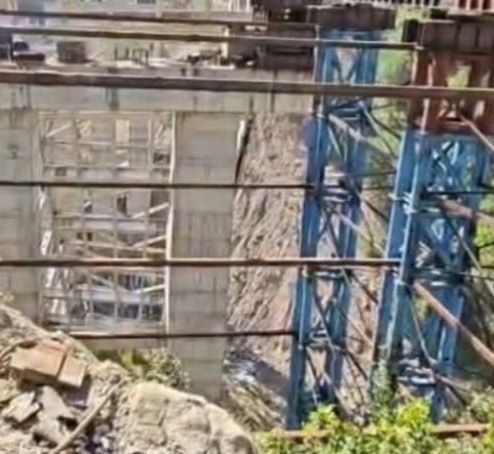
Hamirpur, Himachal Pradesh: A section of an under-construction steel truss bridge on the Shimla-Matour four-lane corridor collapsed during a launching operation in Hamirpur district on Friday, injuring three workers and raising fresh questions about safety controls during major highway construction projects.
The incident took place at Hathali Khud near Masiyana on the under-construction Hamirpur bypass, which forms part of the Shimla-Matour corridor. The bridge is part of the 17-km Kohali-Cheel Bahal section of the four-lane project being executed under the National Highways Authority of India (NHAI). The overall Shimla-Matour highway project has an estimated cost of nearly Rs 10,000 crore, including expenditure related to land acquisition.
The accident occurred while a 90-metre-long steel truss bridge was being moved into position using the incremental launching, or pushing, method. According to NHAI’s preliminary explanation, the launching nose had reached the pier cap when a mechanical failure suddenly occurred. The truss structure then lost support and a substantial portion fell into the deep stream below.
NHAI has said that the bridge piers themselves suffered no damage. Three workers were injured and shifted to the Medical College and Hospital in Hamirpur for treatment. Local reports have described one of the injured as being in serious condition. Rescue and relief operations were initiated immediately after the collapse.
The precise reason for the mechanical failure has not yet been established. NHAI has called in technical experts from Delhi to examine the accident and determine what went wrong during the launching operation. That investigation will be important because the failure occurred not in an already completed bridge carrying traffic, but during one of the most technically sensitive stages of bridge construction.
Launching a large steel truss involves coordinated movement of a heavy structure over supporting piers. The operation requires precise control of equipment, alignment, temporary supports and the forces acting on the structure as it moves forward. A failure at any stage can have serious consequences for workers operating on or around the structure. In this case, the fact that the structure was being moved over a deep gorge makes the incident particularly significant from a construction-safety perspective.
The accident also comes at a time when the quality and safety of National Highway construction have come under increased scrutiny nationally.
In July, information placed before Parliament showed that 19 National Highway projects had witnessed collapses, cave-ins or structural failures involving newly constructed bridges and flyovers during 2025 and 2026. The government said 11 officials had been removed from service following performance assessments, while disciplinary action had been taken against another 11 officers in connection with various cases, including allegations of negligence and dereliction of duty.
Another government disclosure in August said 471 bridges on the National Highway network had been identified as suffering from structural distress. Remedial work had been completed on 159 of them, while work on the remaining 312 was targeted for completion by December 2028.
More recently, NHAI launched a special quality inspection of 17 under-construction highway projects across nine states. The exercise is aimed at projects meeting specific criteria, including estimated costs above Rs 500 crore, tender discounts exceeding 15 per cent and construction progress between 35 and 80 per cent. The inspections are intended to examine construction quality, materials, workmanship and compliance with approved technical standards.
These national developments do not by themselves establish that the Hathali Khud bridge collapse was caused by defective construction, poor materials or negligence. At present, the only specific cause publicly identified by NHAI is a mechanical failure during the launching operation. The technical investigation will have to establish whether the failure was confined to equipment, whether other factors were involved, and whether all prescribed safety procedures were being followed.
The incident is nevertheless significant for Himachal Pradesh, where large highway projects involve difficult terrain, deep valleys, steep slopes and complex engineering operations. The Shimla-Matour corridor is among the state’s major road infrastructure projects and is intended to substantially improve connectivity between the state capital and the Kangra region.
For such projects, speed of construction cannot be separated from the need for rigorous quality assurance and worker safety. Every stage—from design and fabrication to launching, temporary support systems and final structural inspection—carries its own risks. Independent technical inspections become particularly important when a failure occurs before a structure is completed.
Himachal Pradesh has also witnessed other safety-related concerns around highway construction. In August, the Himachal Pradesh High Court directed NHAI and a contractor to share Rs 2.23 crore in compensation following the collapse of a residential building during four-laning work near Shimla in 2025. An inquiry had attributed that building collapse to hill cutting associated with the highway work. That case was separate from the Hathali Khud bridge incident and involved different circumstances, but it illustrates the wider safety concerns that can arise around major highway construction in the state’s fragile terrain.
The immediate priority at Hathali Khud is the recovery and treatment of the injured workers and securing the construction site. The next question will be whether the technical inquiry identifies a failure of machinery alone or points to shortcomings elsewhere in the launching operation.
For a project involving thousands of crores of public investment and infrastructure expected to serve the state for decades, the answer will matter well beyond this single construction site. The collapse is therefore not simply an isolated construction mishap; it is a test of whether safety, engineering checks and accountability are keeping pace with the scale of highway construction underway in Himachal Pradesh.