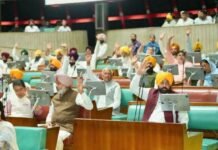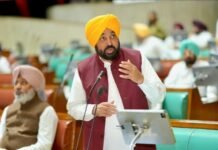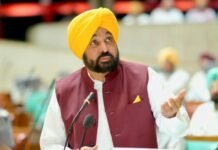

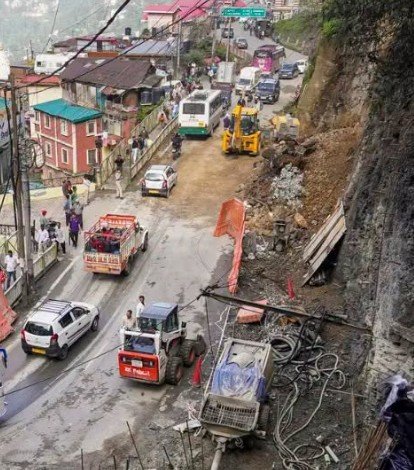
The Himachal Pradesh Assembly has turned the state’s battered road network into one of the most important governance issues of the ongoing monsoon session, with the Sukhvinder Singh Sukhu government preparing an extensive post-monsoon programme to repair and resurface hundreds of kilometres of roads across the state.
Public Works Minister Vikramaditya Singh informed the Assembly that around 800 kilometres of roads are planned to be tarred after the monsoon at an estimated expenditure of ₹120 crore. Around 1,500 kilometres of road construction and upgrading work is already at different stages across Himachal Pradesh.
The announcement comes against the backdrop of another difficult monsoon for the hill state, where heavy rainfall routinely exposes the vulnerability of roads, bridges and other public infrastructure. For the Sukhu government, road connectivity is not simply an infrastructure issue. In a mountainous state where villages and towns can depend on a single road link for access to hospitals, schools, markets and government services, maintaining roads is directly connected with the functioning of the rural economy.
The Assembly discussion has therefore given the government an opportunity to explain how it intends to move from emergency restoration to longer-term infrastructure strengthening.
The proposed post-monsoon tarring programme is particularly significant because repeated patchwork repairs have often failed to provide a durable solution in areas exposed to heavy rainfall, landslides and difficult geological conditions. The government now faces pressure to ensure that public money spent on restoration produces roads capable of withstanding increasingly unpredictable weather conditions.
The political stakes are equally important.
The BJP Opposition has repeatedly questioned the Congress government over the condition of roads and the pace of restoration in disaster-affected areas. Leader of Opposition Jai Ram Thakur has maintained that infrastructure damage and the government’s response should receive greater attention during the Assembly session.
For the BJP, poor road conditions provide a direct political issue because the consequences are visible to ordinary citizens. A damaged road does not require an elaborate political explanation; it affects daily travel, transportation costs, tourism, agricultural marketing and access to essential services.
The Sukhu government, however, has a different argument.
The administration has been dealing with a state where monsoon damage has become a recurring financial burden. Roads damaged by landslides and cloudbursts require immediate restoration, while the state simultaneously has to finance health, education, salaries, pensions and other essential services.
This makes infrastructure spending a difficult balancing exercise.
The government must restore roads quickly without compromising financial discipline.
The proposed ₹120-crore tarring programme comes at a time when Sukhu is increasingly emphasising expenditure management. The Chief Minister has recently announced measures aimed at reducing administrative expenditure, including a proposal to rationalise the sanctioned strength of senior officers, with the government projecting substantial savings.
The message from the administration is that every rupee must be used more efficiently.
Road infrastructure will be one of the areas where that principle will be tested most visibly.
The state cannot afford to repeatedly spend on the same stretch of road without improving its durability. At the same time, delaying restoration can create far greater economic losses, particularly in rural areas where agriculture, horticulture and tourism depend heavily on reliable connectivity.
The issue is particularly sensitive for horticultural regions.
Apple and other fruit-growing areas rely on roads to transport produce from remote orchards to markets. When roads are blocked or badly damaged, farmers can face delays, increased transportation costs and losses in the value of perishable produce.
For tourism, the stakes are similar.
Himachal’s economy depends heavily on visitors travelling to destinations spread across difficult mountain terrain. Road conditions influence not only tourist arrivals but also the movement of local residents and businesses that depend on tourism.
The Assembly debate therefore reflects a much larger economic question: how can Himachal build infrastructure capable of supporting its rural economy while coping with increasingly frequent weather-related disruptions?
The Sukhu government is attempting to answer that question through a combination of restoration and new construction.
The Public Works Department’s plan covers both immediate road repairs and larger upgrading projects. The government has indicated that around 1,500 kilometres of road work is already at different stages, suggesting that its infrastructure strategy extends beyond repairing monsoon damage.
Yet execution will remain the decisive factor.
Himachal’s difficult terrain makes road construction considerably more complicated than in plains states. Projects face challenges related to land stability, environmental clearances, forest permissions, drainage and extreme weather.
This means that government departments must coordinate closely if projects are to be completed within reasonable timelines.
For the Opposition, this is where scrutiny will continue.
The BJP can be expected to ask whether the government has released sufficient funds, whether contractors are completing projects on time and whether road-quality standards are being maintained.
The Congress government, meanwhile, will seek to demonstrate that it is not merely reacting to damage but building a longer-term infrastructure strategy.
The political conversation inside the Assembly is consequently moving beyond the immediate question of how many kilometres of road will be repaired.
It is becoming a debate over the quality of governance itself.
For Sukhu, road restoration offers a practical opportunity to demonstrate that his administration can deliver visible results despite fiscal constraints. For the BJP, roads provide a straightforward measure against which government performance can be judged.
The coming months will therefore be important.
Once the monsoon recedes, the government will have to move quickly to implement the promised tarring programme. Delays could create further political criticism, while successful execution could give the administration a strong response to allegations that infrastructure development is lagging.
The larger challenge is sustainability.
Himachal cannot continue treating every monsoon as an extraordinary event. Climate-related risks, heavy rainfall and landslides have become recurring threats, requiring stronger drainage systems, better engineering standards, slope stabilisation and more resilient road design.
That is where the Assembly discussion could eventually prove more significant than the ₹120-crore announcement itself.
The state needs an infrastructure model designed for the realities of a fragile mountain environment.
The Sukhu government now has an opportunity to make road restoration part of that larger strategy.
For citizens, however, the measure of success will remain simple: roads that remain open, safe and usable.
For the government, the political calculation is equally clear. If the promised 800-kilometre tarring programme is implemented efficiently and the wider 1,500-kilometre pipeline progresses, the Congress administration can present it as evidence of active governance in difficult circumstances.
If execution falters, the BJP will have another powerful issue with which to challenge the government.
The Assembly’s road debate has therefore placed a very visible responsibility on the Sukhu government: turn financial allocations and official assurances into roads that work for Himachal’s villages, farmers, businesses and travellers.