
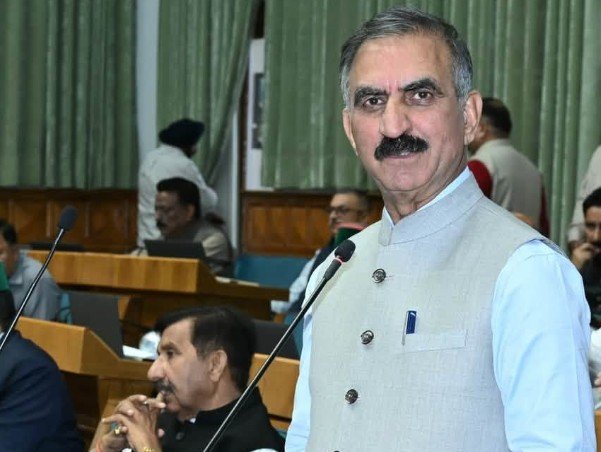
The ongoing monsoon session of the Himachal Pradesh Legislative Assembly is increasingly turning into a broader political examination of the Sukhvinder Singh Sukhu government’s governance record, with questions on infrastructure, healthcare, employment, education and the impact of the monsoon dominating the proceedings.
The session, being held from August 21 to September 3, has received more than 1,000 questions from Congress and BJP legislators, reflecting the breadth of issues confronting the state. According to the Vidhan Sabha Secretariat, 1,036 questions have been submitted, including 787 starred and 249 unstarred questions. The subjects range from vacancies in educational institutions and healthcare facilities to monsoon losses, damaged roads, tourism, agriculture, horticulture and transport.
This extensive questioning has given the Assembly a significance that goes beyond the immediate political exchanges between the ruling Congress and the BJP Opposition. It is providing a detailed picture of the pressures facing Himachal Pradesh at a time when the Sukhu government is attempting to balance development commitments with serious fiscal constraints and repeated natural disasters.
For Chief Minister Sukhu, the session offers an opportunity to demonstrate that his government is responding to these pressures through policy and administrative action rather than simply managing political criticism.
For the BJP, led by Leader of Opposition Jai Ram Thakur, the session provides a platform to scrutinise the government’s performance and argue that several public services are under strain.
The difference in political approaches is becoming increasingly visible.
The BJP has sought to place unemployment, healthcare, roads and governance failures at the centre of the Assembly debate. The party’s legislators have also raised concerns about the functioning of welfare schemes and the government’s handling of issues affecting ordinary citizens.
The Congress government, meanwhile, has been defending its record while highlighting inflation, the state’s financial position and what it considers the Centre’s responsibilities towards Himachal Pradesh.
This political contest is likely to continue throughout the session, but the substantive issues before the House are considerably wider.
Road connectivity is perhaps the most immediate example.
Himachal’s mountainous geography means that roads are essential to almost every aspect of economic and social life. The recent monsoon has once again damaged roads and created landslide-related disruptions across several districts. The government has indicated that extensive repair and tarring work will be undertaken once weather conditions improve.
The Assembly’s discussion of roads is therefore not simply about construction expenditure. It is about the ability of the state to maintain connectivity for villages, farmers, horticulturists, tourists and emergency services.
The same principle applies to healthcare.
BJP legislators recently protested outside the Assembly over what they described as deteriorating health services and alleged problems with the HimCare scheme. The Opposition has accused the Sukhu government of weakening welfare initiatives associated with the previous BJP administration.
The Congress government rejects that political framing and maintains that it is working to strengthen public services while dealing with the state’s financial limitations.
The healthcare debate is important because Himachal’s terrain makes access to medical facilities particularly difficult for people living in remote areas. A policy that looks adequate on paper can still fail to meet expectations if patients cannot reach hospitals easily, specialist services are unavailable or government hospitals face shortages of staff and equipment.
Employment is another issue with considerable political weight.
The BJP has sought an urgent Assembly discussion on unemployment, arguing that the issue deserves immediate attention. The demand comes against the backdrop of the Congress government’s earlier electoral commitments relating to jobs and opportunities for young people.
The Sukhu administration has emphasised that employment generation cannot depend entirely on government recruitment. It has increasingly promoted tourism, investment, entrepreneurship, horticulture and other sectors as potential sources of sustainable employment.
That approach reflects the state’s financial reality.
Himachal cannot indefinitely expand government employment without considering the impact on salaries, pensions and other committed expenditure. The government’s larger challenge is therefore to create a private and semi-private economic ecosystem capable of providing stable opportunities to young people.
The Assembly provides an important forum for the government to explain that strategy.
Education is another area where the large number of questions submitted by legislators could produce significant political debate. Vacancies in educational institutions remain a concern, particularly in rural and remote areas. Teacher shortages can directly affect the quality of education and contribute to the migration of families towards larger towns.
For the Sukhu government, strengthening education is also connected with its employment strategy. Better schools and skill development are essential if young people are to take advantage of new opportunities in tourism, technology, industry and entrepreneurship.
Agriculture and horticulture will also receive attention during the session.
The state’s apple economy and other horticultural sectors are particularly vulnerable to weather-related disruptions. Roads, market access, transportation costs and changing weather patterns all influence farmers’ incomes.
A strong Assembly debate on these issues could therefore provide an opportunity for the government to explain how it intends to protect rural livelihoods while modernising the state’s agricultural economy.
Tourism presents another major policy challenge.
Himachal’s tourism industry remains an important source of employment and revenue, but it is also vulnerable to infrastructure bottlenecks, extreme weather and unplanned development. The government needs to balance tourism expansion with environmental sustainability and the carrying capacity of fragile mountain destinations.
The Assembly session could become an important forum for that discussion.
Underlying all these subjects is the state’s financial condition.
The Sukhu government has repeatedly argued that Himachal’s fiscal situation requires difficult decisions. The administration has been pursuing expenditure rationalisation while seeking additional revenue and greater financial assistance from the Centre.
The Opposition, however, will continue to question whether fiscal constraints are being used to explain shortcomings in public services.
That disagreement is likely to remain one of the defining themes of the session.
The political atmosphere is already tense. The BJP has accused the government of avoiding meaningful discussions on issues such as unemployment, corruption and governance, while Congress leaders have accused the Opposition of disrupting the functioning of the House.
Yet the volume of questions submitted by legislators suggests that there is substantial scope for substantive debate.
The challenge for both sides is to ensure that the Assembly does not become dominated by political confrontation at the expense of legislative scrutiny.
For Sukhu, the session is an opportunity to put figures, policies and implementation plans before the public. If the government can provide convincing answers on roads, healthcare, jobs, education and disaster recovery, it can strengthen its argument that it is governing under exceptionally difficult circumstances while laying the foundation for longer-term reform.
For the BJP, the session provides a chance to demonstrate that its criticism is based on specific public concerns rather than political opposition for its own sake.
The larger significance of the monsoon session lies precisely here.
Himachal Pradesh is facing a combination of problems that cannot be solved through political slogans alone. Climate-related disasters are placing additional pressure on infrastructure. The state’s finances limit the government’s room for manoeuvre. Young people are demanding employment opportunities, while rural communities need stronger roads, healthcare and agricultural support.
These challenges require sustained policy responses.
The Assembly can provide the political space for those responses to be debated, questioned and improved.
As the session progresses, the performance of the Sukhu government will therefore increasingly be judged not by the intensity of the political exchanges inside or outside the House, but by the clarity of its answers and the credibility of its plans.
For Himachal’s people, the most important question is straightforward: can the government convert its promises and Assembly assurances into visible improvements in everyday life?
That will ultimately determine how the current political debate is remembered.