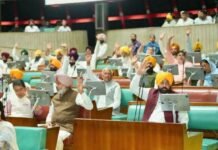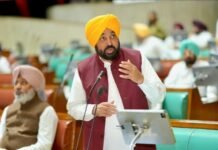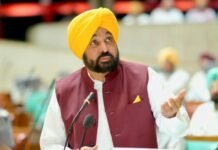

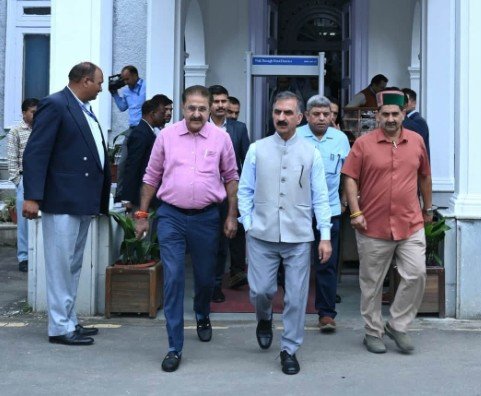
The ongoing monsoon session of the Himachal Pradesh Assembly has been overshadowed by an increasingly sharp confrontation between the ruling Congress government and the Opposition BJP, with a dispute over “Vande Mataram” turning into a broader battle over parliamentary conduct, nationalism and the functioning of the House.
What began as a disagreement over the rendition of the national song has now developed into a political standoff, with BJP legislators staging protests and repeatedly walking out of the Assembly. The Congress government, led by Chief Minister Sukhvinder Singh Sukhu, has accused the Opposition of disrupting legislative proceedings, while BJP leaders have rejected the allegations and demanded evidence to support the government’s claims.
The controversy has added another layer to an already charged Assembly session, where the BJP has been preparing to mount a sustained offensive against the Sukhu administration over corruption allegations, healthcare, unemployment, development and what it describes as failures in governance.
For the Congress government, the immediate priority is to prevent the controversy from overwhelming the legislative agenda. The monsoon session is scheduled to continue until September 3 and was expected to provide an opportunity for detailed discussion on issues directly affecting the people of Himachal Pradesh.
More than 1,000 questions have reportedly been submitted by legislators, covering areas such as education, healthcare, roads, tourism, agriculture, horticulture, transport, employment and the damage caused by the monsoon. These issues carry considerably greater implications for the state’s administration and economy than the immediate political controversy.
Yet the Assembly has increasingly become a platform for confrontation rather than consensus.
Chief Minister Sukhu has accused BJP legislators of showing disrespect towards the national song, while Leader of Opposition Jai Ram Thakur has rejected the charge and demanded that the government establish its allegation through the official proceedings and available footage.
The BJP has maintained that the controversy should not be used to make political accusations against its legislators. Congress, meanwhile, has sought to portray the repeated Opposition protests and walkouts as an attempt to obstruct the functioning of an elected constitutional institution.
The dispute has consequently moved beyond the question of what happened during the rendition of the song. It has become a contest over political credibility.
For the BJP, the issue provides another opportunity to challenge the Congress government on a matter carrying strong emotional and national significance. For Congress, the objective is to ensure that the Opposition does not succeed in defining the entire Assembly session through protests and disruptions.
The confrontation is particularly significant because the BJP has already intensified its broader attack on the Sukhu government.
On August 25, BJP legislators staged a highly visible protest outside the Assembly carrying suitcases. Leader of Opposition Jai Ram Thakur alleged that corruption had spread across different areas of government functioning and accused the Congress administration of failing to maintain the pace of development. The allegations are political claims by the Opposition and have not been established as facts.
The BJP has also raised concerns about healthcare services and the implementation of government schemes. The Opposition has attempted to use these issues to argue that the government’s administrative claims do not match the experience of ordinary citizens.
Congress has strongly rejected the Opposition’s narrative and has maintained that its government is working to strengthen public services while addressing the financial difficulties it inherited.
The political battle is therefore taking place on two parallel levels.
The first is inside the Assembly, where the two sides are fighting over procedure, conduct and the right of the Opposition to raise issues.
The second is outside it, where both parties are attempting to shape public opinion ahead of the next Assembly election.
For Sukhu, the timing is important. His government is approaching the midpoint of its tenure and increasingly faces questions about what it has achieved since coming to power. The Congress came to office in December 2022 after defeating the BJP, and Sukhu has since attempted to establish an identity around fiscal discipline, administrative reforms and what he describes as systemic change.
His government is also attempting to deal with a difficult financial situation. Himachal Pradesh carries a substantial debt burden, while repeated natural disasters have placed additional pressure on public finances. Roads, bridges and other infrastructure require continuous investment, while the government must simultaneously finance salaries, pensions, welfare commitments and essential public services.
The government’s recent proposal to reduce the sanctioned strength of senior IAS, IPS and IFS officers has been presented as part of this broader effort to control administrative expenditure and make the bureaucracy more efficient.
The BJP, however, is attempting to turn these pressures into a political vulnerability.
Jai Ram Thakur has increasingly positioned himself as the principal challenger to Sukhu, attacking the government on corruption, public services and financial management. The BJP’s strategy appears aimed at building an anti-incumbency narrative well before the next election campaign formally begins.
The Congress faces a corresponding challenge. It must defend its record without allowing every political confrontation to become a prolonged disruption in the Assembly. The government also needs to demonstrate that its development and financial-reform agenda is producing tangible results.
The “Vande Mataram” dispute illustrates the intensity of the political environment.
National symbols carry enormous political sensitivity, and disagreements surrounding them can quickly move beyond legislative procedure into questions of patriotism and political identity. That makes compromise more difficult and political escalation easier.
But there is a danger for both sides.
If the controversy continues to dominate the session, important questions relating to employment, education, healthcare, roads, tourism and disaster management could receive less attention. Those are the issues on which the people of Himachal Pradesh ultimately expect their elected representatives to focus.
The political stakes are therefore larger than the immediate dispute.
The BJP wants to establish that the Sukhu government is losing administrative and political credibility. Congress wants to show that the Opposition is more interested in disruption than constructive debate. Both narratives will increasingly shape the public conversation as the state moves towards its next electoral battle.
For the Sukhu government, the immediate task is to restore legislative normalcy while answering the substantive questions being raised by the Opposition. For the BJP, the challenge is to ensure that its protests are translated into a convincing alternative political programme rather than remaining limited to allegations and confrontation.
Himachal Pradesh is facing challenges that cannot be resolved through political symbolism alone. Its fragile mountain infrastructure, recurring extreme-weather events, financial constraints, employment concerns and pressure on public services require sustained legislative attention.
The Assembly was designed to provide precisely that forum.
Whether the remaining days of the monsoon session can move back towards substantive debate will therefore be an important test for both the government and the Opposition.
The “Vande Mataram” controversy may have triggered the latest confrontation, but the political contest behind it is much larger. It is a battle over governance, credibility and the future direction of Himachal Pradesh — and both Congress and BJP are already preparing for the electoral battles that lie ahead.