
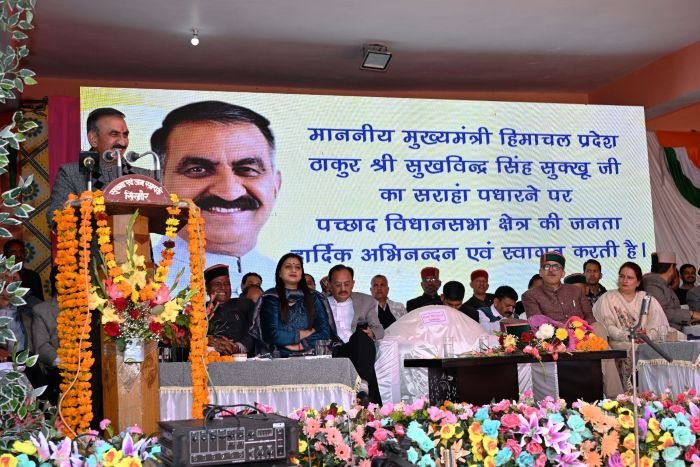
Himachal Pradesh Chief Minister Sukhvinder Singh Sukhu on Friday mounted a sharp political and fiscal challenge to the Bharatiya Janata Party, asking it to clarify whether it supports the restoration of the state’s long-standing Revenue Deficit Grant (RDG), which he claims has been curtailed following the recommendations of the 16th Finance Commission. Addressing a large public gathering in Sarahan in the Pachhad Assembly constituency of Sirmaur district, the Chief Minister combined a defence of his government’s fiscal position with a series of development announcements aimed at strengthening the rural economy and social welfare network in the hill state.
Framing the RDG issue as a question of Himachal Pradesh’s constitutional rights rather than partisan politics, Sukhu said the grant had been flowing to the state since the tenure of its first Chief Minister, Yashwant Singh Parmar, who also enacted Section 118 to protect the land rights of local residents. According to Sukhu, the withdrawal or reduction of RDG represents a significant financial setback for the state, with implications running into thousands of crores. He argued that RDG is not a discretionary favour from the Centre but a rightful entitlement of the people of Himachal Pradesh. In a direct challenge to the opposition, he asked BJP leaders to publicly state whether they support the reinstatement of what he described as a 77-year-old fiscal right and to explain the reported Rs 10,000 crore reduction to the state’s finances.
The Chief Minister said that during a recent all-party meeting convened to discuss the RDG issue, BJP representatives did not clearly articulate their stand. He claimed that while other parties supported the state government’s demand, BJP leaders walked out, raising questions about their commitment to Himachal’s financial interests. Sukhu urged them to press the Prime Minister to restore the grant, asserting that the people of the state are not seeking charity but justice within India’s federal framework.
The RDG debate is unfolding against the backdrop of Himachal Pradesh’s growing debt burden and post-disaster reconstruction costs. Sukhu alleged that the previous BJP government received an additional Rs 70,000 crore over five years but failed to utilise the funds prudently. He claimed that imprudent spending, including the construction of buildings worth around Rs 1,000 crore to favour select interests, contributed to the state’s current debt of approximately Rs 76,000 crore and additional liabilities of Rs 10,000 crore. He further alleged that land worth Rs 5,000 crore in the Baddi-Nalagarh industrial belt was sold at undervalued rates and that freebies worth another Rs 5,000 crore were distributed before elections to secure political advantage.
Beyond the political confrontation, the Chief Minister sought to project a governance-focused agenda. He announced that the state government is already providing a support price for milk and will soon introduce a minimum support price for ginger, a key cash crop in several hill districts. The ginger MSP announcement is expected to benefit small and marginal farmers who often face price volatility in open markets. By linking agricultural price support with rural income stability, the government is attempting to strengthen the state’s agrarian base, which remains vulnerable to climatic and logistical challenges.
Sukhu also unveiled a series of local infrastructure commitments for Sarahan and the Pachhad region. He promised that within a year, the Sarahan hospital would be equipped with specialist doctors and an ultrasound machine, addressing long-standing healthcare gaps in remote areas. He announced the opening of a CBSE-affiliated school in Sarahan and committed to the double-laning of the Sarahan-Chandigarh road to improve connectivity and economic integration. Additionally, he assured that the demands raised by senior Congress leaders Dayal Pyari and former Assembly Speaker Gangu Ram Musafir would be fulfilled.
Highlighting disaster resilience measures, the Chief Minister said his government amended the law to enhance compensation for families whose homes were completely destroyed in natural calamities, raising financial assistance from Rs 1.5 lakh to Rs 8 lakh. He described this as part of a broader “Vyavastha Parivartan,” or systemic transformation, focused on empathy-driven governance. He pointed to the enactment of a law adopting 6,000 orphans as “Children of the State,” ensuring state support until the age of 27, and announced financial assistance for children of widowed women seeking education outside Himachal Pradesh.
The Chief Minister also criticised the Centre’s Agniveer military recruitment scheme, arguing that Himachali youth, who traditionally join the armed forces in significant numbers, have been disadvantaged. He accused the central government of diluting the spirit of employment and rural support schemes, including changes to MNREGA, which he linked to the vision of former Congress leaders.
Industries Minister Harshwardhan Chauhan echoed the Chief Minister’s remarks, stating that the government had faced political instability, economic stress and natural disasters during its three-year tenure. He alleged that attempts were made to destabilise the government during the Rajya Sabha elections and accused the Centre of economically constraining the state by discontinuing RDG, which he said had been available since 1952. Chauhan criticised the BJP’s walkout from the all-party meeting and urged political parties to rise above ideology when state interests are at stake.
Other leaders, including MLA Reena Kashyap and Gangu Ram Musafir, underscored the financial implications of RDG withdrawal and praised the Chief Minister for navigating recent political crises. Dayal Pyari expressed gratitude for development projects initiated in Pachhad and reiterated support for the government’s welfare-oriented agenda.
The convergence of fiscal federalism, rural economic policy and political contestation in Himachal Pradesh underscores the broader tensions within India’s state-centre financial architecture. As debates over Finance Commission allocations intensify nationwide, Himachal’s RDG dispute may become a test case in balancing regional equity with national fiscal consolidation. For a mountain state grappling with disaster vulnerability, agricultural volatility and rising debt, the outcome of this standoff could shape its development trajectory for years to come.
#HimachalPradesh #SukhvinderSinghSukhu #RevenueDeficitGrant #IndianPolitics #FiscalFederalism #GingerMSP #RuralEconomy #StateFinance #IndiaNews
This is an auto web-generated news web story.