
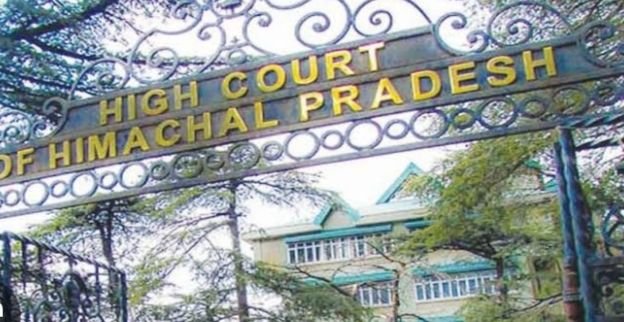
Shimla। : The Himachal Pradesh High Court has upheld the conviction and 20-year rigorous imprisonment awarded to a man for aggravated penetrative sexual assault against a child, making it clear that under the Protection of Children from Sexual Offences Act, 2012 (POCSO), penetration “to any extent” is sufficient to attract the statutory definition of penetrative sexual assault.
A Division Bench comprising Justice Vivek Singh Thakur and Justice Ranjan Sharma dismissed an appeal filed by Shyam Veer, who had challenged his conviction under Section 6 of the POCSO Act and Section 377 of the Indian Penal Code. The judgment was delivered on September 16, 2026, in Criminal Appeal No. 347 of 2022.
The central legal issue before the High Court was whether the prosecution could establish penetrative sexual assault when the medical examination of the child did not reveal visible injuries in the anal region. The defence sought to rely on the absence of an injury, while the prosecution maintained that the statutory definition under Section 3 of the POCSO Act does not make physical injury a prerequisite for proving penetration.
The High Court rejected the argument that the absence of an anal tear, abrasion or bleeding was sufficient to discredit the prosecution case. Referring to Section 3(1) of the POCSO Act, the Bench held that the statutory language covers penetration “to any extent”. The Court observed that even rubbing or touching the penis at the opening of the anus, or the slightest attempt at insertion, would fall within the statutory definition where the evidence establishes such conduct.
The significance of the ruling, from a legal perspective, lies in the distinction between proof of an offence and proof of physical injury. POCSO defines penetrative sexual assault by reference to the act of penetration and its extent, rather than by making a visible bodily injury an essential ingredient. Consequently, the absence of an injury cannot, by itself, lead to an acquittal if the prosecution otherwise establishes the ingredients of the offence through reliable evidence.
The case originated from an incident alleged to have taken place on April 27, 2020, during the COVID-19 lockdown. The accused and the victim’s family were residing as tenants in the same building in Shimla district. According to the prosecution case, the appellant took the child into his room. The child was below eight years of age at the time of the incident. The matter was reported to the police soon afterwards, following which the child was medically examined and his statement was recorded before a Magistrate under Section 164 of the Code of Criminal Procedure.
The trial court subsequently convicted the accused under Section 6 of the POCSO Act and Section 377 IPC. It imposed 20 years of rigorous imprisonment under Section 6, along with a 10-year sentence under Section 377 IPC. The substantive sentences were directed to run concurrently. The accused then approached the High Court challenging both the conviction and sentence.
While examining the appeal, the High Court did not consider the medical evidence in isolation. The Bench assessed the testimony of the child along with evidence from neighbours and family members and the forensic material collected during the investigation.
According to the judgment-based record, the prosecution evidence included forensic findings in which semen was detected on the child’s pants and the appellant’s underwear. The DNA profile obtained from the material on the child’s pants was also found to match the DNA profile obtained from the appellant’s blood sample. The High Court treated this forensic evidence as corroborative of the prosecution case.
The Bench also considered the defence contention that the prosecution witnesses were unreliable and that there was a possibility of false implication arising from alleged previous enmity. The Court found that the suggested motive for false implication was not supported by sufficient evidence and that the prosecution evidence, when considered as a whole, was consistent.
The Court’s approach is important because criminal trials involving sexual offences cannot ordinarily be decided on one isolated piece of evidence when the record contains several forms of corroboration. Here, the High Court considered the oral testimony, circumstances surrounding the incident, medical findings and forensic evidence together before determining whether the prosecution had proved its case beyond reasonable doubt.
The aggravated nature of the offence was also central to the sentencing question. Section 5(m) of the POCSO Act treats penetrative sexual assault on a child below 12 years of age as aggravated penetrative sexual assault. Section 6 prescribes the punishment for aggravated penetrative sexual assault, and the High Court found that the trial court had correctly applied the provision in the circumstances of the case.
The Bench therefore found no legal or evidentiary ground to interfere with the trial court’s judgment. It dismissed the appeal and affirmed both the conviction and the 20-year rigorous imprisonment imposed under the POCSO Act. The sentence under Section 377 IPC was also maintained, with the substantive sentences running concurrently.
From a legal reporting standpoint, the judgment reinforces two distinct propositions. First, Section 3 of POCSO adopts a statutory definition in which penetration “to any extent” is sufficient; the law does not prescribe a minimum degree of penetration or require visible physical injury as an independent ingredient. Second, the absence of injury does not mean that a conviction can automatically follow either: the prosecution must still establish the offence through credible and legally admissible evidence.
The Himachal Pradesh High Court’s ruling thus turns on the cumulative assessment of the evidence in this particular case. Its broader significance is that the evidentiary value of a medical examination showing no visible injury must be assessed alongside the testimony and other material on record, rather than being treated as conclusive proof that penetrative sexual assault did not occur.