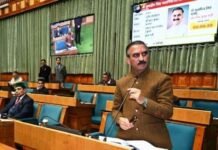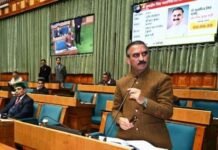

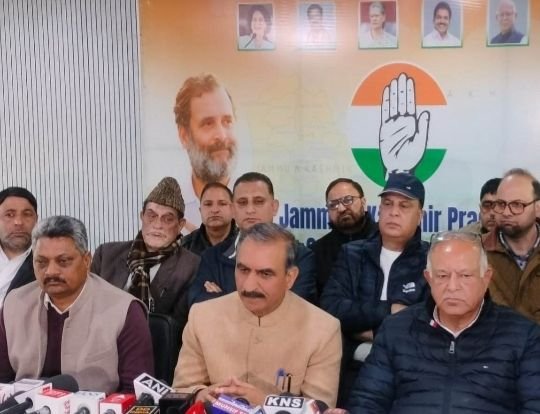
Addressing a press conference in Srinagar, Himachal Pradesh Chief Minister Thakur Sukhvinder Singh Sukhu voiced deep concern over recent Free Trade Agreements (FTAs), warning that they pose a serious threat to the horticulture-based economies of Himachal Pradesh and Jammu and Kashmir.
The Chief Minister cautioned that these trade agreements could open the floodgates for large-scale imports of apples, walnuts, almonds and other horticultural produce, creating an uneven market for local farmers and orchardists. He said such imports would severely distort pricing mechanisms, making it increasingly difficult for domestic growers to secure fair and remunerative returns for their produce. According to him, the long-term impact of these policies would gradually push local farmers into economic distress, with consequences that may only become fully visible in the coming years.
Highlighting the economic significance of horticulture, the Chief Minister underlined that agriculture and fruit farming form the backbone of both hill states. He pointed out that Himachal Pradesh’s apple sector alone generates an annual economy of nearly ₹5,000 crore and supports the livelihoods of around 2.5 lakh families through direct and indirect employment. Similarly, in Jammu and Kashmir, horticulture sustains a large segment of the population, with apples, walnuts and almonds forming the core of the region’s rural economy.
Referring to the Union Government’s trade policies, he stated that FTAs with countries including New Zealand, the United States and the European Union have reportedly led to reduced import duties on apples and dry fruits. He argued that such policy decisions disproportionately benefit foreign producers while weakening domestic agricultural sustainability. According to him, these agreements are being framed without adequately safeguarding the interests of Indian farmers, particularly those in ecologically sensitive hill regions where livelihoods depend almost entirely on horticulture.
Taking a clear political position, the Chief Minister asserted that these trade decisions reflect a policy orientation that prioritises international trade commitments over local agricultural protection. He maintained that such an approach undermines the principle of economic justice for farmers and rural communities.
He also referred to the consistent political advocacy for farmers’ rights by **Rahul Gandhi**, stating that voices raising concerns for farmers and the common people are being systematically sidelined. He alleged that attempts to silence such issues would not succeed, and reaffirmed that his party would continue to stand firmly with farmers and orchardists.
Concluding his address, the Chief Minister made it clear that the issue of FTAs is no longer just a trade policy debate but a question of economic survival for hill राज्यों. He vowed that the interests of farmers, orchardists and rural communities would be defended politically and institutionally, and that any policy threatening the sustainability of local agriculture would face strong resistance.