

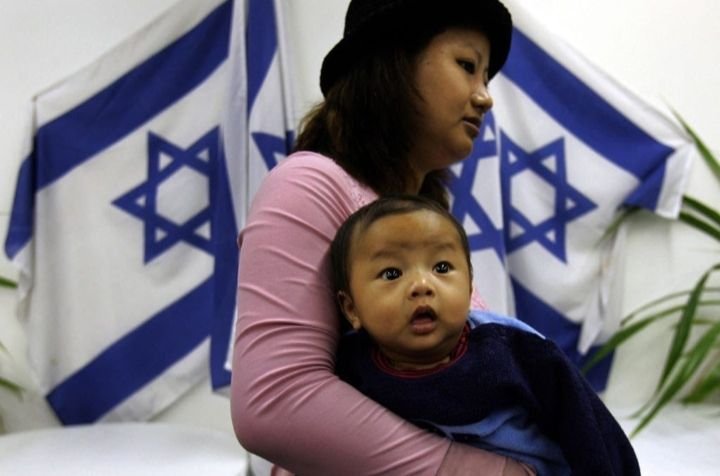
Saptrishi Soni। In a landmark decision, the Israeli government has approved a multi-year plan to facilitate the immigration of the remaining Bnei Menashe community from northeastern India—an initiative that will see thousands make Aliyah (immigrate to Israel) over the next few years.
Who Are the Bnei Menashe?
The Bnei Menashe (literally “Children of Manasseh”) trace their origins to one of the so-called “Ten Lost Tribes” of Israel, exiled by the Assyrian Empire more than two millennia ago. Over centuries, their ancestors migrated through Central Asia before settling in the northeastern Indian states of Manipur and Mizoram. Despite geographic distance, the Bnei Menashe preserved key elements of Jewish tradition — including Sabbath observance, kosher dietary laws, and Jewish festivals. Over the last two decades, many have converted formally to Judaism, and around 4,000–5,000 have already made Aliyah to Israel.
The New Immigration Plan: What It Means
* The first phase, approved by the cabinet, targets 1,200 individuals from the Bnei Menashe community to immigrate by end of 2026.
* A second phase, stretching up to 2030, aims to bring an additional 4,600 people — thereby completing the relocation of nearly 5,800 Bnei Menashe to Israel.
* The budget for the program is estimated at 90 million shekels, covering not just flights, but also accommodation in absorption centers, Hebrew studies, conversion, employment support, and social integration.
* Israeli authorities plan to place many of the newcomers in the Galilee region and other northern towns, strengthening communities there.
* A delegation from Israeli state agencies and the Sephardi Chief Rabbinate is set to travel to India soon to assess eligibility and carry out formal procedures.
Why This Initiative Matters
Prime Minister Benjamin Netanyahu described the move as both “important and Zionist,” highlighting its dual impact: reuniting a dispersed historic community, and reinforcing the demographic strength of Israel’s northern regions. For the Bnei Menashe themselves, this is more than migration: it’s the fulfilment of an ancient, deeply rooted aspiration to return to their ancestral homeland.
Organizations like Shavei Israel, a Jerusalem-based nonprofit led by Michael Freund, have played a crucial role for years — supporting Bnei Menashe communities in India through education, synagogues, Hebrew programs and conversion. Their work will now intersect directly with state-led efforts.
Challenges Ahead & the Path Forward
While the historic plan marks a hopeful turning point, successful absorption will require more than relocation. The immigrants will need not only housing and language education, but also social and economic integration. Israel’s experience with absorption agencies and immigrant infrastructure will be tested as these new waves arrive.
For the Bnei Menashe, arriving in Israel is only one part of the journey — the longer challenge will be preserving their cultural identity while integrating into a very different society. But with government backing, decades of groundwork by civil-society organizations, and growing momentum, this initiative stands as a powerful symbol of reconnection, heritage, and a “homecoming” after centuries of separation.