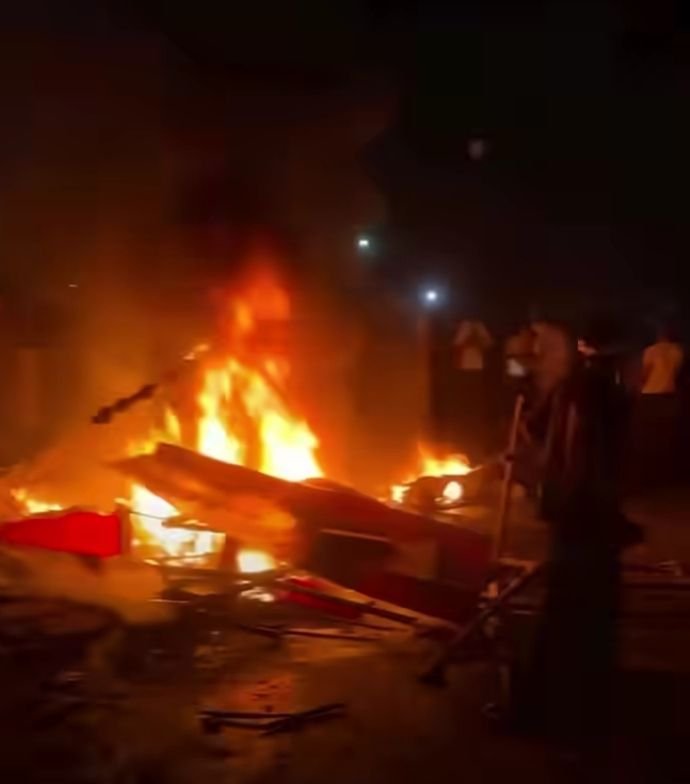


Phagwara/Chandigarh : Punjab witnessed a second major episode of student unrest at a private university within two days on Sunday, as protests at Lovely Professional University in Phagwara escalated into campus vandalism and a blockade of the Jalandhar-Phagwara National Highway following reports circulating on social media about the alleged sexual assault of a female student.
The incident has triggered a police investigation as well as a wider debate over student safety, hostel management and the speed with which unverified information can spread through campus networks. The development is particularly significant because it came just a day after unrest at Chitkara University near Rajpura, where rumours about missing or dead female students had triggered a large student gathering, clashes with police and damage to property. In the Chitkara case, however, police and university authorities said they found no evidence that the alleged deaths or disappearances had occurred.
At LPU, the situation developed during the early hours of Sunday after claims began circulating that a female student had allegedly been sexually assaulted on the university campus, with some versions of the information alleging the involvement of an outsider. Students gathered near the girls’ hostel and subsequently moved towards the main entrance, with the protest growing as students from different hostels joined in.
The agitation later turned violent. Protesters damaged university property, smashed window panes and other installations, and some objects were reportedly set on fire. The demonstration then spilled onto the Jalandhar-Phagwara National Highway, causing significant disruption to traffic and forcing diversions as police moved in to control the situation.
Police have begun investigating the underlying allegation rather than relying on social-media versions of the incident. Jalandhar Range DIG Naveen Singla said an FIR was being registered, while a Special Investigation Team comprising senior police officers, a woman police officer and student representatives has been constituted to examine the matter. Investigators are expected to examine forensic evidence, CCTV footage and phone-related evidence as part of the probe.
The distinction between an allegation and an established crime is crucial at this stage. Police had initially said that the alleged incident had not been independently confirmed and that the identity of any accused person had not been established. Subsequent reports said police received a statement from a woman student and initiated the FIR process. The investigation will have to establish what actually happened, where it happened and who, if anyone, was responsible.
LPU, meanwhile, has strongly rejected the allegations being circulated on social media. In a statement, the university described the claims as false, baseless and fabricated, alleging that misleading information was being circulated by anti-social elements in an attempt to damage the institution’s reputation. The university has urged students and parents to rely on official communication rather than unverified posts and messages.
The students, however, have raised concerns extending beyond the specific allegation. Among their demands is that the entire hostel staff responsible for girls’ hostels should comprise women. University management has indicated that this demand will be addressed.
That demand points to a broader concern at residential universities: students and parents increasingly expect hostel security systems to provide not merely physical surveillance but also a clear, accountable and gender-sensitive support structure. The manner in which complaints are received, verified and communicated can be as important as the security infrastructure itself.
The timing of the LPU unrest has added another dimension to the situation in Punjab’s higher-education sector.
Only a day earlier, Chitkara University’s Rajpura campus had witnessed a night of unrest after unverified social-media claims circulated about female students allegedly missing or having died by suicide. Hundreds of students gathered, and the situation escalated into clashes with police, damage to campus property and vandalism of police vehicles. Police and university officials subsequently said that no students had been reported missing or harmed.
The Chitkara episode appears to have originated from a chain of rumours that included claims about screams from a girls’ hostel and a supposed incident involving an alumnus. Police said students could not provide the name, photograph, roll number or other identifying details of the alleged missing students. The university also denied that any such incident had occurred.
The two incidents should not be treated as identical. At Chitkara, authorities said the claims were false and no missing student or death was established. At LPU, by contrast, police have initiated a formal investigation after receiving a student’s statement concerning an alleged sexual assault. The truth of the LPU allegation remains a matter for investigation and should not be prejudged.
Yet there is a common thread that deserves attention: the extraordinary speed with which unverified information can move through university hostels, WhatsApp groups and social-media platforms, often before students, parents, administrators or police have access to verified facts.
For university administrations, the events underline the importance of rapid and credible communication during a crisis. Silence or delayed clarification can allow rumours to fill the information vacuum. For students, the incidents demonstrate the potential consequences when unverified claims become the basis for mass mobilisation. And for law-enforcement agencies, the challenge is to investigate genuine complaints swiftly while simultaneously identifying the origin of misinformation that may trigger panic and violence.
There is also a larger question of institutional trust. Students living away from their families place considerable reliance on university administrations for accommodation, safety and emergency response. When questions arise around hostel security, the administration’s first responsibility is to establish facts, communicate them transparently and ensure that genuine complaints receive due process.
The LPU investigation will now be closely watched. The police probe, including CCTV, forensic and phone analysis, is expected to establish the factual sequence behind the allegations and the subsequent protests. At the same time, the university faces the task of addressing students’ safety concerns and restoring confidence across its residential campuses.
What has happened at LPU and Chitkara within such a short period has therefore moved beyond two isolated campus disturbances. It has exposed a difficult intersection of student safety, institutional accountability, social-media misinformation and public order.
The immediate priority remains clear: establish the facts at LPU through an impartial investigation, protect the rights and privacy of any student involved, address legitimate safety concerns and ensure that unverified claims do not become a substitute for evidence.
For Punjab’s large private university sector, the events offer a serious reminder that campus safety is not only about gates, guards and CCTV cameras. It is also about trust, transparent communication, responsive grievance mechanisms and the ability of institutions to respond quickly and credibly when fear spreads through a campus.