
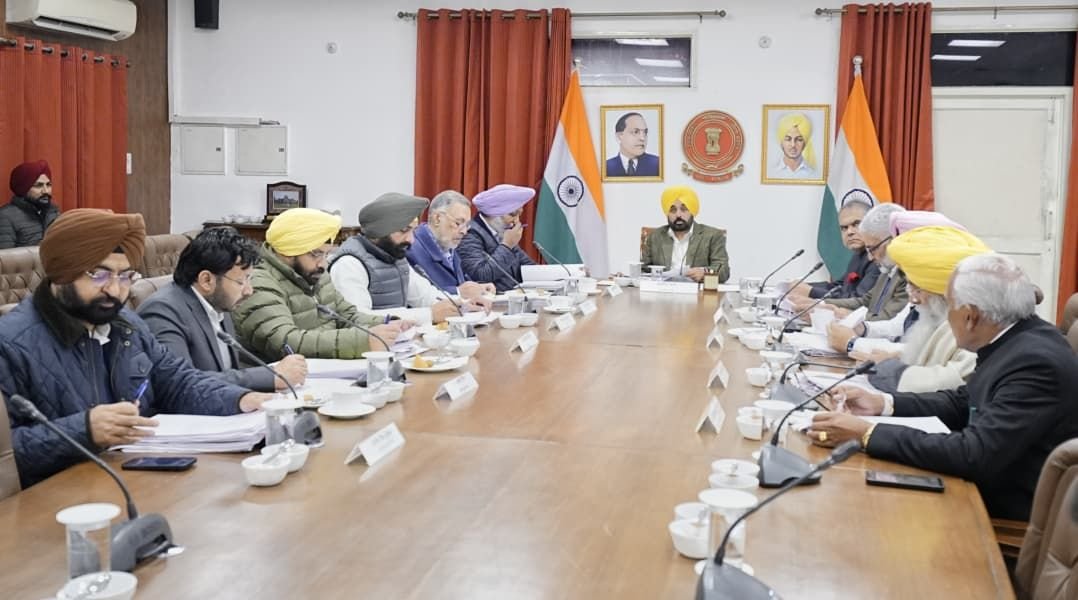
The Punjab Cabinet, led by Chief Minister Bhagwant Singh Mann, has approved a series of far-reaching decisions aimed at strengthening public healthcare, reforming higher education, accelerating infrastructure development and providing direct relief to citizens. The decisions were taken during a meeting of the Council of Ministers chaired by the Chief Minister and reflect the government’s emphasis on people-centric and future-ready governance.
A key decision of the Cabinet is the approval of more than 19 acres of land at Lehragaga for the establishment of a new medical college and hospital. The land, located at the Baba Hira Singh Bhattal Technical College campus, will be allotted on nominal lease rent to a public welfare society of the Jain community. The proposed institution will begin operations with a hospital of at least 220 beds and an intake of 50 MBBS students. Within eight years, it is planned to expand into a 400-bed hospital with 100 MBBS seats. The government has made it clear that admissions and fee structures will be strictly regulated as per state norms to ensure transparency and affordability. The move is expected to improve access to quality medical education and healthcare services, especially in the Malwa region, while also strengthening Punjab’s position as a medical education hub.
In a landmark reform in the education sector, the Cabinet approved the Punjab Private Digital Open Universities Policy, 2026. This is being seen as a pioneering step, as it allows the establishment of fully digital private universities offering online and open distance learning programmes under a comprehensive legal framework. Aligned with UGC regulations, the policy sets clear standards for quality education, digital infrastructure, student protection and data governance. The government believes this initiative will make higher education more flexible, affordable and accessible, particularly for working professionals and students unable to relocate. Degrees awarded under this system will be legally valid and compliant with national regulatory standards, bridging the long-standing gap between formal degrees and skill-based online learning.
The Cabinet also extended the Amnesty Policy 2025 for plot allottees, offering relief to those who have defaulted on payments for plots allotted under various housing and urban development schemes. Eligible allottees will get another opportunity to regularise their dues by applying before March 31, 2026. This decision is expected to benefit a large number of families and ease financial stress while also helping development authorities recover pending dues in an orderly manner.
In another pro-people move, the government approved the rationalisation of property prices under the Greater Mohali Area Development Authority. Reserve prices for unsold residential, commercial and institutional plots will now be determined based on assessments by independent valuers empanelled with nationalised banks or the Income Tax Department. This step aims to make property rates more realistic, boost demand and ensure transparency in public auctions.
To speed up infrastructure projects, the Cabinet gave approval for the desilting of the Sutlej river at identified locations. This will facilitate the supply of earth for major road projects, including the Ludhiana–Ropar corridor, at controlled rates. The decision is expected to reduce construction delays while ensuring efficient use of natural resources under government supervision.
The Cabinet also decided to adjust staff of the Baba Hira Singh Bhattal Institute of Engineering and Technology against vacant posts in technical education and industrial training departments. This move is intended to safeguard the interests of employees while strengthening technical institutions across the state.
Overall, the decisions taken by the Punjab Cabinet underline the government’s intent to invest in healthcare infrastructure, modernise education through digital innovation, improve urban governance and deliver tangible benefits to citizens. The Mann government has projected these reforms as steps toward inclusive growth, long-term capacity building and a more responsive administrative system in Punjab.