

Saptrishi Soni। Chandigarh:
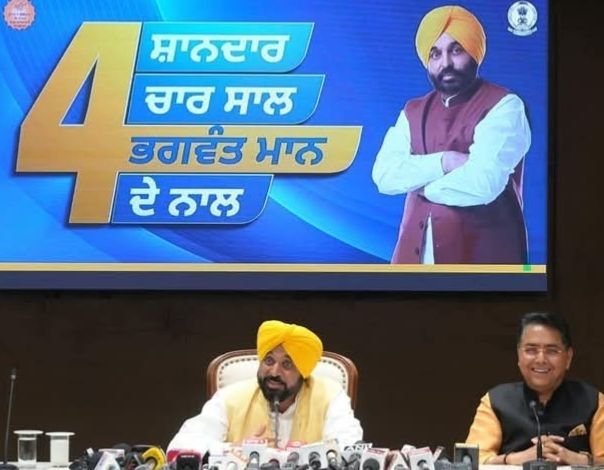
Marking the completion of four years in office, the government in Punjab led by Aam Aadmi Party presented a detailed account of its governance, highlighting what it described as “historic achievements” across multiple departments and a strong push toward public welfare. Addressing the media, party leaders outlined key reforms, administrative changes, and welfare initiatives aimed at transforming governance and improving the daily lives of citizens.
At the core of the government’s narrative has been its emphasis on employment generation. Under what has been termed a “jobs revolution,” the administration claims to have provided more than 65,000 government jobs to youth over the past four years. A notable aspect repeatedly emphasized is the recruitment process being free from bribery and political recommendations, an issue that had long plagued public hiring in the state. This move has been projected as a significant step toward restoring faith among young job seekers and ensuring merit-based selection.
Another major pillar of governance has been the rapid expansion of digital services. The government stated that over 82 million services have been delivered digitally, reflecting a strong push toward building a “Digital Punjab.” Through the integration of technology into governance, citizens are now able to access a wide range of services without the need to visit government offices physically. This has not only improved efficiency but also reduced bureaucratic delays and opportunities for corruption.
A flagship initiative that has gained attention is the doorstep delivery model under the “government at your doorstep” program. According to official claims, more than 430 services are now being delivered directly to citizens at their homes. This initiative is being seen as a transformative shift in public service delivery, particularly benefiting elderly citizens, women, and those living in rural or remote areas. It reflects a governance approach focused on accessibility and convenience, aiming to bridge the gap between the administration and the public.
The government has also highlighted its zero-tolerance policy against corruption as a defining feature of its tenure. Strict action against officials found guilty of corrupt practices has been projected as a key deterrent. By introducing systems such as e-registration, digital land records, and online transport services, the administration claims to have minimized human interface in critical processes, thereby enhancing transparency. Initiatives like digital land documentation and streamlined registration systems have significantly reduced delays and alleged malpractice in property-related transactions.
Reforms in revenue and transport departments, including simplified digital processes, have been presented as examples of systemic change. The introduction of user-friendly platforms for land records and vehicle-related services has helped eliminate long-standing inefficiencies and public grievances. These measures are being framed as part of a broader effort to modernize governance and ensure accountability at every level.
Beyond administrative reforms, the government has reiterated its commitment to inclusive and holistic development. Officials stated that policy decisions have been guided by a citizen-first approach, with a focus on improving education, healthcare, infrastructure, and rural development. The emphasis has been on ensuring that the benefits of governance reach every section of society without discrimination.
Politically, the completion of four years is being positioned as a milestone moment, allowing the ruling party to consolidate its governance narrative ahead of future electoral challenges. By focusing on tangible outcomes such as job creation, service delivery, and anti-corruption measures, the leadership is attempting to strengthen its connect with voters and build a credibility-based campaign.
However, as with any government nearing the end of a term phase, these claims are expected to face scrutiny from opposition parties, which may question the scale and impact of the achievements. The coming months are likely to witness a sharper political contest, with governance performance becoming a central theme in public discourse.
Overall, the four-year report card presented by the Punjab government reflects an attempt to project a model of governance rooted in transparency, efficiency, and public welfare. Whether these claims translate into sustained public support will depend on how voters perceive the changes in their everyday lives and the credibility of the government’s delivery on its promises.
#PunjabPolitics #Governance #PublicPolicy #DigitalIndia #Employment #Transparency