
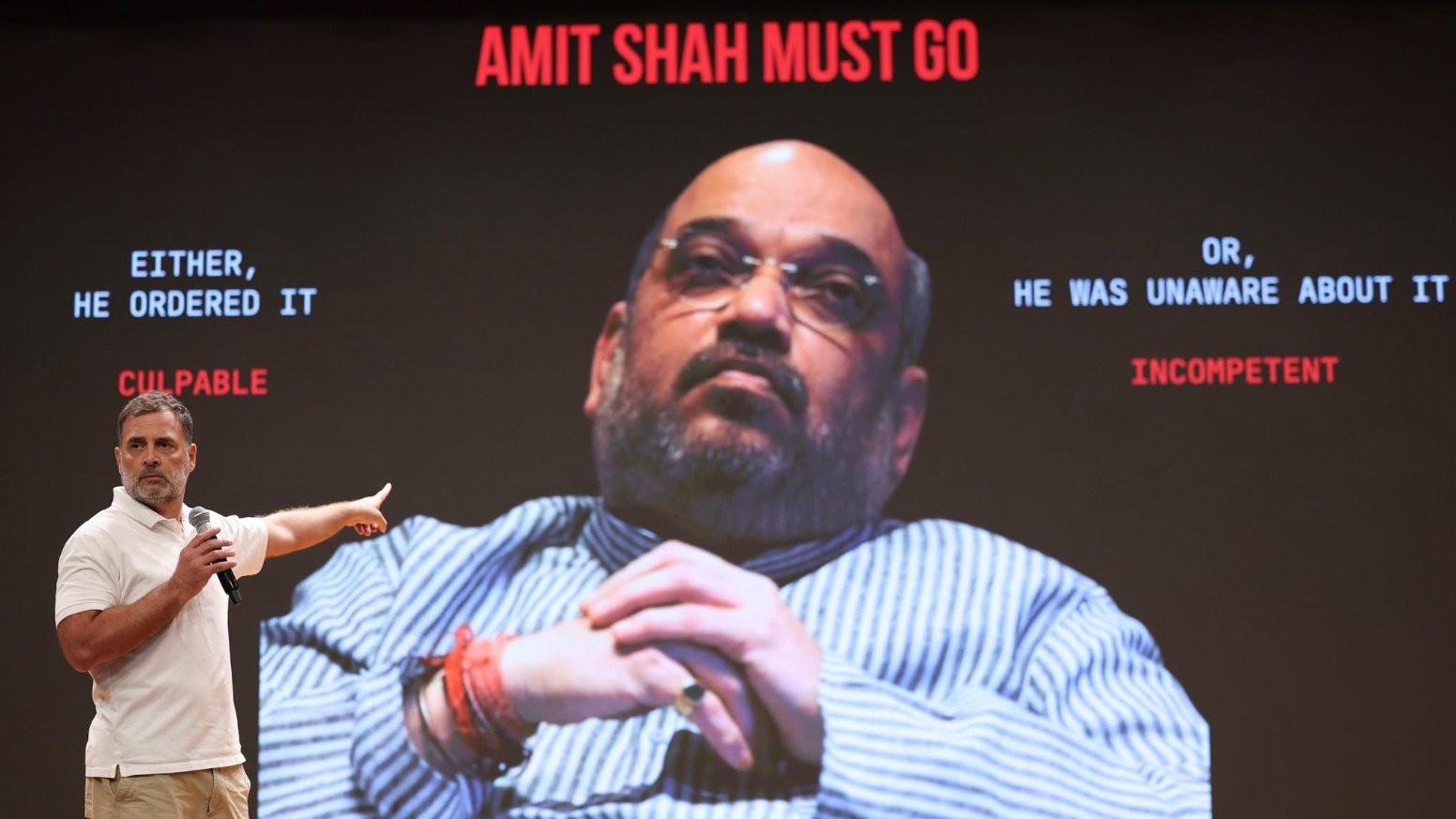
Leader of Opposition Rahul Gandhi on Wednesday mounted a sharp political offensive against the Narendra Modi-led government, demanding the removal of Union Home Minister Amit Shah over the alleged use of excessive force against students during recent protests. Calling for accountability at the highest level, the Congress leader urged Prime Minister Narendra Modi to dismiss the Home Minister and institute a Supreme Court-monitored investigation into the police action, which he described as an assault on democratic rights.
Addressing a press conference after proceedings in Parliament, Rahul Gandhi alleged that the government’s response to the student demonstrations had raised serious questions about constitutional accountability and the protection of democratic freedoms. He argued that incidents involving alleged police excesses against protesting students warranted an independent judicial inquiry rather than an internal administrative review.
The Congress leader maintained that the issue was no longer confined to law and order but had become a question of political responsibility. According to Gandhi, accountability must extend beyond the officers on the ground to those responsible for overseeing the country’s internal security apparatus.
Referring to the reported police action during the July 20 protest march led by student groups in New Delhi, Rahul Gandhi alleged that protesters were subjected to excessive force, including baton charges and the use of pellet guns. He asserted that responsibility ultimately rested with the Union Home Minister.
Presenting what he described as a clear question of accountability, Gandhi said there were only two possibilities. If the alleged police action had taken place on the directions or with the knowledge of the Home Minister, then he must accept responsibility for it. If, on the other hand, such action occurred without his knowledge, Gandhi argued that it reflected a serious failure in the functioning of the country’s internal security system under his leadership.
“Either the Home Minister ordered the action, in which case he is accountable for it, or he was unaware of what happened, which raises equally serious questions about administrative responsibility,” Gandhi said.
The Congress leader also accused the government of attempting to suppress opposition voices inside Parliament. He alleged that he was repeatedly prevented from speaking in the Lok Sabha while ministers from the treasury benches were allowed to present their views uninterrupted.
Rahul Gandhi claimed that despite making repeated requests to the Chair to allow him to raise the issue of the alleged police action against students, he was not given an opportunity to speak. According to him, he was informally told that he could address the House only if he withdrew or apologised for his remarks concerning the Home Minister.
Rejecting any possibility of retracting his statements, Gandhi declared that he would not apologise for demanding accountability from the government. He maintained that raising questions over the treatment of students and the conduct of security forces was part of the constitutional responsibility of the Leader of the Opposition.
Expanding his criticism, Gandhi said democratic institutions must remain open to scrutiny and public accountability, particularly when allegations involve the use of force against young citizens exercising their right to protest. He argued that an investigation monitored by the Supreme Court would inspire greater public confidence than an inquiry conducted solely through executive agencies.
The Congress has consistently maintained that the events surrounding the recent student protests require an impartial judicial examination, while the BJP has defended the government’s handling of the situation and rejected the Opposition’s allegations.
Rahul Gandhi’s remarks signal the Congress’ strategy of keeping the issue of student protests, alleged police excesses and institutional accountability at the centre of the national political debate. By directly demanding the Home Minister’s resignation and calling for judicial oversight, the Congress leader has sought to frame the controversy not merely as a law-and-order issue but as a broader test of democratic accountability and the government’s commitment to protecting the rights of citizens.