


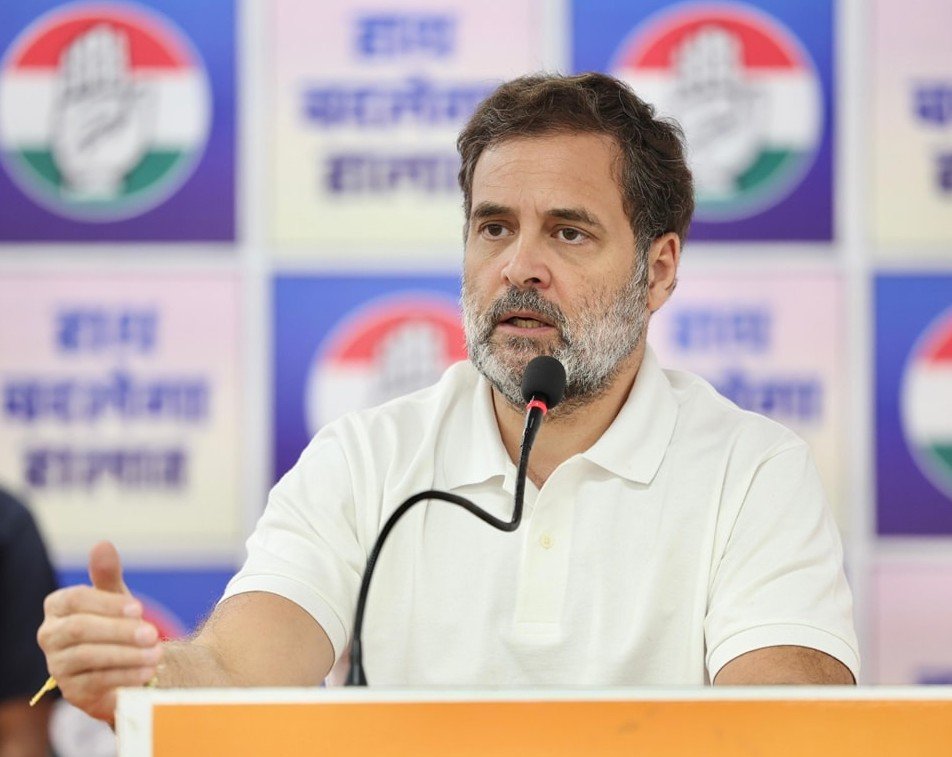
Saptrishi Soni : Rahul Gandhi’s November 4 visit to Punjab is emerging as an important political moment for the Congress, not merely because it will mark the beginning of an intensified campaign against the Aam Aadmi Party government, but because it will test the party’s ability to overcome its internal divisions and present a united political alternative ahead of the 2027 Assembly elections.
For the Congress leadership, the challenge is clear: before asking Punjab’s voters to give the party another opportunity to govern, it must demonstrate that its own leaders are prepared to work together. The continuing differences among senior state leaders, competing political ambitions and uncertainty over leadership have weakened the party’s ability to convert public dissatisfaction with the ruling government into a consolidated electoral advantage.
Rahul Gandhi’s visit, therefore, carries significance beyond a rally or a political address. It offers the Congress high command an opportunity to bring its Punjab leadership under one umbrella, establish a common campaign strategy and reassure party workers that the organisation is moving towards the next election with a collective purpose.
The November 4 programme at Sangrur, where the Congress is set to launch its ‘Hisab Maango’ campaign, is expected to focus on questions concerning the performance of the Bhagwant Mann government. Sangrur, being the Chief Minister’s home district, gives the Congress an opportunity to take its political challenge directly into the AAP’s stronghold in the Malwa region, which holds considerable importance in determining the outcome of Punjab elections.
However, the success of Rahul Gandhi’s visit will depend less on the strength of the speeches delivered from the stage and more on what happens within the Congress organisation before and after the event.
Punjab Congress has several prominent leaders, each with political influence, a constituency base and ambitions for a larger role. Differences involving former state party president Amarinder Singh Raja Warring, former chief minister Charanjit Singh Channi and other senior leaders have repeatedly brought the party’s internal tensions into public view. Leader of Opposition Partap Singh Bajwa and other influential figures also have their own political standing and organisational interests.
The appointment of Pargat Singh as Punjab Congress president was expected to help the party move towards a more coordinated structure. Yet, changing the organisational leadership alone cannot resolve the deeper problem of competing ambitions. The party needs a mechanism through which its senior leaders can work together without allowing personal differences to disrupt the campaign.
This is where Rahul Gandhi’s intervention becomes crucial. As one of the most influential figures in the national Congress leadership, he has the political authority to insist on discipline, collective responsibility and a unified approach. His task will be to ensure that the state leadership does not turn the preparation for the 2027 election into another contest for political supremacy.
The Congress high command has already indicated that the party intends to fight the Punjab elections collectively rather than projecting a chief ministerial face prematurely. This approach could help prevent an early leadership battle, but it will work only if all major leaders accept a common framework and respect the organisational decisions taken by the party.
For Rahul Gandhi, the immediate priority should be to move the Punjab Congress beyond factional politics and establish a credible collective leadership. The party needs to send a clear message that its senior leaders will campaign together, support one another’s candidates and refrain from public criticism that damages the organisation.
The political stakes are considerable. Congress remains one of the principal challengers to AAP in Punjab, but it cannot rely only on anti-incumbency or criticism of the state government. It must convince voters that it has the unity, leadership and organisational strength required to govern.
The ‘Hisab Maango’ campaign could provide a platform for that effort. Issues such as employment, the drug menace, law and order, farmers’ concerns, the state’s financial position and the delivery of government promises are likely to feature prominently in the Congress campaign. But the party will need to present these issues with a consistent message and a credible alternative rather than allowing its internal disagreements to overshadow its political agenda.
A united Congress could gain significantly from such a transformation. First, it would help restore the confidence of party workers who have witnessed repeated factional confrontations. A united leadership would make it easier to mobilise cadres, strengthen booth-level networks and coordinate campaign activities across constituencies.
Second, unity could improve the party’s ability to attract voters who are dissatisfied with the AAP government but remain uncertain about whether Congress has overcome the problems that contributed to its earlier electoral setbacks. Voters looking for a stable alternative will want to see a party that is internally organised and capable of taking collective decisions.
Third, a coordinated Congress campaign could place greater pressure on AAP. Instead of allowing the ruling party to exploit divisions among its opponents, Congress could focus public attention on governance, policy delivery and its own proposed solutions to Punjab’s challenges.
The importance of this consolidation becomes even greater in the Malwa belt, which has traditionally played a decisive role in Punjab politics. A strong and coordinated campaign in this region could help Congress rebuild its electoral base, particularly if it combines local leadership with a consistent state-level narrative.
Yet, unity cannot be achieved through public appearances alone. A photograph of senior leaders sharing a stage with Rahul Gandhi may create a positive political impression, but voters and party workers will judge the Congress by what follows. Candidate selection, constituency-level coordination, distribution of organisational responsibilities and the handling of internal disagreements will determine whether the show of unity becomes a lasting political reality.
There is also a risk that unresolved differences could return as the election approaches. The question of who will lead the campaign, who will influence ticket distribution and how the party will accommodate competing political interests could become major flashpoints. Rahul Gandhi and the central leadership will have to ensure that no individual leader or faction is allowed to place personal ambitions above the party’s collective electoral objective.
For AAP, a divided Congress would offer a political advantage. The ruling party could portray its principal challenger as an organisation unable to manage its own affairs. The BJP and the Shiromani Akali Dal would also seek to benefit from any continuing confusion within the Congress camp. In a multi-cornered contest, even a limited erosion of support caused by factionalism could have serious consequences in closely fought constituencies.
On the other hand, if Rahul Gandhi succeeds in bringing the Punjab unit together, Congress could enter the 2027 election with renewed confidence. A common leadership platform, a disciplined campaign and a stronger organisational network would improve its ability to challenge the ruling party and reconnect with voters across the state.
The November 4 visit, therefore, should be seen as an important test of Rahul Gandhi’s political management in Punjab. His challenge is not simply to launch an aggressive campaign against the Mann government, but to ensure that Congress becomes a united political force before it seeks a fresh mandate from the people.
Punjab’s voters will ultimately assess the Congress on its record, its leadership and the credibility of its promises. But the first message the party must deliver is to its own workers and supporters: that it has moved beyond internal battles and is ready for a serious fight.
The road to the 2027 Assembly elections will be demanding. Rahul Gandhi’s success in Punjab may well depend on whether he can turn a collection of influential but divided leaders into a cohesive political team. If he manages that transformation, Congress could substantially strengthen its position. If factionalism continues, even an energetic campaign and strong criticism of the government may fail to translate into electoral gains.