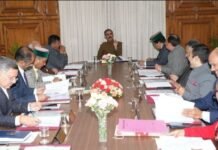

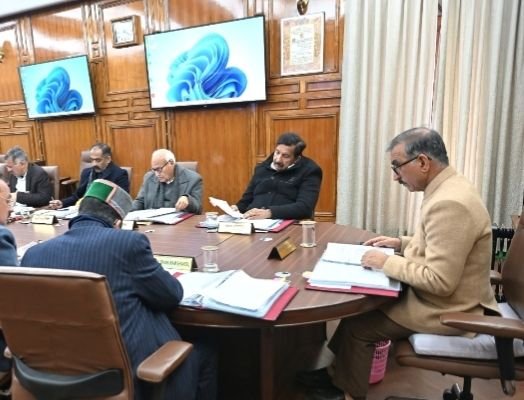
In a decisive show of governance and political resolve following the RDG grant controversy with the Centre, the State Cabinet of Himachal Pradesh, chaired by Chief Minister Thakur Sukhvinder Singh Sukhu, cleared a sweeping set of policy, welfare, education, healthcare, infrastructure, and institutional reforms, reaffirming the government’s commitment to continue working for the development and stability of the state despite financial and political challenges.
The Cabinet approved the Toll Tax Barrier Policy 2026–27 and the Excise Policy 2026–27, laying down a new framework for revenue mobilisation and regulation. In a major welfare decision, it extended the benefit of 26 weeks of maternity leave to female Home Guard volunteers, bringing them at par with formal sector protections and recognising their contribution to public service.
The Cabinet also approved the Governor’s address for the upcoming Budget Session of the Himachal Pradesh Vidhan Sabha, setting the tone for a politically significant session amid ongoing tensions with the Centre over financial support.
Strengthening social security and women empowerment
Significant amendments were approved to the Indira Gandhi Sukh Shiksha Yojana, under which daughters of widows pursuing professional courses in government-run institutions, both within and outside the state, will now receive financial assistance. In cases where hostel facilities are unavailable, beneficiaries will also be eligible for rent support of ₹3,000 per month, ensuring continuity of education for economically vulnerable families.
The Cabinet also cleared the rollout of the Indira Gandhi Matri Shishu Sankalp Yojana, aimed at improving the nutritional status of children below six years of age, as well as expectant and lactating mothers, through enhanced supplementary nutrition programmes across the state.
Support for persons with disabilities was significantly strengthened through the enhancement of marriage grants. Financial assistance has been increased from ₹50,000 to ₹2 lakh for persons with disabilities above 70 percent, while those with disabilities between 40 and 70 percent will now receive ₹25,000.
Education reforms and employment generation
In a major boost to school education and employment, the Cabinet approved the creation of 600 teaching posts for proposed CBSE schools, including 150 posts each of Sanskrit Teachers, Physical Education Teachers, Music Teachers and Drawing Teachers. These posts will be filled through the Rajya Chayan Aayog. Additionally, 31 boys’ and girls’ schools across the state will be merged into co-educational institutions to improve infrastructure utilisation and academic integration.
The Digital Classroom Project will now be implemented in 777 additional schools, significantly expanding digital education infrastructure across rural and urban Himachal.
Healthcare transformation worth ₹1,617 crore
One of the most significant decisions was the approval of a ₹1,617.40 crore project for modernising medical colleges, super-specialty hospitals and Adarsh Swasthya Sansthans. The objective is to strengthen healthcare services within the state and reduce the need for patients to seek treatment outside Himachal by ensuring affordable and quality healthcare facilities locally.
The Cabinet also approved procurement of modern medical equipment for major health institutions including the Mother and Child Hospital at Kamla Nehru Hospital Shimla, Civil Hospitals at Sundernagar and Nurpur, Regional Hospital Una, the 50-bedded Critical Care Block at Civil Hospital Bhoranj, and the District Integrated Public Health Laboratory at Regional Hospital Bilaspur.
Departments of Immunohematology and Blood Transfusion will be established at Dr. Y.S. Parmar Government Medical College, Nahan, along with the creation and filling up of requisite posts. A statewide Biomedical Equipment Management and Maintenance Programme will also be implemented to ensure regular maintenance of equipment, enhance patient safety, prevent breakdowns and ensure smooth hospital functioning.
Large-scale recruitment and institutional strengthening
The Cabinet approved the creation and filling of 190 Junior Engineer (Civil) posts and 151 Junior Office Assistant (IT) posts in the Directorate of Recruitment as separate cadres. It also cleared recruitment of 40 Pharmacy Officers, 150 Assistant Staff Nurses, 30 Radiographers, 10 Food Safety Officers, and the creation of Drug Testing Laboratories at Nurpur, Baddi and Una with 36 new posts across categories.
Other approvals include filling posts of Safai Karamchari in the Himachal Pradesh High Court Registry, Welfare Organisers in the Sainik Welfare Department, Junior Office Assistants (IT) in the Revenue Department, and multiple health-sector positions across the state.
Infrastructure, roads and public works reforms
The Cabinet approved the Road Drainage Policy for the Public Works Department to enhance climate resilience, reduce life-cycle maintenance costs, improve road safety and ensure all-weather connectivity across Himachal. A Standard Operating Procedure for pothole filling and patch repair on bituminous and flexible pavements was also cleared to ensure repairs meet national standards and promote transparency.
PWD divisions in Sirmaur district were reorganised in line with Assembly constituencies to improve administrative efficiency.
Tourism, sports and youth development
The bed capacity of the Sports Hostel at Luhnu in Bilaspur district will be increased from 80 to 100. New sports hostels were approved, including a Volleyball Hostel for boys at Government Senior Secondary School Chopal, a Kabaddi Hostel for girls at Government Senior Secondary School Shillai, the introduction of boxing for girls at Thakur Ram Lal Girls Sports Hostel Jubbal, and a new Handball Sports Hostel at Morsinghi in Bilaspur district.
The Cabinet also approved the establishment of the Distil Global Skills and Digital University in Chamba district, positioning the region as a future hub for digital education and skill development.
Governance and regulatory reforms
A Cabinet Sub-Committee was constituted under the chairmanship of Rural Development and Panchayati Raj Minister Anirudh Singh, with Town and Country Planning Minister Rajesh Dharmani as a member, to draft the H.P. State Lottery (Regulation) Rules, 2026. The Director, Treasury and Accounts will serve as the Member Secretary of the committee.
A clear political message
This Cabinet meeting, held in the backdrop of the RDG grant dispute with the Centre, carried a strong political message from the Sukhu government. The leadership reiterated that financial pressure, political obstacles, and administrative challenges will not slow the state’s development agenda. The government made it clear that every difficulty will be confronted through policy action, institutional reform, and governance-driven solutions.
The decisions taken reflect a governance strategy focused on social security, healthcare strengthening, education reform, employment generation, infrastructure resilience, and institutional capacity-building — signalling that the Sukhu administration intends to convert political adversity into an opportunity for structural transformation of Himachal Pradesh.
In both policy intent and scale, the Cabinet’s decisions underline a clear resolve: despite external pressures and fiscal constraints, the government will continue to work decisively for the long-term upliftment, stability, and self-reliance of the state.