

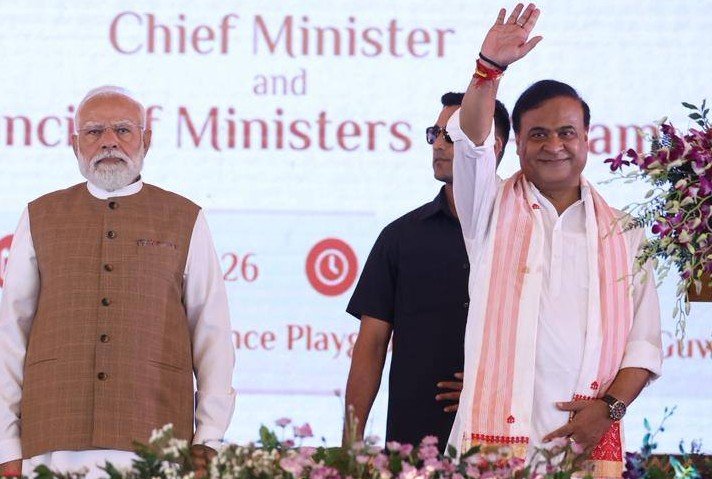
In a significant political moment for Assam, Himanta Biswa Sarma has been sworn in as Chief Minister for a second consecutive term, marking the continuation of the National Democratic Alliance’s (NDA) governance in the state. The ceremony, held at the Veterinary Ground in Khanapara in Guwahati, underscored both political continuity and the BJP-led alliance’s sustained dominance in Assam’s electoral landscape.
The oath of office was administered by Governor Lakshman Prasad Acharya in the presence of a large gathering that included senior national leaders, party functionaries and supporters. The event carried the weight of both symbolism and strategy, as it marked the formation of the third successive NDA government in Assam—an achievement that reflects the alliance’s deepening political roots in the northeastern state.
Alongside Sarma, four legislators were sworn in as ministers, representing key constituents of the ruling alliance. These included the Bharatiya Janata Party’s Rameswar Teli and Ajanta Neog, Asom Gana Parishad’s Atul Bora and Bodoland People’s Front’s Charan Boro. Their inclusion highlights the coalition’s effort to maintain a balanced representation of political partners and regional interests within the government.
The presence of Prime Minister Narendra Modi at the ceremony added national significance to the occasion. He was joined by Union Home Minister Amit Shah, Defence Minister Rajnath Singh, Road Transport and Highways Minister Nitin Gadkari and several other senior leaders. Chief ministers and deputy chief ministers from BJP-ruled states also attended, turning the swearing-in into a broader display of political unity and organisational strength.
Himanta Biswa Sarma’s return to office comes at a time when Assam continues to navigate a complex mix of developmental challenges and socio-political dynamics. During his first term, Sarma focused on infrastructure expansion, governance reforms and efforts to maintain law and order, while also addressing sensitive issues such as identity, migration and regional autonomy. His leadership style—marked by administrative assertiveness and political agility—has played a crucial role in shaping the BJP’s trajectory in the Northeast.
The new term is expected to build upon these priorities while also addressing emerging concerns such as employment generation, economic diversification and climate resilience, particularly in flood-prone regions of the state. Assam’s strategic importance, both geographically and politically, makes governance outcomes here significant not just for the state but for the broader northeastern region.
The inclusion of leaders from alliance partners such as the AGP and BPF signals a continued emphasis on coalition politics, which has been central to the NDA’s success in Assam. By accommodating diverse political voices, the government aims to maintain stability while addressing the aspirations of different communities and regions.
Political analysts view the formation of a third consecutive NDA government as a reflection of voter confidence in the alliance’s governance model. At the same time, it places greater responsibility on the leadership to deliver tangible results and maintain public trust over the long term.
As Himanta Biswa Sarma embarks on his second term, the focus will inevitably shift from ceremony to governance. The expectations are high, and the challenges are complex, but the continuity in leadership and coalition structure provides a foundation for policy consistency and administrative momentum.
For Assam, this moment represents both a reaffirmation of political direction and an opportunity to translate electoral success into sustained development and inclusive growth.