
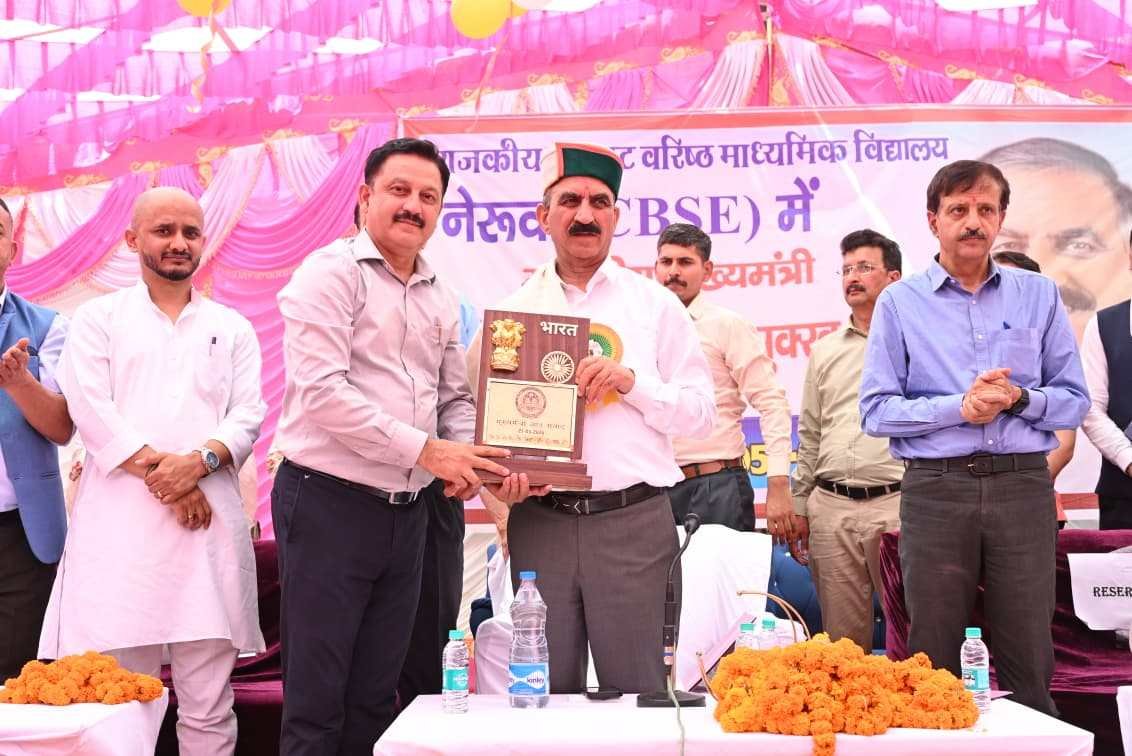
In the hills of Shimla district, a routine government visit transformed into a lively exchange of ideas, aspirations and questions as Himachal Pradesh Chief Minister Thakur Sukhvinder Singh Sukhu spent time interacting directly with students of Government Senior Secondary School, Nerwa. The visit not only brought a major infrastructure announcement for the institution but also offered a rare glimpse into how young minds view leadership, education and the future of their state.
Addressing students at the recently upgraded CBSE-affiliated school, the Chief Minister announced that a new school building would be constructed at Nerwa at an estimated cost of Rs 5 crore. The project, he said, is expected to be completed within the next two years and is part of the state government’s broader effort to strengthen educational infrastructure across Himachal Pradesh.
The announcement comes at a time when the school is witnessing a remarkable surge in enrolment following its transition to the CBSE curriculum. According to officials, the institution had 959 students during the previous academic session. This year, enrolment has risen by 341 students, taking the total strength to around 1,300 students. The increase reflects growing confidence among parents in the quality of education being offered at the institution and the wider educational reforms being undertaken by the state government.
Recognising the pressure created by the rising number of students, the government has already permitted the school to function in two shifts. The Chief Minister said that improving educational standards in rural areas remains one of the government’s central priorities and that visible changes would continue to emerge over the coming years.
However, it was not the infrastructure announcement alone that captured attention. The interaction session evolved into a candid conversation where students questioned the Chief Minister on subjects ranging from politics and personal struggles to employment opportunities and the future of Himachal Pradesh.
One of the most memorable moments came when Class XI student Sara Negi asked why people often describe him as a “warrior.” Responding with a personal reflection, Sukhu said he came from an ordinary family background and had faced numerous challenges throughout his life. He told students that failures are an inevitable part of any journey, but persistence and determination ultimately define success. The Chief Minister encouraged students not to become disheartened by setbacks, saying that resilience often shapes a person’s greatest achievements.
The discussion then turned to the future of the state. When Class XII student Jessica asked about his biggest goal for Himachal Pradesh, the Chief Minister replied that making the state self-reliant remains his foremost ambition. He said that strengthening education was a key pillar of that vision and explained that the expansion of CBSE-affiliated schools into rural regions was intended to ensure that students in villages receive opportunities comparable to those available in urban centres.
Students also raised practical concerns about employment and skill development. Anushka, an Information Technology student, suggested that on-the-job training opportunities should be introduced for IT students, similar to vocational programmes. Sukhu acknowledged the suggestion and assured students that the government would examine the proposal.
Perhaps the most thought-provoking question came from Class X student Viheen Chauhan, who asked why there is no formal examination for those seeking to become Members of the Legislative Assembly. The Chief Minister responded with a lesson in democracy. While teachers prepare students for academic examinations, he said, politicians face a different kind of test every five years when voters decide their fate at the ballot box. According to him, the democratic process itself serves as the ultimate examination for public representatives, and informed voting is crucial to ensuring capable leadership.
The answer drew enthusiasm from fellow student Vaibhav, who responded by saying he hoped to contest elections himself one day, prompting smiles from the audience.
The conversation also touched upon rural-urban disparities in education. Class XII student Neha asked how students studying in villages could receive education on par with their counterparts in cities. The Chief Minister said that the government’s decision to introduce CBSE schools in rural areas was a major step towards narrowing that gap. He added that teacher recruitment and infrastructure strengthening were being accelerated to ensure equal educational opportunities.
Other students highlighted issues including traffic congestion and the need for foreign language education. Responding to concerns about traffic jams affecting daily life, Sukhu assured students that a bypass road would be constructed to ease congestion in the area. On the issue of foreign language learning, he said the government was exploring ways to create opportunities for students after Class XII, particularly as increasing numbers of young people seek employment opportunities abroad. Language skills, he noted, are becoming increasingly important in a globalised job market.
A lighter moment emerged when the Chief Minister asked students whether any of them carried mobile phones to school. The unanimous “no” from students triggered laughter throughout the gathering and briefly lightened the otherwise serious discussion.
Students also raised concerns about sanitation and cleanliness within schools. The Chief Minister said that improving toilet facilities and maintaining hygiene standards remain priorities and encouraged students to report any deficiencies directly to school authorities.
Before concluding his visit, Sukhu inspected various sections of the school, interacted individually with students and later shared lunch with them, an informal gesture that resonated strongly with many present.
The visit underscored the government’s growing emphasis on transforming education in Himachal Pradesh, particularly in rural regions where access to quality schooling has often lagged behind urban centres. With rising enrolment, infrastructure expansion and direct engagement between policymakers and students, Nerwa’s school has become a symbol of the changing educational landscape the state government hopes to build.
For many students, however, the most enduring takeaway may not be the promise of a new building, but the opportunity to question their state’s highest elected leader and receive answers that linked classrooms, democracy and ambition in a single conversation.