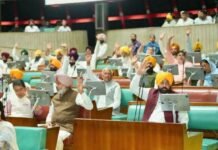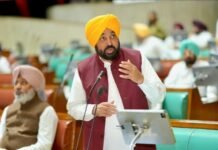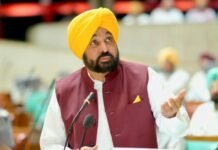

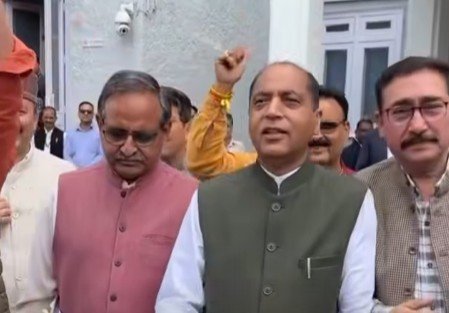
The political confrontation between the Congress government and the BJP in Himachal Pradesh has moved into another sensitive area, with healthcare and the implementation of welfare schemes emerging as fresh points of contention during the ongoing monsoon session of the state Assembly.
The latest dispute is politically significant because healthcare remains one of the most visible measures of government performance. Roads, infrastructure projects and policy announcements may take years to produce results, but the condition of hospitals, availability of medicines and access to treatment are matters that citizens experience directly. The BJP is therefore seeking to use concerns surrounding the health sector to strengthen its wider criticism of the government led by Chief Minister Sukhvinder Singh Sukhu.
BJP legislators, led by Leader of Opposition Jai Ram Thakur, have intensified their attack on the government over what they describe as deterioration in healthcare services and problems surrounding the implementation of the HimCare scheme. The Opposition has alleged that the government is weakening an important healthcare support mechanism and has demanded greater clarity over the availability of cashless treatment and the functioning of the scheme.
The allegations are political claims by the Opposition and have been rejected by the government.
For the BJP, however, the issue offers an opportunity to take the political debate beyond the continuing confrontation over the functioning of the Assembly. The ongoing monsoon session has already witnessed heated exchanges between the treasury benches and the Opposition over the “Vande Mataram” controversy, alleged corruption and other governance issues.
Healthcare allows the BJP to shift the focus towards a matter that directly affects households.
The HimCare scheme has particular political importance because it was designed to expand access to cashless treatment for eligible families. Any uncertainty over its implementation, hospital participation or settlement of treatment-related payments can quickly become a matter of public concern.
The Opposition is attempting to portray the issue as evidence of a broader administrative problem within the Sukhu government. Its argument is that welfare programmes must not merely exist on paper but must function smoothly when citizens need them most.
For Congress, the challenge is to demonstrate that the healthcare system remains functional and that financial or administrative difficulties are not compromising patient care.
That challenge is particularly important in Himachal Pradesh because of the state’s geography.
Remote villages, difficult terrain and long travel distances make government hospitals and health centres especially important. In many mountainous areas, a local health facility is not simply a public service but a lifeline for families who may otherwise have to travel considerable distances for basic treatment.
Any perception that healthcare services are becoming less accessible can therefore acquire political significance quickly.
The wider Assembly debate has also highlighted the scale of healthcare requirements in the state. Government data presented during the session indicated that more than 84,000 cancer patients had visited government and private Ayurvedic medical colleges and hospitals in Himachal Pradesh between January 2023 and August 10, 2026.
The figure illustrates the enormous and growing demand placed on the state’s healthcare infrastructure.
The government, meanwhile, is attempting to defend its broader governance record while dealing with severe fiscal constraints. Sukhu has repeatedly emphasised the need for financial discipline and has initiated measures aimed at reducing expenditure and improving administrative efficiency.
One of the government’s latest proposals is to reduce the sanctioned strength of senior IAS, IPS and Indian Forest Service officers. The administration has estimated that the move could save approximately ₹200 crore annually.
The government argues that difficult financial decisions are necessary to protect the state’s long-term economic stability.
The Opposition is likely to counter that fiscal discipline cannot come at the expense of essential services.
This is where healthcare becomes politically sensitive.
For the Congress government, the argument is that Himachal’s financial problems require structural reforms while ensuring that welfare and public services remain protected. For the BJP, the emerging political message is that the government’s financial difficulties are beginning to affect areas that directly matter to ordinary citizens.
The two narratives are likely to compete increasingly strongly as the state moves towards the next Assembly election.
The BJP has already been building a broader campaign around alleged corruption, unemployment, law and order and administrative shortcomings. During the current Assembly session, BJP legislators staged a protest outside the House carrying suitcases, using the symbolism to accuse the government of corruption and financial mismanagement.
The allegations have not been established as facts, but politically they demonstrate the Opposition’s attempt to construct a sustained anti-government narrative.
Healthcare fits naturally into that campaign because it allows the BJP to connect administrative criticism with personal experiences of citizens.
The Congress government, however, has its own political calculation. It wants to prevent the Opposition from presenting every administrative difficulty as evidence of systemic failure. The government is expected to emphasise its investments in public institutions and its efforts to improve healthcare delivery while arguing that many of the state’s financial problems are structural and cannot be resolved overnight.
For Chief Minister Sukhu, the timing is becoming increasingly important.
His government is approaching the second half of its tenure. The political conversation is gradually moving away from the circumstances that brought Congress to power in 2022 and towards the question of what the government has actually delivered since then.
That means schemes such as HimCare will increasingly be judged on performance.
The Opposition will ask whether beneficiaries are receiving treatment without financial obstacles. The government will have to demonstrate that its reforms are strengthening the system rather than creating new difficulties.
The political battle is therefore likely to become increasingly focused on implementation.
This is also why the current Assembly session matters beyond its immediate legislative proceedings. The BJP wants to use the House to document what it sees as government failures and create political pressure. Congress wants to show that it can answer those questions while continuing to legislate and govern effectively.
The danger for both sides is that political confrontation could overshadow substantive debate.
Himachal Pradesh faces serious challenges that demand legislative attention: recurring monsoon disasters, damaged roads and bridges, unemployment, pressure on public finances, healthcare requirements, tourism infrastructure and the needs of rural communities.
These issues cannot be resolved through protests or political accusations alone.
For the Sukhu government, the immediate priority will be to reassure citizens that healthcare remains protected despite financial pressures. For the BJP, the challenge will be to establish that its criticism reflects genuine public concerns and to offer a convincing alternative approach to healthcare administration.
The coming months could determine how effectively both parties accomplish those objectives.
The political significance of healthcare is likely to grow as the 2027 election approaches. Voters will ultimately evaluate the government not only on major announcements but also on whether public institutions work when they are needed.
That makes hospitals, health centres and welfare schemes an increasingly important part of Himachal Pradesh’s political landscape.
The latest BJP offensive over healthcare is therefore more than another Assembly confrontation. It is an early indication of how the next electoral battle may be fought — not simply over ideology or political personalities, but over the everyday experience of governance.
For Sukhu, the test is whether his government can prove that fiscal reform and efficient administration can coexist with reliable public healthcare.
For the BJP, the test is whether it can turn dissatisfaction into a credible alternative.
As Himachal’s political temperature rises, healthcare could become one of the most closely watched measures of the government’s performance — and one of the most important issues shaping the political narrative before 2027.