
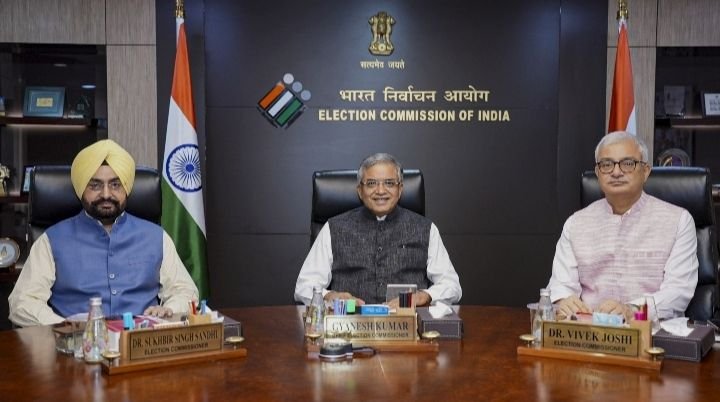
New Delhi। — An unusual internal disagreement has surfaced within the Election Commission of India, with Election Commissioners Sukhbir Singh Sandhu and Vivek Joshi raising formal objections on multiple occasions to decisions and administrative steps taken in the name of the poll panel.
An investigation published by The Indian Express on Wednesday reported that the two Election Commissioners recorded objections at least 14 times over a period of 10 months. Their concerns relate to some of the most sensitive aspects of the electoral process, including the addition and deletion of voters, changes to the voter-registration Form 6 and the increasing centralisation of the technology and software used to manage electoral rolls.
The significance of the development lies not merely in the existence of differences within the Commission, but in the fact that two of its three members are reported to have formally placed their concerns on record. The Election Commission is a constitutional body under Article 324, comprising the Chief Election Commissioner and two Election Commissioners. Under the 2023 law governing the Commission, its business is to be conducted, as far as possible, unanimously; where the members differ, the matter is to be decided by majority.
According to The Indian Express investigation, Sandhu and Joshi questioned whether some decisions and communications had been issued without the requisite approval of the full Commission. In separate communications to officials, they reportedly stressed that communications going out in the name of the ECI should have the necessary approval under the constitutional and statutory framework.
One of the major areas of disagreement concerns Form 6, the application used by citizens seeking inclusion in the electoral roll. The Indian Express reported that changes introduced through the ECINet portal brought questions linked to the Special Intensive Revision (SIR) into the process for new voters. Applicants were asked to indicate whether their own name, or that of a parent or grandparent, appeared in the electoral roll of the previous SIR, or whether none of them did.
Sandhu and Joshi reportedly objected to the change, describing it as unauthorised and illegal and arguing that it should be removed and sent to the government for consideration. The issue assumes importance because Form 6 is a gateway for first-time voters seeking inclusion in the electoral system.
The controversy also extends to the administration of the Election Commission’s voter database and software systems. The Indian Express reported that the two Commissioners separately approached Cabinet Secretary T V Somanathan after concerns arose over changes in the allocation of administrative responsibilities that, according to them, could further concentrate control over the electoral-roll technology structure in Delhi.
The report cited a case from Goa in which 97 applicants had reportedly met the requirements determined by the Electoral Registration Officer but were subsequently affected because the software system did not allow the officer’s decisions to be recorded. The episode has raised a broader institutional question about the balance between centralised technological systems and the statutory authority of officials working at the ground level.
The wider backdrop is the Special Intensive Revision of electoral rolls. According to The Indian Express, the exercise, which began in Bihar in June 2025, has subsequently extended across 30 States and Union Territories, with more than 13 crore names removed from draft electoral rolls. The scale of the exercise has already generated considerable public and political debate over the process through which voters are retained, added or excluded from electoral lists.
The internal objections reported by the newspaper therefore come at a particularly consequential time. The issue is not simply about an administrative disagreement between senior officials; it concerns how decisions affecting citizens’ ability to register and remain on electoral rolls are made, recorded and implemented.
The Indian Express also reported that the three Election Commissioners held their first full meeting in four months on September 9, following the disputes over voter-roll systems and administrative arrangements. The newspaper said it sent detailed questions to the Commission on September 21 regarding the concerns raised by the two Commissioners, but had received no response at the time of publication.
The developments have already triggered political reactions. Opposition leaders have cited the reported objections as evidence of serious questions over the functioning of the poll panel. Those political responses, however, are separate from the underlying factual issue identified by The Indian Express: that two members of the three-member Commission formally recorded disagreements over several decisions and procedures.
For an institution entrusted with conducting India’s elections, the central issue now is institutional clarity — how decisions are authorised, how differences between Commissioners are resolved, and how the integrity of the electoral-roll system is protected while large-scale revisions are undertaken.
The episode places renewed attention on the internal functioning of the Election Commission at a time when electoral rolls, voter eligibility and the mechanisms used to update them have become matters of intense national scrutiny. Any sustained disagreement within the three-member constitutional authority over these processes is therefore likely to remain an important issue for public and institutional debate.
Source: The Indian Express investigation, September 23, 2026.