
Himachal Pradesh Chief Minister Thakur Sukhvinder Singh Sukhu has described the recently signed Kishau Multipurpose Project agreement as the outcome of his government’s sustained efforts to protect the state’s financial and resource interests, saying Himachal Pradesh would benefit without taking on the financial burden originally associated with the project.
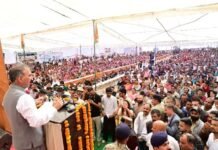
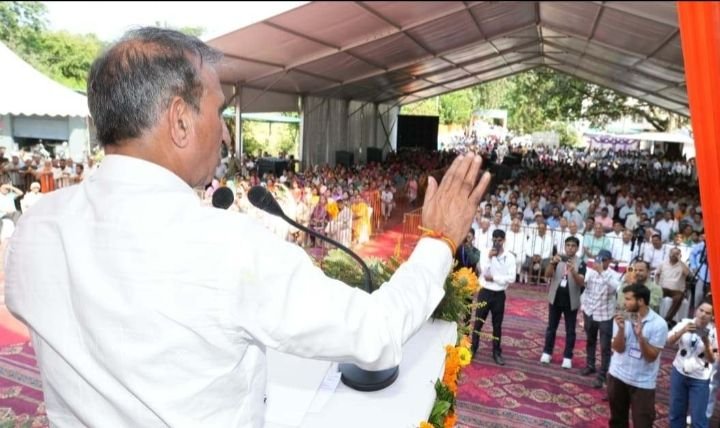
Addressing a public meeting at Rail in the Nadaun Assembly constituency of Hamirpur district, Sukhu said the agreement should be viewed in the context of the negotiations undertaken by his government over the terms of the long-delayed project. He credited the people of Himachal Pradesh and his Congress government for what he described as a successful effort to safeguard the state’s interests.
The Kishau project moved forward on September 15 after Himachal Pradesh, Uttarakhand, Uttar Pradesh, Haryana, Rajasthan and Delhi signed an agreement in New Delhi. The proposed 422-MW project is to be built on the Tons river along the Himachal Pradesh-Uttarakhand border. The Centre has classified it as a national project and is expected to bear about 90% of its financial burden, with the participating states sharing the remaining component under the agreed framework.
Sukhu said the negotiations had been particularly important for Himachal because the state had earlier faced the possibility of having to shoulder a significant share of the project’s power-related cost. According to his latest account, other beneficiary states would bear an estimated ₹2,000 crore towards Himachal’s power component. He has also said the state could receive around ₹1,200 crore annually once the project becomes operational, principally through its power entitlement.
The Chief Minister said three important meetings on the project had taken place after the Congress government assumed office and that his administration had consistently pressed for terms that would not place an undue financial burden on Himachal Pradesh.
The agreement follows years of disagreement over cost sharing, water allocation and the distribution of benefits. The project envisages a 232.6-metre-high dam with a storage capacity of about 1,562 million cubic metres. It is expected to support irrigation over roughly 97,000 hectares and generate around 1,476 million units of electricity annually.
Sukhu also referred to Uttarakhand’s concerns over the project and said BJP leaders from Himachal Pradesh should seek an explanation from the neighbouring state about its position. He said he had personally understood Uttarakhand Chief Minister Pushkar Singh Dhami’s concerns during discussions and argued that the financial arrangement ultimately reached for Himachal was different from the burden Uttarakhand had been facing.
Beyond Kishau, Sukhu used the public meeting to present a broader account of his government’s efforts to improve the state’s finances and protect its economic interests.
He cited the long-running Wildflower Hall dispute as one example, saying the state’s success in the Supreme Court had brought ₹401 crore into the state exchequer and was generating additional monthly income. He also referred to the dispute over an additional six per cent royalty from JSW, saying his government had challenged the earlier High Court outcome in the Supreme Court and secured an arrangement that would provide Himachal with around ₹150 crore in additional annual revenue.
The Chief Minister also highlighted changes in the state’s liquor policy. He said the earlier system of renewing licences had been replaced by auctions and that this had increased revenue from around ₹150 crore to approximately ₹450 crore.
Health and education formed another major part of his address.
Sukhu said the government had undertaken efforts to strengthen staffing and diagnostic facilities in state medical institutions. He claimed that staff availability in medical colleges had risen from about 35% during the previous government to around 60% under the present administration. He also pointed to the replacement and upgrading of ageing medical equipment and the recruitment of doctors, specialists, technical personnel and paramedical staff.
He alleged irregularities in the earlier implementation of the Himcare health insurance scheme, citing bills that he said contained discrepancies, including claims involving hysterectomy procedures recorded for male patients. Such allegations remain claims made by the Chief Minister and would require independent verification.
On education, Sukhu said Himachal Pradesh had moved from 21st position in a quality-education ranking in 2021 to fifth position after three-and-a-half years of the Congress government. He also highlighted the state’s fully literate status and the proposed expansion of CBSE schools, saying recruitment of teachers would be merit-based.
The Chief Minister also reiterated his government’s position on the Old Pension Scheme, saying Himachal would continue with OPS despite pressure to move towards the Unified Pension Scheme. He linked the issue to the dignity and security of government employees and said his government was working towards making the state financially self-reliant by 2027.
He criticised BJP representatives over what he described as inadequate efforts to secure additional assistance from the Centre after natural disasters in the state. He claimed that although ₹1,500 crore had been announced for Himachal Pradesh, the state had not received the amount. He also raised the issue of the withdrawal of Revenue Deficit Grant support, which he said had previously provided the state with ₹8,000–10,000 crore annually.
Sukhu meanwhile announced a major healthcare education initiative for Hamirpur, saying the country’s first Allied Healthcare College would be established at Karandola in Nadaun this year. He also said Himachal had submitted a proposal for an AIIMS-level Ayurvedic institute and that new-age courses would be introduced in polytechnic colleges and ITIs to improve students’ access to modern skills and employment opportunities.
At Rail, the Chief Minister inaugurated a newly constructed Primary Health Centre building costing ₹2 crore. He also laid the foundation stones for a ₹2.10-crore Government Senior Secondary School building and a ₹9.43-crore additional block at Government Industrial Training Institute, Nadaun.
The public meeting thus became an occasion for Sukhu to combine the Kishau agreement with a wider political and economic narrative: protecting Himachal’s resources, reducing the state’s financial liabilities, increasing revenue and expanding public infrastructure.
Sukhu ended his address by telling the people of Nadaun that their continued support had played an important role in his political journey. He said the next election would centre on Himachal Pradesh’s rights and interests and expressed confidence in the people’s support.
The Kishau agreement itself now moves into the implementation phase, with the project still requiring the necessary institutional and financial clearances. The central government has said the project will be placed before the Union Cabinet following the agreement.