
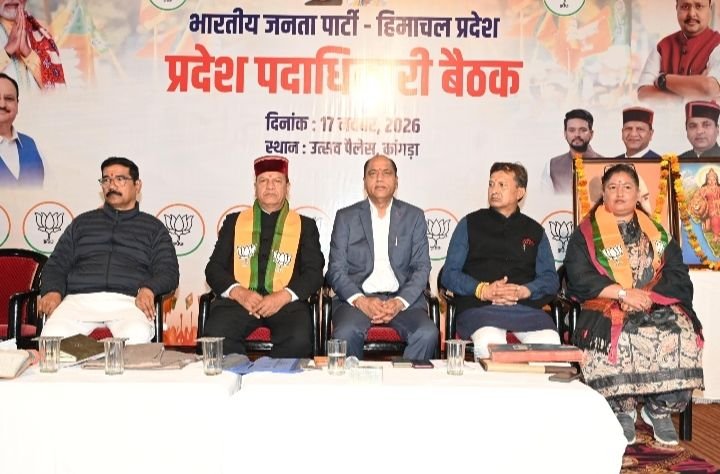
Jai Ram Thakur outlines Opposition’s agenda as Winter Session begins at Tapovan; BJP signals sustained focus on land transactions, alleged irregularities, drug menace, healthcare and law-and-order concerns
DHARAMSHALA: The opening day of the Winter Session of the Himachal Pradesh Legislative Assembly has set the stage for an intense political debate, with the BJP seeking to use the House as a platform to raise issues relating to governance, protection of public assets, transparency in land transactions and the delivery of essential services.
Addressing the media after the Assembly proceedings were adjourned on the first day, former Chief Minister and Leader of the Opposition Jai Ram Thakur outlined the party’s approach to the session. He indicated that the BJP intends to pursue a wider public-interest agenda, taking up issues that it believes require greater scrutiny and accountability from the government.
For the principal Opposition party, the Winter Session is not merely an opportunity for floor-level exchanges but also a platform to place concerns raised by people across the state before the government. Thakur said the BJP would continue to highlight matters concerning alleged corruption, questions surrounding property and land transactions, the state’s financial and developmental priorities, and challenges facing the health and law-and-order systems.
The party has particularly drawn attention to what it describes as the need to safeguard Himachal Pradesh’s public assets and historical properties. The expression “Himachal on Sale”, used by the BJP in its political campaign, reflects its objection to certain decisions involving state-owned properties and assets. Thakur alleged that public resources were being disposed of without adequate consideration of their long-term value and the interests of the people.
The issue of land transactions and the manner in which government properties are being dealt with is expected to remain part of the BJP’s political scrutiny during the session. The Opposition is seeking greater clarity on the policy framework, valuation procedures and public interest considerations behind such decisions. These concerns also connect with the larger debate over the state’s financial position and the responsibility of the government to protect assets created through decades of public investment.
Thakur also referred to allegations of corruption and favouritism, arguing that questions of transparency and accountability should not remain confined to political exchanges. The BJP intends to carry these issues beyond the Assembly and take them to the public, making governance and the management of state resources central themes of its political engagement.
Another significant part of the party’s agenda concerns the growing challenge of substance abuse, particularly among young people. The BJP has maintained that the drug menace requires sustained attention, stronger enforcement and coordinated action involving the police, administration, educational institutions and communities. By placing the issue prominently in its Assembly agenda, the party is seeking to keep public safety and the future of the younger generation in focus.
Healthcare and law-and-order concerns are also expected to feature in the Opposition’s interventions. Thakur referred to public apprehensions about the functioning of health institutions and the overall law-and-order environment, indicating that the BJP would seek answers on these matters from the government. The party’s position is that public services, particularly healthcare, must remain accessible, adequately staffed and responsive to the needs of people living in both urban and remote areas.
The timing and scheduling of the Winter Session also emerged as a point of discussion. Thakur said legislators from both the ruling and Opposition sides had requested the Chief Minister to consider the wedding season while deciding the dates of the session. According to him, these representations were not accommodated. He also questioned the government’s decision to convene the session ahead of the completion of its fourth year in office, linking the schedule to the proposed anniversary celebrations. These observations reflect the Opposition’s broader argument that legislative business and public priorities should remain at the centre of the government’s calendar.
The BJP leader further raised the issue of development projects and political credit, maintaining that the state’s progress has been shaped by the efforts and struggles of successive governments and institutions. He said historical achievements should be viewed in their proper context and that the contribution of earlier administrations and other stakeholders should be acknowledged. The party has also objected to what it considers excessive publicity around government achievements, arguing that development claims should be assessed against measurable outcomes and the condition of public services.
The political significance of the session lies in the range of issues the BJP is seeking to bring into the legislative debate. Rather than limiting its approach to individual controversies, the party is attempting to connect questions of public assets, land policy, corruption allegations, employment, healthcare, law and order and drug abuse with the wider question of governance in Himachal Pradesh.
For Jai Ram Thakur, the session provides an opportunity to lead the Opposition’s interventions in the House while articulating the BJP’s concerns outside the legislature. His remarks indicate that the party intends to maintain pressure through both legislative proceedings and public outreach, keeping the focus on decisions that it believes have a direct bearing on the state’s economic interests and everyday public life.
As the Winter Session progresses, the government will face questions on these subjects, while the BJP will seek to establish its role as an active Opposition by demanding explanations, placing its concerns on record and taking the debate beyond the Assembly. The coming days are therefore likely to revolve not only around the legislative business before the House but also around competing political narratives on development, accountability and the protection of Himachal Pradesh’s interests.