


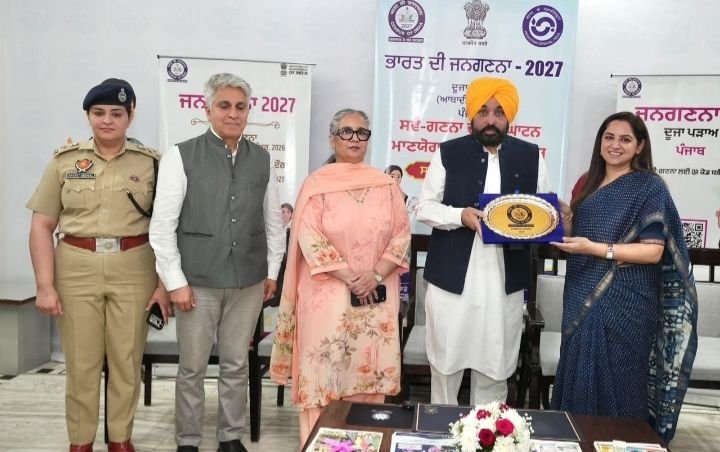
Sangrur, November 16: Punjab Chief Minister Bhagwant Singh Mann on Monday formally launched the second phase of Census 2027 by completing the online self-enumeration exercise for himself and his family, urging people across the state to participate actively in the nationwide population-counting process.
The online self-enumeration facility will remain available from November 16 to November 30, giving residents an opportunity to submit household and family details through the online platform without waiting for census officials to visit their homes. The exercise will subsequently move into its door-to-door phase, with enumerators scheduled to visit households between December 1, 2026, and January 4, 2027.
Emphasising the importance of accurate information, Mann said the data collected would provide an essential basis for the state’s future development planning, resource allocation and public welfare policies. He appealed to every Punjabi household to cooperate with census personnel and ensure that the information submitted reflects the actual circumstances of their families.
After completing his own self-enumeration, the Chief Minister described the process as straightforward and convenient. He said it took approximately 25 to 30 minutes to complete and did not require people to upload or submit supporting documents.
Mann assured residents that the information furnished during the census would remain confidential and would be used exclusively for census-related purposes and development planning. He urged people not to hesitate while sharing the required details, stressing that every individual must be counted for the exercise to provide a reliable picture of Punjab’s population and socio-economic conditions.
### **Second phase to capture demographic and socio-economic details**
Explaining the scope of the ongoing phase, the Chief Minister said Population Enumeration would collect information relating to individual family members, their demographic profiles, educational qualifications, socio-economic circumstances, migration patterns and other relevant details, including fertility-related information.
The information gathered will help the government understand the composition and changing needs of Punjab’s population. Such data is expected to support policy decisions across sectors, including education, healthcare, housing, employment, social welfare and infrastructure.
Mann pointed out that the Census of India was being conducted after a gap of 16 years, making the current exercise particularly important for governments and policymakers. He said Punjab was among the first states in the country to undertake the scheduled process and called for public participation to ensure that the exercise was comprehensive and accurate.
The Chief Minister also recalled that the first phase, covering House Listing and Housing Census, had already been completed in Punjab. That phase focused on the physical condition of residential structures, basic household amenities and assets available to families.
### **CM acknowledges contribution of census personnel**
Appreciating the work carried out during the first phase, Mann acknowledged the efforts of Census Officers, Enumerators, Supervisors, Master Trainers, Field Trainers and other officials and employees of the state administration.
He said their commitment and coordination had been important in completing the initial stage and would remain essential as the exercise moved into population enumeration. He expressed confidence that their continued efforts, supported by public cooperation, would help ensure that the final data was reliable and comprehensive.
Director Census Operations Punjab Dr Navjot Khosa briefed the Chief Minister on the online self-enumeration mechanism and the arrangements for the second phase.
### **Public participation crucial for Punjab’s development planning**
Mann said the census should not be viewed merely as a statistical exercise but as a national responsibility with long-term implications for governance and development. According to him, accurate population data would help the state identify emerging needs, understand demographic changes and frame policies that respond more effectively to different sections of society.
He also highlighted the use of technology in the exercise, describing Census 2027 as India’s first digital census, with information being collected through a mobile application and an online self-enumeration facility.
The Chief Minister reiterated his appeal to residents to complete the online process within the November 16–30 window rather than wait for the house-to-house enumeration. He said the success of the exercise would depend on the willingness of citizens to provide correct information and extend full cooperation to the census teams.
With online self-enumeration now underway, Punjab has entered the second and crucial stage of Census 2027. The coming weeks will test the reach of the digital facility and the effectiveness of the administrative machinery in ensuring that every household and every individual is covered in the population count.