

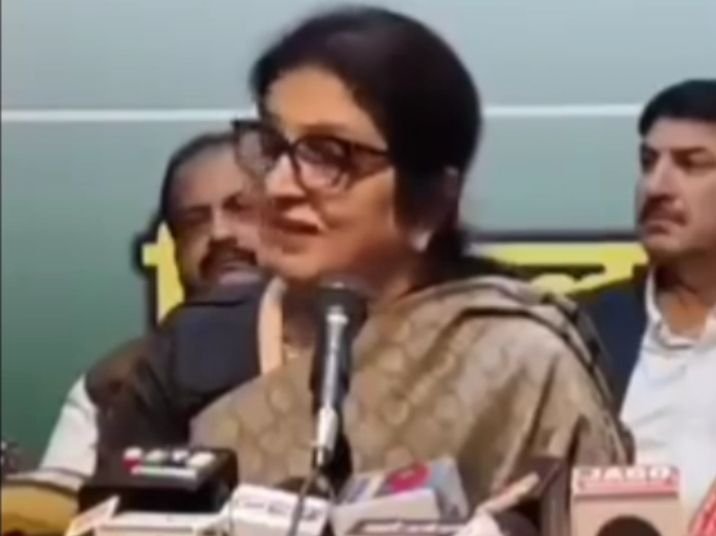
Shimla: The Himachal Pradesh Congress has begun what could become one of its most important organisational exercises ahead of the 2027 Assembly elections, with party in-charge Rajani Patil openly acknowledging internal differences and coordination problems while making it clear that the organisation will have to put its house in order before entering the electoral battle.
After a series of meetings with the state leadership, ministers, district presidents, office-bearers and grassroots workers, Patil said the Congress leadership was preparing a roadmap aimed at bringing the organisation onto a common platform and improving coordination between the party structure and the government.
Her remarks are significant because they come at a time when the Congress government in Himachal Pradesh has entered the second half of its term and the political focus is gradually shifting towards the 2027 Assembly contest.
Patil did not describe the differences as an organisational split. Instead, she said disagreements were natural in a large political organisation but could not be permitted to interfere with its functioning or weaken the party ahead of the elections. She said her responsibility was to bring leaders and workers together and ensure that the organisation worked with greater coordination.
The message from the Congress leadership is therefore increasingly clear: the next election will not be fought only on the performance of the government. The party’s organisational machinery will also have to demonstrate that it can work cohesively from the state capital down to the constituency, block and booth levels.
Patil’s recent review meetings have exposed some of the practical problems facing the organisation. District-level functionaries have raised complaints about coordination with block-level office-bearers, while the party has been assessing whether those holding organisational positions are actually carrying out the responsibilities assigned to them.
Patil has indicated that Congress office-bearers who are unable or unwilling to devote sufficient time to organisational work could be replaced by more active workers. District leaders have also been asked to undertake regular visits, strengthen local committees and ensure that the party structure is functional at the grassroots.
This is particularly important in Himachal Pradesh, where Assembly elections are fought constituency by constituency and where local organisation, candidate networks and booth-level mobilisation can have a direct bearing on the political contest.
The Congress has already started preparations for what it calls its Mission 2027. The party has been conducting organisational meetings and has discussed programmes aimed at expanding its reach beyond district headquarters to blocks, panchayats and villages. A proposed ‘Himachal Jodo Yatra’ from Bharmour to Sirmaur is also part of the organisational outreach being planned by the state unit.
The second major issue on Patil’s agenda is the relationship between the Congress organisation and the state government.
Although Patil has stressed that the government and the party organisation are not adversaries, her call for improved coordination indicates that the leadership believes the relationship needs closer management. The distinction is important: a government is responsible for administration, while the party organisation is responsible for political mobilisation and communicating the government’s work to its workers and supporters.
Ahead of 2027, the Congress will need both sides to function in greater alignment without allowing the party structure to become merely an extension of the government machinery.
The question of a possible Cabinet expansion or reshuffle has added another layer to the political discussion.
Patil said Chief Minister Sukhvinder Singh Sukhu had been asked to submit a proposal to the party leadership but that the proposal had not yet been received. That effectively leaves the speculation over changes in the Council of Ministers unresolved for now.
For the Congress, however, organisational restructuring appears to be moving faster than any possible Cabinet exercise.
Patil has also signalled a tougher approach towards indiscipline. The party leadership is reviewing the performance of office-bearers and has indicated that responsibilities will not be allowed to remain merely on paper. The objective is to create an organisation capable of responding quickly to political developments and maintaining contact with voters throughout the year rather than becoming active only during an election campaign.
The Congress is simultaneously preparing to take several national and state issues to the people.
Patil has reiterated the party’s allegations concerning electoral irregularities and its campaign against the Election Commission’s functioning. The Himachal Congress held a protest outside the Chief Electoral Officer’s office in Shimla on Friday and demanded the removal of Chief Election Commissioner Gyanesh Kumar. The party has announced district-level demonstrations as part of the campaign. These are Congress allegations and demands; the Election Commission has not been established by the party’s claims to have acted unlawfully.
For Himachal’s electorate, however, issues closer to everyday life are likely to remain equally important.
Patil raised concerns over examination paper leaks and the cancellation of examinations, arguing that repeated disruptions have affected young people preparing for competitive examinations. She also criticised the Centre over issues that she said affect Himachal’s tourism and apple sectors and raised concerns about charges associated with digital payments.
The Congress’s challenge will be to connect these issues with a clear state-level political programme.
The party is already in a position to campaign on the performance of its government, but that also means it will face questions about delivery, employment, public services, finances, infrastructure, agriculture, tourism and the concerns of young people.
For Chief Minister Sukhu and the Congress organisation, the coming months will therefore be crucial for converting government programmes into a coherent political narrative at the grassroots.
For the opposition BJP, the Congress’s admission that differences exist within the organisation provides an opportunity to question its internal cohesion and governance. But whether such criticism gains traction will depend on how effectively the Congress manages the problems Patil has acknowledged.
The significance of Patil’s intervention ultimately lies in its timing.
With roughly a year left before the 2027 Assembly election campaign enters its decisive phase, the Congress leadership is attempting to address organisational weaknesses before they become an electoral liability. The emphasis is on discipline, grassroots activity, coordination with the government and bringing competing voices onto a common political platform.
Patil’s message is therefore less about denying differences and more about containing them.
The Congress now has to demonstrate that the roadmap being prepared in Shimla can translate into an active organisation across Himachal Pradesh — one capable of reaching voters, defending the government’s record, responding to criticism and presenting a clear agenda for the next Assembly election.
The 2027 contest is still some distance away, but for the Congress, the organisational campaign has already begun.