



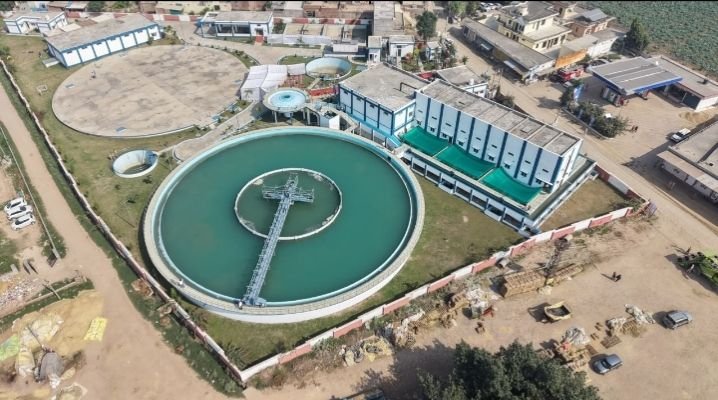
Patiala, November 2: Punjab Chief Minister Bhagwant Singh Mann on Monday dedicated two modern water treatment plants at Mandoli village in Ghanaur constituency, marking a major step towards improving drinking water access and reducing dependence on increasingly depleted groundwater resources in Patiala and neighbouring areas. Built under a ₹432.65-crore bulk surface water supply initiative, the facilities are intended to benefit 316 villages across five Assembly constituencies, reaching approximately 4.5 lakh residents and nearly 75,000 households through an extensive pipeline network.
The project, centred on the treatment and distribution of canal water, is particularly significant for villages facing groundwater contamination, including excessive fluoride and the presence of heavy metals. The state government says the new infrastructure will provide a more sustainable source of drinking water and help address long-standing public health concerns linked to poor groundwater quality.
Addressing the gathering, Mann described the occasion as an important milestone for Patiala and Fatehgarh Sahib districts, saying access to safe drinking water was directly connected with public health and the quality of life of rural communities. He regretted that even eight decades after Independence, several villages were still struggling to secure this basic necessity.
According to the Chief Minister, the problem had remained neglected for years, and the present government had taken up the responsibility of providing a lasting solution.
The two treatment facilities have been established at Mandoli and Pabri. The Mandoli plant has been constructed at a cost of ₹266.20 crore, while the Pabri facility represents an investment of ₹166.46 crore. Together, the plants are designed to treat canal water and supply it to the targeted rural areas. The project is supported by a 752-kilometre transmission pipeline network, while another 1,216 kilometres of existing distribution pipelines have been upgraded across the villages. Water will be delivered through storage infrastructure comprising 322 tanks under the existing supply schemes, according to the details shared by the government.
The initiative is aimed at reducing pressure on groundwater reserves at a time when Punjab is extracting water far beyond its natural replenishment capacity. Government figures place the state’s groundwater extraction at 156.36 per cent of its annual recharge. The situation in Patiala is particularly concerning: against an annual groundwater recharge of 1.01 billion cubic metres, extraction stands at 1.89 billion cubic metres, while the extractable limit is estimated at 0.9 billion cubic metres. This puts the district’s groundwater exploitation level at around 208 per cent.
The government identified excessive concentrations of fluoride and other contaminants, including aluminium, lead, sulphate, arsenic and uranium, in groundwater across 316 villages in Ghanaur, Rajpura, Sanour, Patiala Rural and Shambu Kalan areas. The shift towards treated canal water is intended to reduce exposure to these contaminants while easing dependence on underground sources.
The infrastructure also incorporates automated monitoring and water-quality control systems. Supervisory Control and Data Acquisition (SCADA) technology has been installed at treatment facilities and water storage points to enable continuous monitoring of supply operations. The project includes laboratory facilities where water samples are tested before and after treatment. Testing reports are also forwarded to the State-Level Water Testing Laboratory every month, as part of the quality-monitoring mechanism.
Mann said the project had been designed with a long-term perspective, keeping the region’s drinking water requirements in view up to 2049. The Chief Minister also highlighted the importance of community participation, stating that Water Supply and Sanitation Committees had been constituted in all 316 villages to support effective operation and monitoring. The executing company has been entrusted with the operation and maintenance of the facilities for 10 years.
The project has also drawn positive reactions from residents who had faced difficulties with groundwater quality. Gurpreet Singh, a resident of Patiala district, said that access to treated canal water had brought considerable relief to families that were previously concerned about the quality of water available for everyday use. Harpreet Kaur, a resident of Sanour, similarly welcomed the initiative, saying that the availability of treated water at household level had eased a major concern for local families.
Beyond the rural initiative, Mann said work was progressing on major surface-water supply projects for Ludhiana, Amritsar, Jalandhar and Patiala cities. These schemes are intended to benefit a combined urban population of approximately 78 lakh residents. With a proposed treatment capacity of 1,410 million litres per day, the projects include more than 500 kilometres of rising-main and distribution pipelines, along with 224 new overhead service reservoirs, underground reservoirs and pumping stations. Their implementation, however, continues to face challenges involving land acquisition, clearances and labour availability.
The government has also outlined plans to strengthen wastewater management across the state. Punjab currently has 152 operational Sewage Treatment Plants (STPs) with a combined capacity of 2,243.7 million litres per day across 23 districts. The treatment capacity is projected to rise to approximately 2,676 MLD by December 2027, with around 58 additional plants planned, including two 50-MLD facilities at Amritsar and Zirakpur.
Separately, 114.24 kilometres of desilting work has been reported across various urban local bodies in Patiala district, forming part of the ongoing civic infrastructure efforts.
The commissioning of the Mandoli and Pabri water treatment facilities marks a significant intervention in a region where groundwater depletion and contamination have emerged as serious challenges. The larger test for the government will now be to ensure that the infrastructure delivers a reliable supply of safe water to every targeted household, maintains quality standards and remains effective over the long term.