


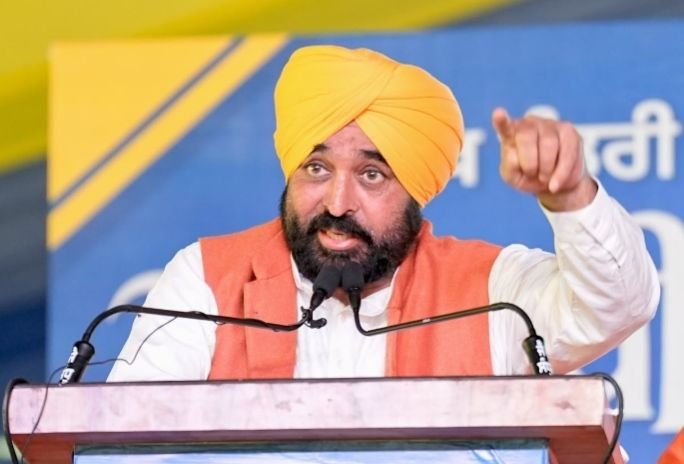
More than 37.43 lakh women receive direct bank transfers; 80.05 lakh registrations completed so far as CM Bhagwant Mann announces further instalments and promises January 1 payment
Abohar, The Punjab government has transferred ₹1,291 crore in financial assistance to more than 37.43 lakh women under the Mukh Mantri Mawan-Dheeyan Satkar Yojna, with Chief Minister Bhagwant Singh Mann describing the initiative as a major step towards strengthening women’s financial independence and social dignity. Addressing a public gathering in Abohar on Sunday, Mann said the government aimed to bring one crore women under the scheme and had already completed 80.05 lakh registrations as of October 29.
The latest transfer has taken the total financial assistance distributed under the scheme to ₹3,934.80 crore, according to figures shared by the Chief Minister. He said that ₹2,643.71 crore had previously been disbursed to 76.35 lakh women, while the latest instalment of ₹1,291 crore had been credited directly to the bank accounts of more than 37.43 lakh beneficiaries.
Mann said the scheme was designed to put financial resources directly in the hands of women, enabling them to exercise greater independence in household decisions and meet their personal needs with dignity. He maintained that the initiative was not merely a welfare payment but an effort to strengthen women’s economic position and recognise their contribution to families and society.
The Chief Minister emphasised that the benefit was not restricted by household-based eligibility limits. According to him, every eligible woman can receive assistance independently, even when several eligible women live in the same household. He said the government intended to extend the scheme to one crore beneficiaries, with annual financial assistance projected at ₹12,000 crore once the target is achieved.
Announcing the next payment schedule, Mann said the government would continue transferring assistance on December 1 and January 1. He described the January 1 transfer as a New Year gift for registered women, expressing confidence that the number of beneficiaries would move closer to the one-crore target by then.
The Chief Minister also acknowledged the contribution of women and grassroots workers involved in the registration drive. He said 1,37,723 Satkar Sakhis were helping women complete the registration process and that incentives worth ₹51.30 crore had been earmarked for them. Anganwadi workers engaged in the exercise would also receive incentives amounting to ₹25 crore.
Taking aim at opposition criticism, Mann said women from families associated with the Akali Dal and Congress were also receiving the benefits, arguing that the scheme was being implemented without political discrimination. He accused opposition leaders of criticising public welfare initiatives for political reasons and said the government’s responsibility was to serve eligible beneficiaries irrespective of their political affiliations.
Presenting the scheme as part of a wider public-welfare approach, Mann said the government was returning taxpayers’ money to people through healthcare, education, electricity, roads, irrigation and other development programmes. He cited the Mukh Mantri Sehat Yojna, under which eligible families can receive cashless treatment of up to ₹10 lakh, and said 54 lakh health cards had been issued. He also referred to Aam Aadmi Clinics and the provision of 300 units of free electricity every month to around 90 per cent of households in the state.
On employment, the Chief Minister said the government had provided 70,685 government jobs strictly on merit, without cash payments, political recommendations or favouritism. He maintained that creating opportunities for young people and improving public services remained central to the government’s agenda.
Mann also used the Abohar gathering to launch a political attack on the BJP, Congress and Shiromani Akali Dal, accusing them of putting political interests ahead of Punjab’s development. He alleged that the Akali Dal had failed to provide satisfactory answers over incidents of sacrilege, while the Congress continued to struggle with internal divisions. He claimed that these parties lacked a constructive alternative for the state and said the AAP government was seeking another opportunity to serve Punjab in the 2027 Assembly elections.
The Chief Minister further highlighted the government’s rural infrastructure and agricultural initiatives. He said around 3,100 sports grounds were being developed across Punjab to encourage young people to take up sports and help steer them away from drugs. He also referred to the closure of toll plazas, claiming that commuters were saving approximately ₹70 lakh every day, and said village development grants were being provided to improve basic facilities.
Education, Mann said, remained the most effective instrument for breaking the cycle of poverty and inequality. Referring to teacher training programmes, Schools of Eminence and improvements in government schools, he said the government wanted children from ordinary families to have access to quality education and opportunities to compete at the highest levels. He cited the increase in government-school students qualifying for NEET, from 80 in 2021 to 882 in 2026, as an indication of the progress achieved in the education sector.
On agriculture, Mann claimed that canal water had reached the fields of 1,587 villages that had previously lacked access to the facility. He said the state had invested ₹7,200 crore in expanding and strengthening the canal network. According to the figures he presented, the area receiving canal irrigation had increased from 20.89 lakh acres in 2022 to 60.30 lakh acres, while the share of agricultural land covered by canal irrigation had risen from 26 per cent to around 80 per cent. He also said approximately 45,000 kilometres of roads were being renovated and upgraded across the state.
The Abohar programme thus combined the announcement of a major welfare disbursement with the government’s broader political and development message ahead of the next Assembly elections. Mann sought to project the Mawan-Dheeyan Satkar Yojna as a direct investment in women’s financial security, while linking it with employment, education, healthcare and rural development initiatives.
The government’s next challenge will be to ensure that the promised instalments reach eligible beneficiaries on schedule, registrations are completed transparently and the scheme’s long-term benefits translate into greater financial independence for women. With the target set at one crore beneficiaries, the initiative is likely to remain a prominent part of the AAP government’s public outreach and electoral narrative in the run-up to the 2027 Punjab Assembly polls.