


Mann Sharpens Attack on SAD-BJP Alliance, Predicts Akali Dal’s Political Decline Ahead of 2027 Punjab Polls
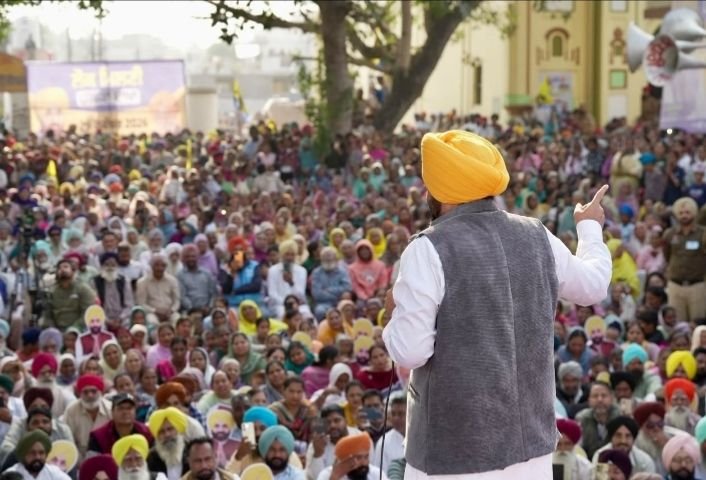
Ludhiana . With the 2027 Punjab Assembly elections approaching, Chief Minister Bhagwant Singh Mann has intensified his political attack on the Shiromani Akali Dal (SAD) and the BJP over their renewed alliance, accusing the Akali leadership of compromising Punjab’s interests for the sake of political power. Addressing a Lok Milni programme at Hans Kalan village in the Dakha Assembly constituency, Mann predicted that the BJP would eventually weaken and absorb the Akali Dal, just as he alleged it had done with regional political parties and their leaders in other states.
Mann also sought to project his government’s development agenda as the central issue for the next election, pointing to its initiatives in education, healthcare, agriculture, electricity supply and rural infrastructure. He asserted that voters would give the Aam Aadmi Party (AAP) another mandate because of its work and public welfare programmes, rather than return to parties that, in his words, had misled Punjab for decades.
Targeting the SAD over its alliance with the BJP, Mann said the two parties had once been sharply opposed to each other on several issues concerning farmers, Sikh institutions and Punjab’s political interests. He referred particularly to the farmers’ agitation against the three farm laws and alleged that the Akali leadership had now set aside its earlier criticism of the BJP to pursue electoral gains. He invoked the deaths of 750 farmers during the agitation, saying their sacrifices should not be forgotten while assessing the political choices of those now entering into an alliance.
The Chief Minister argued that the BJP’s record with regional allies in states such as Maharashtra and Bihar should serve as a warning for the Akali Dal. Referring to political developments involving the Shiv Sena, the Nationalist Congress Party and the Janata Dal (United), he claimed that the BJP had systematically weakened regional partners wherever it expanded its influence. He also cited the Indian National Lok Dal in Haryana while making his broader political argument. These comparisons formed part of Mann’s criticism of the alliance, which the SAD and BJP have presented as a partnership aimed at strengthening their electoral prospects in Punjab.
He further accused the Akali leadership of failing to protect religious sentiments during its ten-year tenure from 2007 to 2017 and alleged that religious symbolism was now being used for political purposes. Mann also criticised the Congress, saying its leaders remained occupied with internal rivalries instead of presenting a united challenge on issues affecting the state.
The Chief Minister urged voters to judge political parties by their performance and public commitments rather than electoral inducements or slogans. Recalling the 2022 Assembly election, he said Punjab had rejected several established political leaders and given AAP a decisive mandate in the hope of bringing a change in governance. He maintained that his government intended to seek another term on the basis of its work.
Women’s payment instalment scheduled for December 1
A major part of Mann’s address focused on the government’s welfare commitments, particularly financial assistance for women. He announced that the next instalment under the Mawan Dheeyan Satkar Yojana would be released on December 1 at a state-level function. He said women beneficiaries would receive payment alerts on their mobile phones and described the initiative as a measure to strengthen their financial independence.
Turning to the government’s development record, Mann said its priorities included improving the quality of education, expanding healthcare services, ensuring daytime electricity for farmers, increasing the availability of canal water and accelerating development in villages. He maintained that public money was being directed towards welfare and infrastructure, in contrast to what he described as the misuse of state resources by previous governments.
On agriculture, the Chief Minister claimed that Punjab’s use of canal water had increased from around 22 per cent before AAP assumed office to nearly 85 per cent under the present government. He also cited the laying of approximately 14,000 kilometres of underground pipelines as part of efforts to improve irrigation and reduce dependence on groundwater. According to Mann, better access to canal water was helping farmers manage agricultural operations more effectively.
Education was another key focus of his address. Mann claimed that Punjab had made substantial progress in school education since 2022, highlighting teacher-training initiatives, Schools of Eminence and exposure programmes in Finland, Singapore and institutions such as the Indian Institutes of Management. He said the government was also working towards establishing centres to prepare students for the Union Public Service Commission examinations, with particular attention to young people from rural and economically weaker backgrounds.
Describing education as a long-term instrument for overcoming poverty, Mann said welfare assistance could provide immediate support, but quality education would create opportunities for children to become professionals and public servants. He reiterated that improving government schools was central to his administration’s approach to social and economic progress.
On healthcare, he referred to the network of around 1,200 Aam Aadmi Clinics across the state, claiming that these facilities were providing free medicines and diagnostic services. He also cited the benefits extended under the Mukh Mantri Sehat Yojana, including treatment involving heart stents and knee replacement procedures. These initiatives, he said, were intended to make healthcare more accessible and reduce the financial burden on families.
Mann also spoke about the need to strengthen village infrastructure and support local development. He said the government would continue to make funds available for public works and address issues raised directly by residents through Lok Milni programmes. He described the initiative as a platform for direct interaction between the Chief Minister and citizens, allowing people to bring their grievances and development-related demands to the government.
During the programme, he also disclosed that he had written to the Central Government seeking the naming of Halwara Airport after Shaheed Kartar Singh Sarabha, recognising the freedom fighter’s contribution to the country’s independence struggle.
The Hans Kalan gathering was also an opportunity for Mann to connect the government’s welfare narrative with the political battle taking shape ahead of 2027. His criticism of the SAD-BJP alliance suggests that the AAP intends to make the partnership a major campaign issue, particularly by linking it to the farmers’ agitation and questions of Punjab’s political and agricultural interests.
At the same time, the Chief Minister’s emphasis on women’s financial assistance, education, healthcare and irrigation indicates that AAP is preparing to defend its record through a combination of welfare delivery and development claims. With the opposition parties seeking to rebuild their political strength and challenge the ruling party, the coming election is likely to revolve around competing claims of governance, credibility and the ability to protect Punjab’s interests.
The announcements, performance figures and political allegations in this report reflect the Chief Minister’s address and claims; they should be assessed against official records and the responses of the parties concerned.