
As Himachal Pradesh heads into crucial municipal and panchayat elections, the Congress party is positioning itself not merely as a political organisation seeking votes, but as a government attempting to build its campaign around welfare delivery, clean governance and grassroots credibility. Under the leadership of Chief Minister Sukhvinder Singh Sukhu, the Congress appears to be banking heavily on governance-centric politics rather than aggressive rhetoric, and party strategists believe this could become the defining factor in the local body elections.
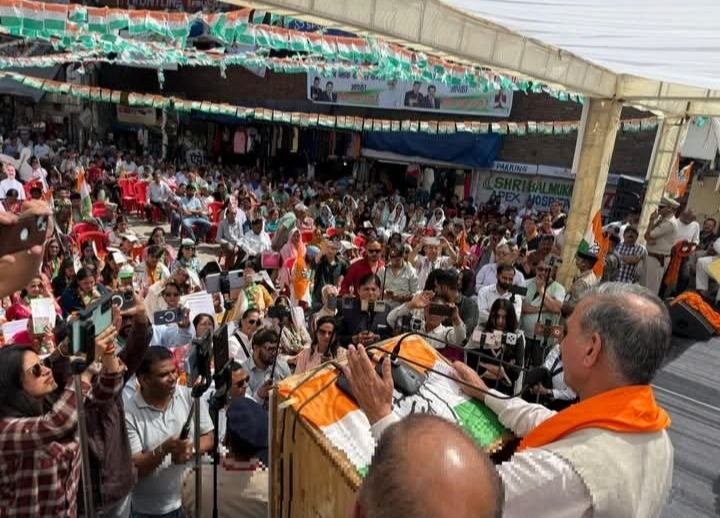
Across urban and rural Himachal, Congress leaders have activated ward-level and booth-level campaign structures with a clear message — the government’s work should reach every household before polling day. Meetings held by party observers and organisational in-charges in Shimla and district headquarters have focused on strengthening coordination between local leaders, councillors, panchayat representatives and grassroots workers.
Unlike traditional election campaigns dominated by slogans alone, the Congress campaign in Himachal is attempting to create a narrative around “visible governance”. Party leaders are repeatedly highlighting that despite financial constraints, the government has continued welfare-oriented interventions aimed at vulnerable communities, farmers, youth and disaster-affected families.
One of the strongest pillars of the Congress campaign is the image of Chief Minister Sukhvinder Singh Sukhu himself. Coming from a modest socio-economic background, Sukhu is being projected by the party as a leader who understands the struggles of ordinary families, rural households and lower-income sections. Congress leaders argue that this social and political grounding has directly shaped the policy direction of the government.
Political observers note that the Sukhu government has consistently attempted to distinguish itself through targeted welfare schemes rather than headline-driven announcements. The Mukhyamantri Sukh-Aashray Yojana has emerged as one of the government’s most emotionally resonant programmes. Designed to support orphaned and vulnerable children, the scheme has helped create an image of a government focused on social protection and humanitarian governance.
The Congress leadership is also aggressively projecting its anti-corruption stance as a major electoral advantage. The government has taken action against officials accused of irregularities and corruption, and several employees facing serious allegations have reportedly faced disciplinary measures, including dismissals. Congress leaders maintain that the administration has adopted a “zero tolerance” approach towards corruption and misuse of public office.
This anti-corruption positioning is politically significant because Himachal politics has traditionally revolved around perceptions of administrative fairness and accessibility. Congress leaders are using this narrative to argue that governance under the present dispensation is more accountable and transparent.
Another major campaign theme is the government’s action against drug abuse. In recent years, drug-related concerns have become increasingly prominent in several hill districts. Congress leaders say the government’s crackdown on narcotics networks, combined with awareness campaigns and policing measures, has strengthened public confidence, particularly among parents and rural communities.
The state government’s push for solar energy and green development is also being highlighted as a future-oriented policy initiative. Congress leaders argue that the promotion of solar projects is not only helping Himachal move towards sustainable energy, but is also creating opportunities for local employment and supplementary income generation for youth and rural households.
Agriculture and rural economy remain central to the Congress campaign. The government’s support for natural farming and its decision to provide minimum support price-linked benefits for milk producers are being projected as historic interventions. Congress leaders point out that Himachal became one of the first states in the country to move aggressively in this direction, and they frequently cite appreciation from policy institutions for the state’s innovative rural initiatives.
The Congress campaign is also drawing strength from the government’s disaster relief measures. After devastating floods and natural calamities, the Sukhu government significantly enhanced compensation and relief assistance for affected families. Party leaders repeatedly mention that while earlier assistance figures remained limited, the present government increased aid substantially despite severe financial pressures on the state exchequer.
This welfare-oriented politics is being strategically contrasted with what Congress describes as “conventional opposition politics” focused more on criticism than governance delivery. Congress campaigners are attempting to convince voters that the present administration has continued development and welfare work even under difficult fiscal conditions.
Tourism development has emerged as another important talking point. The government has pushed infrastructure improvements, tourism expansion and destination-based employment generation in several districts. Congress believes these efforts have helped improve economic activity in local markets dependent on tourism and hospitality.
Within party circles, there is growing confidence that these elections may become a referendum on governance credibility rather than pure political mobilisation. Congress leaders believe that schemes linked to social justice, rural welfare, natural farming, employment generation and transparent administration are resonating more strongly with voters than traditional campaign attacks.
The party is also benefiting from a relatively coordinated organisational structure in many local bodies, where ward-level workers have been instructed to focus on direct voter engagement instead of large symbolic events alone. Congress insiders claim that this “micro-contact campaign” is helping the party strengthen its grassroots network ahead of polling.
Political analysts believe the Congress strategy in Himachal reflects a broader attempt to build an electoral model centred on governance outcomes and welfare credibility. Whether that translates into sweeping victories will ultimately depend on voter turnout and local equations, but there is little doubt that the Congress campaign in Himachal is being driven by a strong attempt to convert governance performance into electoral momentum.