

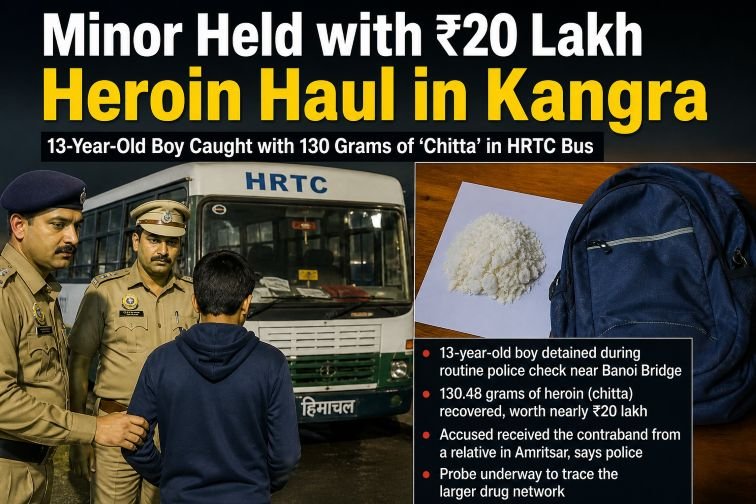
A troubling case from Himachal Pradesh’s Kangra district has once again brought attention to the deepening crisis of narcotics trafficking in northern India, particularly the alarming involvement of minors in the illegal trade. Police officials confirmed that a 13-year-old boy was detained after being found in possession of a substantial quantity of heroin, commonly referred to as “chitta,” with an estimated street value of nearly ₹20 lakh.
The incident unfolded near Banoi Bridge under the jurisdiction of Gaggal police station, where a routine checkpoint operation led to the interception of a state-run bus traveling from Amritsar to Baijnath. According to officials, the bus was stopped as part of a late-evening inspection drive aimed at curbing the movement of contraband through inter-district routes. During the search, officers noticed the minor traveling alone, carrying a backpack that aroused suspicion.
Upon inspection, the bag was found to contain approximately 130.48 grams of heroin—a quantity that falls under commercial volume as per narcotics regulations, indicating a serious offense with potential links to organized trafficking networks. The sheer scale of the recovery from a minor has intensified concerns among law enforcement agencies about the evolving tactics of drug syndicates, which increasingly appear to be using juveniles as couriers to evade stricter legal consequences.
Preliminary questioning of the minor revealed that the contraband had allegedly been handed over to him by a relative in Amritsar. The instructions, according to the boy’s statement, were to transport the substance to a designated location, where it would be collected by another individual. Authorities believe this points to a larger, well-coordinated network that operates across state borders, exploiting vulnerable individuals to facilitate the movement of narcotics.
The investigation has now been handed over to a senior officer, with efforts underway to trace the relative who is suspected to be a key link in the supply chain. Police teams are also examining call records and travel patterns to identify other possible connections and to determine whether the minor had been used in similar operations in the past.
This case highlights a disturbing trend in the region, where drug trafficking networks are adapting to increased surveillance and enforcement by recruiting younger individuals who are less likely to attract suspicion. Experts warn that such developments not only complicate policing efforts but also pose a serious social challenge, as minors drawn into these activities risk long-term psychological and legal consequences.
Himachal Pradesh, traditionally known for its tranquil environment, has in recent years witnessed a steady rise in drug-related cases, particularly in districts that serve as transit points between Punjab and other hill regions. Law enforcement agencies have intensified surveillance and launched multiple awareness campaigns, but the persistence of such incidents underscores the need for a broader, multi-pronged strategy that includes community engagement, stricter border monitoring, and targeted intervention for at-risk youth.
Officials have reiterated their commitment to dismantling the networks behind such operations and ensuring that those orchestrating the trade are brought to justice. At the same time, child protection mechanisms are expected to play a crucial role in rehabilitating minors found involved in such cases, emphasizing correction and reintegration over punishment.
As the investigation progresses, this incident serves as a stark reminder of the shifting dynamics of the narcotics trade and the urgent need to address its human cost—especially when it begins to involve the youngest and most vulnerable members of society.