
The battle over the leadership of the Punjab Congress has moved well beyond an internal organisational dispute, exposing deeper divisions over the party’s future and, more significantly, over who could emerge as its chief ministerial face if it returns to power in the 2027 Assembly elections.
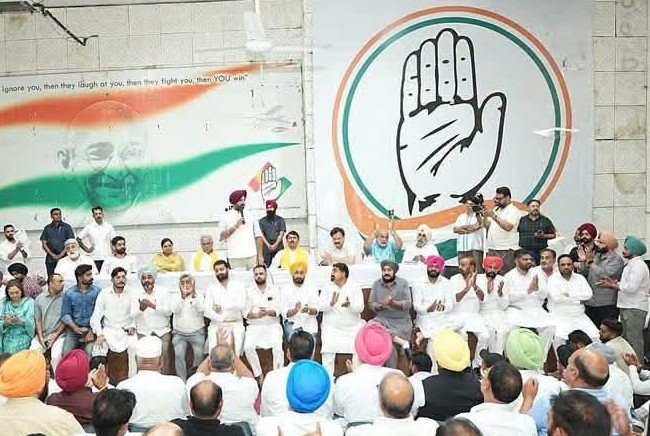
The latest round of consultations failed to produce a breakthrough after former Punjab Chief Minister and Jalandhar MP Charanjit Singh Channi met Punjab Congress in-charge Bhupesh Baghel along with his supporters on Saturday. Party sources said the meeting ended without any consensus, with differences between rival factions remaining firmly in place.
Baghel later returned to Raipur, with indications that the matter will now be referred to the Congress high command for a final political decision.
While the immediate issue revolves around the leadership of the Punjab Pradesh Congress Committee (PPCC), political observers believe the dispute reflects a much larger contest over the party’s electoral strategy and future leadership.
According to party sources, leaders aligned with Channi and senior Congress leader Sukhjinder Singh Randhawa made it clear during discussions that the impasse could only be resolved under two possible scenarios. One would involve replacing Amarinder Singh Raja Warring as Punjab Congress president. The other would see Channi projected as the party’s chief ministerial candidate for the 2027 Assembly elections, with a decisive role in ticket distribution and campaign strategy.
Sources familiar with the discussions said Baghel conveyed that neither proposal fell within his authority to approve, explaining that such decisions rested exclusively with the Congress high command. His role, he reportedly told the leaders, was limited to conveying the concerns and recommendations of various factions before the party leadership.
Earlier in the day, Channi struck a defiant tone while speaking to reporters, saying, “We will see how things unfold,” remarks widely interpreted as a signal that he was prepared for a prolonged political confrontation if his concerns remained unaddressed.
Behind the dispute over the state presidency lies a well-established political calculation within Punjab Congress.
Historically, the state party president has played a pivotal role in shaping election strategy, overseeing candidate selection, managing the organisation and leading the campaign. The example most frequently cited within the party is that of former Chief Minister Captain Amarinder Singh, who headed the Punjab Congress organisation before leading the party to victory and subsequently assuming the chief minister’s office.
Many within the Congress view that sequence as a proven political template.
Political analysts believe Channi is attempting to position himself within the same framework. Securing the state presidency before the 2027 elections would significantly strengthen his influence over organisational appointments, campaign planning and candidate selection. Should the Congress return to power, that organisational authority could substantially reinforce his claim to the chief minister’s post.
That explains why the Congress high command’s decision to retain Amarinder Singh Raja Warring as Punjab Congress president has triggered strong resistance from Channi’s camp.
In an apparent attempt to strike a balance, the party leadership appointed Channi as chairman of the Campaign Committee. However, his supporters argue that the position lacks the organisational authority and political influence associated with the state presidency.
The disagreement has also opened a wider debate over the party’s performance as the principal opposition in Punjab.
Leaders aligned with Channi contend that the Congress has not mounted an aggressive enough campaign against the Aam Aadmi Party government on issues including law and order, organised crime, drug trafficking, extortion, bomb blast incidents and farmers’ concerns. They argue that the opposition has failed to convert public dissatisfaction into sustained political momentum.
Some within the faction have also accused Raja Warring of adopting an overly restrained approach towards the ruling AAP government, an allegation that Warring has consistently rejected.
The Punjab Congress chief has maintained that the party remains united and has dismissed suggestions of any leadership crisis, insisting that no senior leader has publicly questioned his leadership or organisational functioning.
The emerging contest also reflects the significance of caste arithmetic in Punjab’s electoral politics.
Charanjit Singh Channi remains the state’s first Dalit Chief Minister, and his supporters believe his leadership offers the Congress an opportunity to consolidate Scheduled Caste voters, who constitute nearly one-third of Punjab’s population—the highest proportion among Indian states.
His camp argues that placing a prominent Dalit leader at the organisational helm would strengthen the party’s social coalition and improve its electoral prospects ahead of 2027.
For the Congress high command, however, the challenge extends beyond resolving a disagreement over appointments. The leadership must now balance competing regional, organisational and social interests without allowing factional divisions to weaken the party before a crucial election cycle.
The coming weeks are likely to prove decisive.
If the high command succeeds in forging a compromise acceptable to both camps, the Punjab Congress could emerge with a clearer organisational structure before entering election mode. Failure to bridge the divide, however, risks prolonging internal uncertainty at a time when the party is seeking to rebuild its political fortunes against the ruling Aam Aadmi Party while also countering the BJP and Shiromani Akali Dal in an increasingly competitive political landscape.
For now, the debate over the Punjab Congress presidency has evolved into something much larger: a contest over leadership, political authority and the party’s roadmap to the 2027 Assembly elections. The final word now rests with the Congress high command, whose decision is expected to shape not only the organisation’s internal balance of power but also its electoral strategy for one of its most significant political battlegrounds.