
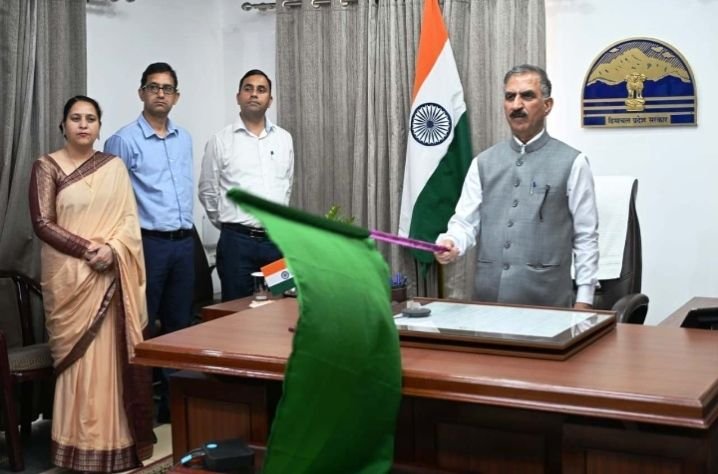
Mandi: Himachal Pradesh has taken another significant step towards expanding clean and sustainable public transport, with Chief Minister Thakur Sukhvinder Singh Sukhu virtually flagging off 25 new Type-I electric bus services of the Himachal Road Transport Corporation (HRTC) for Mandi district.
The services were launched from Paddal Ground in Mandi town, marking another phase in the state government’s broader plan to modernise the HRTC fleet, reduce dependence on fossil fuels and move towards a greener public transport system.
Chief Minister Sukhu said the state government has already procured 297 Type-I electric buses for HRTC. These buses are currently operating in Shimla, Nahan, Nalagarh, Una, Haroli, Bilaspur, Dehra, Hamirpur, Palampur, Dharamshala and Nagrota.
With charging infrastructure now developed in Kullu, Mandi and Sundernagar, new electric bus operations are also commencing in these areas.
The Chief Minister highlighted the performance of the electric buses, saying a Type-I bus has a prescribed driving range of around 180 kilometres at 80 per cent State of Charge. More significantly, he pointed out that an electric bus operating on the Shimla-Chandigarh route has successfully covered around 270 kilometres on a single charge.
The performance, he said, demonstrates that electric buses can be effectively deployed even on longer inter-city routes involving Himachal Pradesh’s demanding mountainous terrain.
Major savings in HRTC’s operating costs
Apart from environmental benefits, the electric bus programme is also expected to ease the financial burden on HRTC.
According to the Chief Minister, electric buses are generating savings of around Rs. 12–13 per kilometre in energy costs compared with conventional diesel buses. With the expansion of the electric fleet, these savings could help reduce the Corporation’s fuel expenditure and improve the overall efficiency of its operations.
The government sees electric mobility as more than an environmental initiative. It is being positioned as an important component of the long-term restructuring of HRTC, which remains one of the state’s most important public transport institutions.
Sukhu said the state government currently provides buses to HRTC and extends annual grant-in-aid of Rs. 840 crore to the Corporation. HRTC, he added, generates a similar amount of revenue through its own resources.
The Chief Minister said the government has set an ambitious target of making HRTC self-reliant within the next five years.
As part of the longer-term transition, the state plans to procure another 1,000 electric buses and 200 hydrogen-powered buses in the coming years. The proposed expansion is intended to gradually create a modern, energy-efficient and environmentally sustainable public transport network across Himachal Pradesh.
Sukhu also linked the initiative to the government’s broader vision of a “Green Himachal”, which was outlined in the state’s first budget of the present government.
He said the expansion of electric bus services would help reduce carbon emissions, lower dependence on conventional fuels and establish cleaner public transportation while ensuring reliable mobility for people across the state.
The development of charging infrastructure in key locations is expected to remain crucial to this transition, particularly given Himachal’s difficult terrain, long-distance routes and varying climatic conditions.
Additional Chief Secretary Omkar Chand Sharma and HRTC Managing Director Shivam Pratap Singh were present at Shimla during the virtual launch.
At Mandi, HRTC Vice Chairman Ajay Verma, APMC Chairman Sanjeev Guleria, Vice Chairman of the Jal Prabandhan Board Shashi Sharma and District Congress Committee Mandi President Champa Thakur, along with other dignitaries, participated virtually.
The launch of the 25 services adds another chapter to Himachal Pradesh’s transition towards electric public transport and reflects the government’s effort to combine environmental priorities with the financial and operational restructuring of HRTC.