
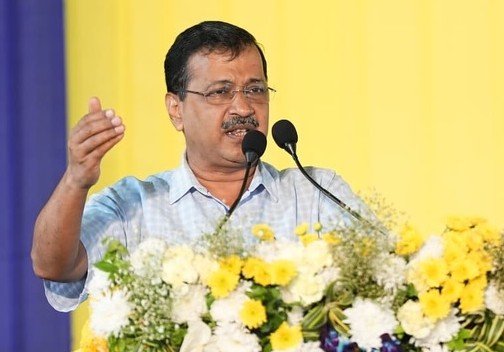
In a clear indication that the electoral contest in Punjab has entered a decisive phase, Arvind Kejriwal has issued a strong political directive to party legislators, urging them to accelerate their grassroots engagement as the state moves toward assembly elections expected within the next ten months. The message, delivered during a high-level meeting with party MLAs, reflected both confidence and urgency—highlighting governance achievements while underlining the narrowing political window ahead.
The meeting, held at Kapurthala House, carried a distinctly strategic tone. Kejriwal reminded lawmakers that the government had completed nearly four years in office and was now entering its final stretch before returning to the electorate. Traditionally, this phase in electoral cycles is associated with anti-incumbency sentiment. However, Kejriwal presented a counter-narrative, asserting that the state was experiencing “pro-incumbency,” with public sentiment, according to him, leaning in favour of the ruling party.
He pointed to internal assessments and feedback mechanisms to argue that the government’s development agenda had resonated with voters. Particular emphasis was placed on infrastructure expansion, especially large-scale road development projects. Kejriwal described these initiatives as transformative, claiming that investments worth tens of thousands of crores were reshaping connectivity and boosting economic prospects across the state. This, he suggested, would form a central pillar of the party’s campaign narrative.
Yet beneath the optimism, the address carried a calibrated warning. Kejriwal made it clear that the remaining months would be politically decisive and that complacency could prove costly. He urged MLAs to maintain constant engagement with constituents, stressing the importance of visibility, responsiveness, and local presence. In contemporary electoral politics, such sustained grassroots interaction is often critical in countering opposition narratives and reinforcing voter trust.
The timing of this intervention is particularly significant. The party has recently witnessed internal churn, with some prominent figures exiting the organisation. In this context, Kejriwal’s emphasis on pro-incumbency appears aimed not only at shaping public perception but also at stabilising internal morale. By projecting confidence, the leadership is seeking to unify its cadre and maintain momentum ahead of a high-stakes electoral contest.
Kejriwal also widened the political discourse by linking Punjab’s electoral trajectory to broader national developments. Launching a pointed critique of the Bharatiya Janata Party, he raised concerns about electoral processes in other states, suggesting that democratic institutions were under pressure. These remarks align with the opposition’s wider narrative at the national level and indicate an attempt to position the Punjab election within a larger political framework.
In a striking assertion, he went further to suggest that political developments in Punjab could influence the stability of the central government after the elections. While such claims are often part of electoral rhetoric, they underscore the party’s effort to elevate the contest beyond a state-level battle and frame it as part of a broader national political shift.
At the same time, Kejriwal invoked past electoral successes to energise party workers, referencing how voters in Delhi had previously halted the expansion of rival political forces. By drawing these parallels, he sought to reinforce the idea that disciplined grassroots mobilisation could once again deliver decisive results.
His remarks also included a sharp critique of the BJP’s approach toward Punjab, alleging political hostility toward the state and its people. This line of argument reflects a strategy aimed at consolidating regional sentiment—an approach frequently deployed in state elections to counter national narratives.
Overall, the meeting highlighted a dual-track strategy: projecting governance achievements while preparing the organisation for an intense electoral contest. Infrastructure development, particularly in road connectivity, remains central to the party’s messaging. At the same time, the repeated emphasis on time constraints signals a push for heightened political activity at every level of the organisation.
As Punjab moves closer to elections, the coming months are likely to witness a sharp escalation in campaign activity across parties. For the Aam Aadmi Party, the challenge will be to translate its governance claims into electoral gains while maintaining organisational cohesion. Kejriwal’s latest intervention makes one thing clear—the party has shifted firmly into election mode, with little room for error as the contest approaches its most critical phase.