

Saptrishi Soni
Chandigarh: As Congress attempts to rebuild itself ahead of the crucial 2027 Punjab Assembly elections, the party finds itself navigating one of its most significant internal challenges in recent years. What initially appeared to be a disagreement over organisational appointments has now evolved into a larger test of leadership, discipline and political messaging.
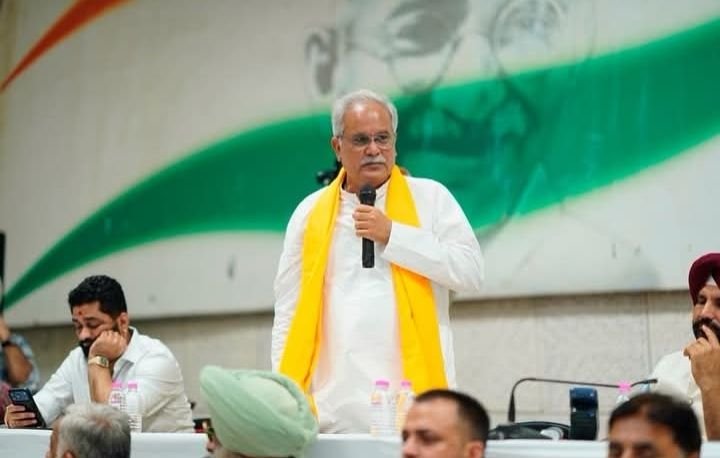
Friday marks the final day of Congress general secretary in charge of Punjab Bhupesh Baghel’s five-day organisational exercise in the state, a visit aimed at calming internal differences and preparing the party for the electoral battle ahead. While the meetings have largely focused on consensus-building, they have also underscored a reality familiar to most political observers: electoral revival is impossible without organisational cohesion.
The latest phase of the dispute began after the Congress high command announced its revamped organisational structure for Punjab while retaining Amarinder Singh Raja Warring as Punjab Congress president and Pratap Singh Bajwa as Leader of the Opposition. Although the appointments were presented as an attempt to provide continuity before the elections, sections of the party expressed dissatisfaction, with former Chief Minister Charanjit Singh Channi emerging as the most prominent face of the discontent.
Rather than responding through public confrontation, Channi held a series of meetings with supporters, former legislators and senior party functionaries. Those consultations fuelled speculation that a parallel pressure group was taking shape within the Punjab Congress at a politically sensitive time.
However, developments over the past few days suggest that the Congress high command has sought to establish a clear chain of command. According to party sources, Channi was advised to engage directly with Punjab in-charge Bhupesh Baghel rather than escalating the matter to the national leadership. Whether viewed as an administrative decision or a political signal, the message appeared unambiguous: internal disagreements should be addressed within the organisational framework, not through competing centres of influence.
That approach is consistent with Rahul Gandhi’s recent emphasis on strengthening organisational discipline while encouraging consultation within defined institutional channels. Over the past few years, Gandhi has increasingly projected the need for accountability, internal restructuring and grassroots engagement as the foundation of the Congress’s revival strategy.
Political analysts believe the Punjab episode is becoming an important test of that approach. If the leadership were to revisit every organisational decision following internal resistance, it could weaken the authority of future appointments. Conversely, by standing behind decisions already announced while simultaneously encouraging dialogue, the leadership seeks to balance discipline with inclusiveness.
One figure who has attracted attention during the episode is Punjab Congress president Raja Warring. Throughout the disagreement, Warring has refrained from escalating the confrontation publicly. Instead, he has repeatedly stressed party unity and even remarked that he would be willing to make personal efforts to reconcile differences if required.
Within Congress circles, that posture has been interpreted by some as political maturity rather than weakness. Loyalty to the organisation, particularly during periods of internal strain, often carries long-term political value in parties where leadership places emphasis on discipline and collective functioning.
For Channi, however, the coming days may prove equally significant. As a former Chief Minister with considerable influence among sections of Punjab’s electorate, he remains an important political asset for the Congress. Yet influence within a political party is often measured not only by public support but also by the ability to work within the party’s collective leadership structure.
The challenge before Channi is therefore not simply political but strategic. If differences are resolved through dialogue, his experience could continue to strengthen the Congress campaign. If disagreements persist in the public domain, they risk diverting attention from the party’s broader objective of challenging the ruling Aam Aadmi Party in 2027.
The Congress leadership also faces a wider electoral calculation. Punjab remains one of the few major states where the party believes it has a realistic opportunity to return to power. Internal uncertainty at this stage could weaken that momentum, particularly when both the Aam Aadmi Party and the Bharatiya Janata Party are expected to intensify their campaigns over the coming months.
Whether the current exercise ultimately becomes a story of reconciliation or prolonged factionalism will depend largely on the outcome of the discussions taking place in Chandigarh. The emphasis so far has been on dialogue rather than confrontation, suggesting that the leadership is keen to prevent organisational disagreements from overshadowing electoral preparation.
Ultimately, parties preparing for elections face two simultaneous tasks: projecting unity before the electorate while accommodating differing voices within the organisation. Punjab Congress is now attempting to strike that balance.
The next few weeks are likely to reveal whether the party has succeeded in converting an internal challenge into an opportunity for organisational consolidation—or whether unresolved differences continue to cast a shadow over its preparations for the 2027 Assembly elections.
At this stage, one conclusion appears clear: the Congress leadership has indicated that organisational decisions, once taken, are not easily revisited. The focus now shifts from debates over appointments to the larger electoral challenge ahead. How effectively Punjab Congress rallies behind that objective may well determine its political trajectory over the next two years.