
Haryana Chief Minister Nayab Singh Saini’s investment outreach in Mumbai has put the state’s industrial ambitions firmly in the spotlight, with investors and corporate leaders responding positively to the government’s emphasis on policy stability, faster approvals, industrial infrastructure and a plug-and-play approach to setting up businesses.
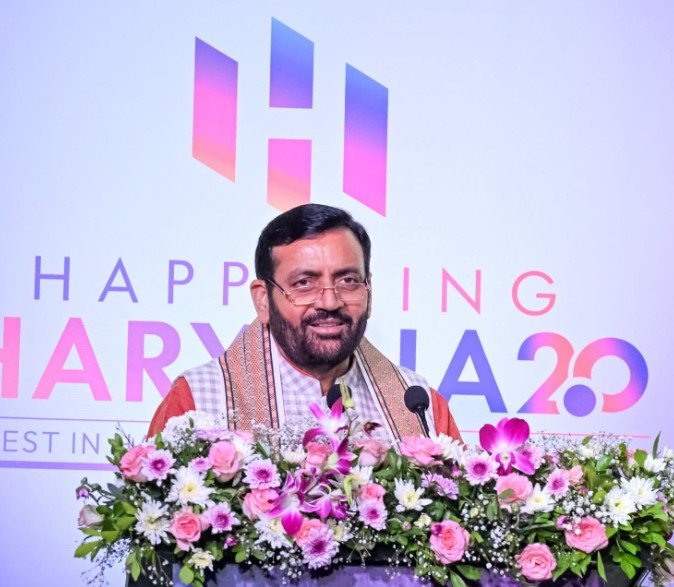
The latest round of the ‘Happening Haryana 2.0’ Global Capital Campaign brought the Haryana government face to face with some of India’s leading investment firms and corporate representatives. At a round-table conference in Mumbai on August 24, Saini sought to present Haryana not simply as a state offering land and incentives, but as a long-term business partner capable of providing scale, connectivity, skilled manpower and responsive government support.
The outreach assumes greater significance with investment agreements worth more than ₹66,000 crore being signed in Mumbai during the campaign. The development gives the state’s investor-pitch an immediate financial dimension, although the larger test for Haryana will be converting these commitments into projects on the ground, jobs and sustained industrial activity. Recent reporting on the Mumbai campaign also noted that the state is offering investors five broad assurances centred on policy stability, time-bound approvals, project facilitation, industry-aligned skills and connectivity, and stronger links between investment and local employment.
Saini used the interaction to underline a change in the government’s approach to investment facilitation. The message was that industrial projects should move through the system rather than remain held up in files. The Chief Minister told investors that suggestions emerging from the meeting would be translated into a time-bound action plan, with departments assigned responsibility for implementation wherever necessary.
For investors, that distinction can be critical. Haryana already enjoys proximity to the National Capital Region, strong road and logistics connectivity and established industrial centres such as Gurugram, Manesar and Faridabad. The government is now attempting to build on those advantages by reducing the friction between investment decisions and actual project execution.
The state’s pitch is also becoming more sector-specific. During the Mumbai discussions, manufacturing, technology, logistics, Global Capability Centres and expansion by existing companies emerged as areas where Haryana wants to attract fresh capital. Defence manufacturing, however, stood out as one of the most closely watched opportunities.
Saini said the government was considering a dedicated defence-sector policy, following what he described as significant interest and suggestions from investors. The proposed policy is expected to provide a more structured framework for defence manufacturing and allied industries, while Haryana is also examining the possibility of developing cluster-based industrial activity in strategic locations.
Hisar is emerging as one potential node in that strategy. A manufacturing cluster is being developed around Maharaja Agrasen Airport, and the government is exploring the possibility of establishing a defence cluster in the area. The state has also begun work related to land for 10 new Industrial Model Townships announced in the previous Budget, widening the potential industrial geography beyond Haryana’s traditional manufacturing belts.
The emphasis on skilled manpower reflects another part of the government’s investment strategy. For companies deciding where to establish manufacturing units, technology operations or service centres, access to trained workers can be as important as land and infrastructure. Haryana is therefore seeking to deepen links between industrial requirements and its ITIs and polytechnic institutions, with industry partnerships and training programmes designed to produce workers with skills relevant to actual market demand.
That approach also gives the investment campaign a broader social dimension. The government is attempting to link industrial expansion with employment for local youth, rather than treating investment merely as a measure of capital inflow. This emphasis is consistent with the five guarantees outlined by Saini during the Mumbai campaign, which include connecting investments with employment, MSMEs, innovation and regional development.
Investors participating in the round-table included senior representatives from major investment and financial firms such as EQT, Warburg Pincus, Premji Invest, Davidson Kempner Investment Advisers India, Samara Capital, IvyCap Ventures and other institutions. Their response, according to the state government, reflected appreciation for Haryana’s industrial policies, ease-of-doing-business measures, investment incentives and plug-and-play infrastructure.
The significance of Mumbai is not accidental. As India’s principal financial and corporate centre, the city provides Haryana with access to institutional investors, private equity firms, corporate leadership and businesses looking for their next expansion destination. The state’s three-day Mumbai outreach, running from August 23 to 25, is part of a wider campaign ahead of the proposed Happening Haryana Global Investors Summit in 2027. A Bengaluru outreach is also scheduled as part of the broader investor engagement programme.
For Saini’s government, however, the real measure of success will extend beyond the headline investment figure. Haryana has increasingly positioned itself as an industrial and services economy, but attracting capital is only the first stage. Land availability, regulatory execution, timely clearances, infrastructure, workforce readiness and the ability to keep investors engaged after the signing ceremony will determine whether the current momentum translates into durable economic gains.
The government appears conscious of that challenge. Its repeated emphasis on time-bound approvals, project facilitation and direct engagement with investors suggests an attempt to move from conventional investment promotion towards a more hands-on model of industrial governance.
The campaign also fits into Haryana’s larger economic vision. The state has been presenting itself as an important contributor to India’s growth story, with ambitions to expand its industrial base while developing newer sectors such as electronics, clean energy, electric mobility, advanced manufacturing, agritech and technology services.
The invitation to investors for the Global Investor Summit in Haryana in April 2027 therefore carries a wider message: the state wants the Mumbai campaign to be the beginning of a longer investment relationship, rather than a one-off roadshow.
The challenge now is execution. If the investment commitments announced in Mumbai evolve into factories, technology centres, logistics hubs, defence units and new employment opportunities, the campaign could strengthen Haryana’s claim to being one of India’s most competitive investment destinations. If implementation slows, however, the ₹66,000-crore headline will remain only a measure of intent.
For the Nayab Singh Saini government, the Mumbai outreach has created momentum. The next phase will be about converting that momentum into visible economic activity across Haryana.