

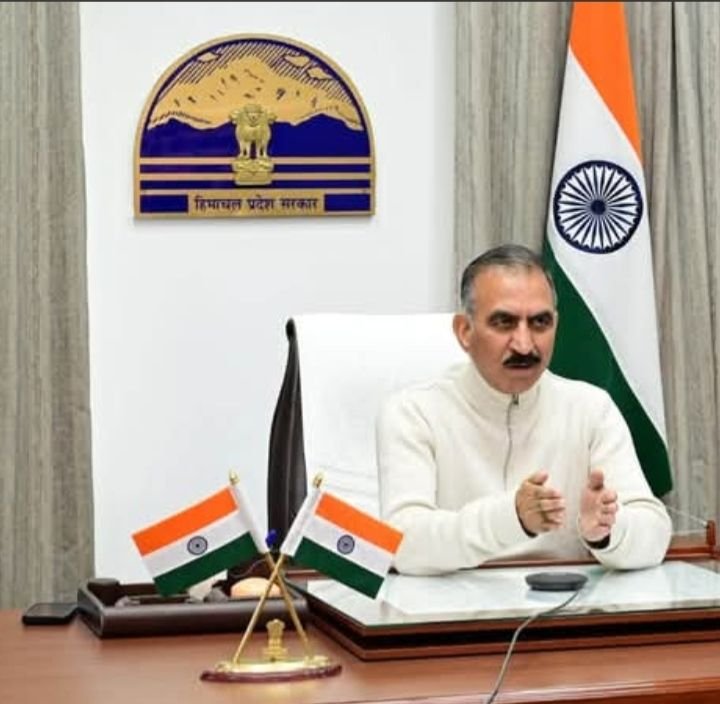
Chief Minister Thakur Sukhvinder Singh Sukhu has warned drug traffickers in Himachal Pradesh that the government will pursue not only those involved in the illegal trade but also the wealth and property accumulated through narcotics trafficking.
Reacting to recent action by the Nurpur Police, Sukhu said properties and other assets acquired from drug money could no longer be treated as legitimate wealth. He argued that such money ultimately came at the expense of ordinary families, particularly those whose children had fallen victim to drug addiction.
“Those who built luxurious houses, purchased hotels and shops or acquired expensive vehicles by selling drugs must understand that this money belongs to the hard-working people and the families affected by addiction,” the Chief Minister said.
Sukhu praised the Nurpur Police for seizing assets estimated at around Rs 3.27 crore in its latest action against suspected drug traffickers. The seized assets include a residential property, land, a hotel, shops, vehicles and bank accounts.
The Chief Minister said the action reflected a broader change in the government’s approach to tackling the drug problem. According to him, merely arresting drug traffickers would not be sufficient unless the financial foundations of their operations were also dismantled.
“Our objective is to completely dismantle the entire drug network, including its financial infrastructure and the illegally acquired assets generated through the drug trade,” Sukhu said.
He added that police and other law-enforcement agencies had been given full freedom to take stringent action against those involved in narcotics trafficking, while assuring them of government support.
The scale of property seizures in Nurpur Police District indicates the extent to which the authorities are attempting to follow the money associated with the drug trade. The government said assets worth more than Rs 29.95 crore had so far been seized in 17 cases in the district.
For the Sukhu government, the seizure of properties is also intended to send a message that profits from the drug trade will not be allowed to become a source of long-term wealth. The Chief Minister said the campaign was aimed at disrupting the wider ecosystem around narcotics, including the networks and financial resources that enable the trade to continue.
“Himachal Pradesh is a Devbhoomi and no attempt to engulf the state in drug abuse and trafficking will be allowed to succeed,” Sukhu said, stressing that the government would continue action against individuals involved in the trade as well as the wider networks supporting them.
The government has also emphasised the use of the Prevention of Illicit Traffic in Narcotic Drugs and Psychotropic Substances Act, or PIT-NDPS Act, against habitual offenders. Sukhu said strict implementation of the law had been pursued since the Congress government came to power, with the objective of keeping repeat offenders behind bars.
The Chief Minister said the administration was also attempting to identify the drug network at the grassroots level. According to him, drug-related networks have been mapped down to the panchayat level, allowing law-enforcement agencies to focus not only on individual sellers but also on the broader chains through which narcotics are supplied and distributed.
The government’s strategy therefore combines criminal investigation with financial action. Property seizures, scrutiny of bank accounts and action against assets allegedly acquired through drug trafficking are being positioned as key elements of the campaign.
Sukhu also appealed to residents to share information about drug trafficking with the police. He said cooperation from local communities would be essential if the state was to break the supply networks and prevent the spread of addiction.
The latest action in Nurpur comes against the backdrop of growing concern over narcotics, particularly among young people in parts of Himachal Pradesh. The government has increasingly presented the issue not simply as a law-and-order problem but as a wider social challenge affecting families, livelihoods and the future of the state’s youth.
Sukhu reiterated that the campaign would continue with what he described as a firm and sustained approach. The message from the government is that its focus will extend beyond arrests to the assets, finances and networks that sustain the illegal drug economy.
For the authorities, the challenge now is to ensure that seizures and arrests translate into a sustained disruption of the drug supply chain. For communities affected by addiction, the effectiveness of the campaign will ultimately be measured not only by the value of property seized, but by whether the availability of drugs and their impact on young people can be reduced.