

Saptrishi Soni
The latest phase of the US-Iran confrontation is no longer being viewed simply as another Middle East conflict. For many strategic observers, it has evolved into a test of political endurance, military credibility and diplomatic influence, raising broader questions about America’s global leadership and the changing balance of power in an increasingly multipolar world.
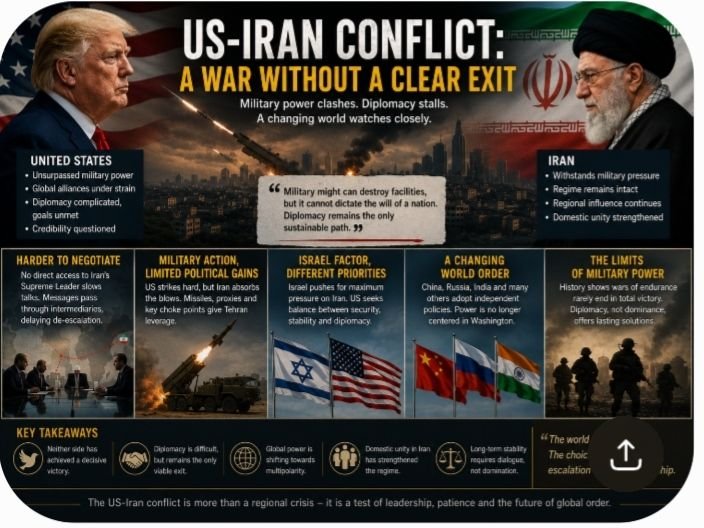
While Washington continues to retain overwhelming military superiority in terms of technology, global force projection and alliance networks, recent developments have demonstrated that military dominance alone does not necessarily translate into political success. Iran’s ability to withstand sustained military pressure, preserve the continuity of its leadership structure and continue influencing regional events has complicated American strategic objectives.
A conflict that has become harder to negotiate
One of the biggest diplomatic challenges confronting Washington has been the complexity of communicating with Iran’s supreme leadership. International reports suggest that indirect negotiations have often been slowed because messages must pass through multiple intermediaries before reaching Iran’s highest decision-making authority. This has made diplomatic engagement unusually cumbersome, delaying responses and limiting opportunities for rapid de-escalation.
Unlike conventional negotiations where political leaders can engage directly, the US-Iran channel has depended heavily on intermediaries, making every breakthrough vulnerable to delay and mistrust.
Military pressure, but limited political gains
The United States has demonstrated that it possesses unmatched military capabilities capable of striking strategic infrastructure across long distances. However, analysts note that despite these capabilities, Washington has not achieved all of its broader political objectives, including compelling Tehran into rapid concessions or fundamentally altering Iran’s strategic posture. At the same time, Iran has shown that it retains enough military and regional leverage to impose costs on its adversaries through missile attacks, proxy networks and its influence over critical maritime routes such as the Strait of Hormuz.
This has led many international observers to conclude that neither side has secured a decisive victory. Instead, both countries have paid a significant economic, diplomatic and military price.
The Israel factor and differing strategic priorities
The conflict has also highlighted the complex relationship between Washington and Israel. Although the two countries remain close allies, analysts have frequently pointed out that their immediate strategic priorities do not always fully coincide.
Israel has consistently viewed Iran’s military and nuclear capabilities as an existential security challenge requiring sustained pressure. The United States, while sharing concerns over Iran’s regional activities and nuclear programme, has historically balanced military pressure with diplomacy, recognising the wider economic and geopolitical consequences of a prolonged regional war.
Previous American administrations, including those led by George W. Bush and Barack Obama, considered military options against Iran but ultimately relied on sanctions, negotiations and multilateral diplomacy rather than launching a full-scale military confrontation. Those decisions reflected concerns that a direct conflict could destabilise the wider Middle East, disrupt global energy markets and draw the United States into another prolonged regional war.
A changing international landscape
The conflict has unfolded against the backdrop of a rapidly changing international order.
Unlike previous decades, today’s geopolitical environment is increasingly shaped by multiple centres of power. China has expanded its economic and diplomatic influence, Russia continues to play an active strategic role in regional conflicts, while countries such as India have pursued independent foreign policies based on strategic autonomy rather than bloc politics.
These developments do not necessarily diminish American military strength. However, they do indicate that Washington now operates in a more competitive global environment where influence depends not only on military capability but also on diplomacy, economic partnerships and international consensus.
The limits of military power
Many defence analysts argue that the conflict illustrates an enduring lesson of international relations: military superiority cannot by itself guarantee political outcomes.
History has repeatedly shown that conflicts involving resilient regional powers often evolve into prolonged contests of endurance rather than decisive military victories. Iran’s ability to absorb pressure while maintaining state institutions has reinforced this assessment, even as the country continues to face severe economic strain and international sanctions.
Domestic unity inside Iran
Contrary to expectations in some Western policy circles that sustained military pressure might rapidly weaken Iran’s governing system, the conflict has, according to several analysts, strengthened nationalist sentiment within parts of Iranian society. During periods of external military confrontation, governments often benefit from increased domestic cohesion, making external pressure less effective in producing immediate political change.
Nevertheless, independent assessments also note that Iran continues to face significant economic challenges, inflation and international isolation that could shape its long-term stability.
The diplomatic challenge ahead
The immediate challenge for Washington is no longer solely military. It is increasingly diplomatic.
Rebuilding confidence among regional partners, maintaining coordination with allies and identifying a credible pathway towards negotiations remain central to any long-term settlement. At the same time, Tehran faces the equally difficult task of balancing domestic expectations, economic recovery and regional influence while avoiding another cycle of escalation.
Neither side appears positioned for an outright strategic victory, making diplomacy—however difficult—the only sustainable route forward.
A world moving towards multipolarity
The US-Iran confrontation has become more than a regional conflict. It reflects the broader transformation of international politics, where global influence is increasingly shared among multiple powers rather than concentrated in one.
Whether the United States can adapt its leadership to this evolving geopolitical reality may prove just as significant as the outcome of the conflict itself. As recent events suggest, military capability remains a critical component of national power, but in today’s international system, durable influence depends equally on diplomacy, alliances, economic resilience and strategic patience.