

Saptrishi Soni
The Bharatiya Janata Party’s electoral success in West Bengal cannot be reduced to the optics of large rallies or high-decibel speeches. Beneath the visible political theatre lay a deeply structured, multi-layered campaign that redefined how voter engagement can be executed in a complex and politically entrenched state. What unfolded was less a conventional election campaign and more a carefully designed exercise in political engineering—where strategy, messaging, and grassroots mobilization were woven together with precision.
At the heart of this effort was a deliberate shift from centralized campaigning to hyper-local engagement. While mass rallies led by national figures like Prime Minister Narendra Modi and Home Minister Amit Shah provided momentum and visibility, the real battle was being fought at the doorstep of voters. The party’s state unit, guided by seasoned organizational strategists, ensured that the campaign penetrated deeply into local communities, cutting across urban and rural divides.
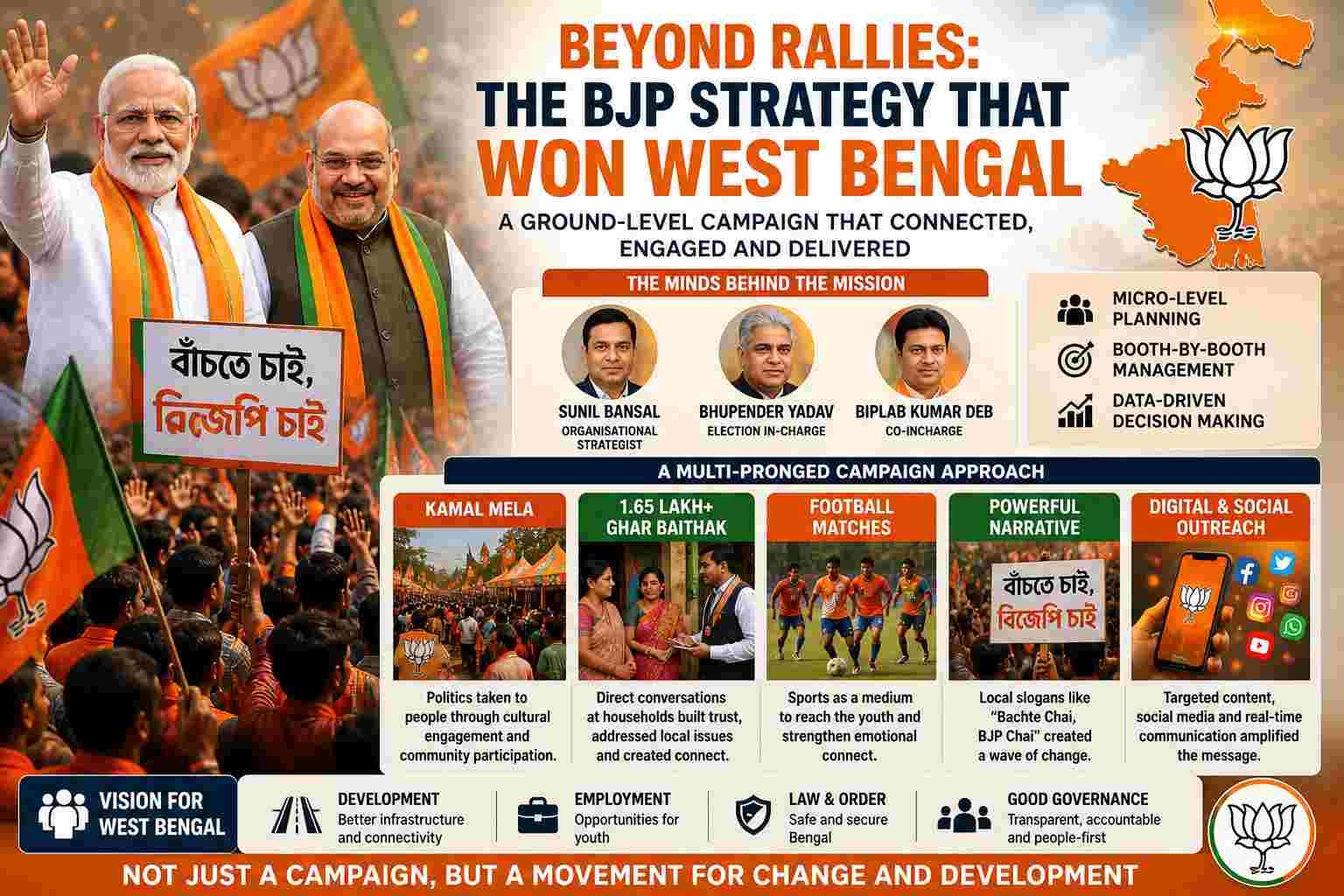
One of the defining features of this campaign was the introduction of innovative outreach formats such as “Kamala Melas.” These were not merely political gatherings but social platforms designed to blend cultural participation with political messaging. By moving politics away from traditional podiums and into community spaces, the BJP succeeded in making voters active participants rather than passive listeners. These events created an environment where conversations about governance, development, and change could unfold organically, allowing the party to connect with people on a more personal level.
Equally significant was the scale of direct voter engagement. With over 165,000 household meetings conducted across the state, the campaign ensured that its message reached individual families rather than broad demographics. This approach allowed party workers to tailor conversations based on local concerns—be it employment, infrastructure, or law and order—thereby making the campaign more relevant and impactful. It also helped build trust, a crucial factor in a state where political loyalties have historically been deeply rooted.
The use of localized slogans further strengthened the campaign’s resonance. Phrases like “Bachate Chai, BJP Chai” were crafted not just as political statements but as emotional appeals, reflecting a perceived need for change among sections of the electorate. Such messaging was carefully calibrated to align with regional sentiments while reinforcing the broader narrative of development and governance that the party sought to project.
Behind this expansive operation was a meticulously coordinated organizational structure. Key strategists played a pivotal role in translating national-level vision into state-specific execution. Their approach emphasized micro-management, where each constituency, booth, and even individual polling station was mapped and monitored. This granular focus ensured that no segment of the electorate was overlooked, and resources were deployed with maximum efficiency.
The involvement of leaders with strong organizational expertise added further depth to the campaign. Their ability to synchronize efforts across multiple layers—from central leadership to local volunteers—created a cohesive machinery capable of responding swiftly to evolving political dynamics. This was particularly important in West Bengal, where electoral contests are often shaped by rapid shifts in narrative and ground realities.
Another critical dimension of the campaign was its narrative construction. Rather than relying solely on criticism of opponents, the BJP sought to position itself as an agent of transformation. The emphasis was on governance, infrastructure development, and economic opportunities, themes that were consistently reinforced through speeches, campaigns, and grassroots interactions. This forward-looking narrative was designed to appeal to aspirational voters, particularly the youth and first-time voters, who are increasingly driven by issues of growth and opportunity.
Digital outreach complemented these efforts, amplifying the campaign’s reach and ensuring message consistency. Social media platforms, targeted content, and real-time communication channels were used to engage with voters, counter opposition narratives, and maintain momentum throughout the election cycle. This integration of digital and physical campaigning created a hybrid model that maximized impact.
The role of national leadership cannot be understated in this context. Prime Minister Narendra Modi’s sustained engagement provided a unifying vision, while Amit Shah’s strategic oversight ensured that organizational strengths were effectively leveraged. Their combined efforts lent credibility and direction to the campaign, reinforcing the party’s commitment to expanding its footprint in the state.
However, what truly distinguished this campaign was its relentless focus on execution. From organizing local events to managing booth-level operations, every aspect was approached with discipline and attention to detail. Volunteers and party workers formed the backbone of this effort, working tirelessly to maintain contact with voters, address concerns, and mobilize support. Their dedication transformed strategy into tangible outcomes on the ground.
In many ways, the BJP’s campaign in West Bengal represents a case study in modern political campaigning. It demonstrates how a combination of innovative outreach, data-driven planning, and grassroots engagement can reshape electoral dynamics, even in regions with strong political traditions. By prioritizing direct communication and localized strategies, the party was able to bridge the gap between leadership and voters, creating a sense of connection that transcended conventional campaign methods.
Ultimately, this was not just an electoral exercise but a demonstration of how political messaging can be engineered to resonate at multiple levels. It underscores the evolving nature of Indian politics, where success increasingly depends on the ability to integrate vision with execution, and narrative with organization. In West Bengal, the BJP’s approach offered a glimpse into this new paradigm—one where elections are won not just on stages, but in the everyday conversations of people across the state.