

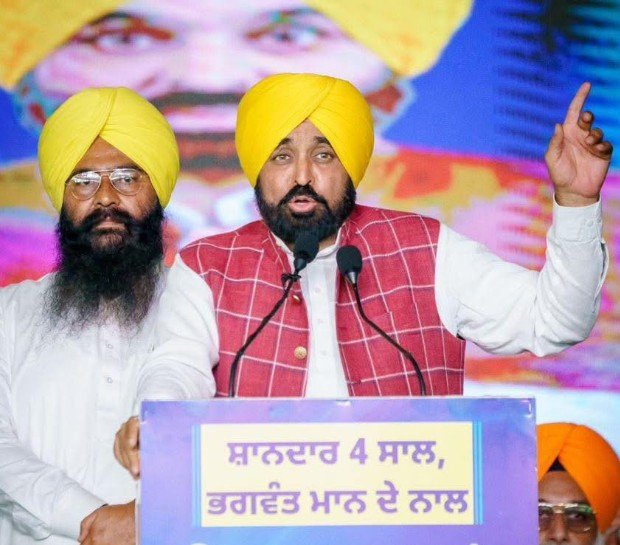
Punjab Chief Minister Bhagwant Mann on Wednesday combined governance outreach with sharp political messaging during a state-level public event in Tanda, Hoshiarpur, where he inaugurated and announced development projects worth approximately ₹150 crore while simultaneously launching a direct attack on the Bharatiya Janata Party (BJP).
Addressing a large gathering, Mann highlighted his government’s focus on strengthening grassroots infrastructure and improving essential services, particularly in rural and semi-urban regions. He said that projects worth over ₹141 crore have been dedicated to the renovation and upgradation of link roads, a move aimed at improving connectivity and boosting local economic activity. Emphasising inclusive development, he also announced the construction of a high-level bridge to facilitate easier access for devotees visiting Gurdwara Rampur Khera Sahib, along with multiple public utility projects including a health and wellness centre and a rural water supply scheme.
The Chief Minister stressed that his administration is committed to ensuring that basic facilities reach every citizen, describing the effort as part of a broader vision to build a progressive and vibrant Punjab. He underlined that infrastructure and healthcare improvements are central to the Aam Aadmi Party’s governance model, which seeks to deliver visible, on-ground results rather than relying on symbolic announcements.
However, the tone of the rally turned overtly political as Mann addressed recent developments involving Ashok Mittal, a senior AAP leader and Rajya Sabha member, whose residence and institutional premises were recently searched by the Enforcement Directorate. Without delving into specifics of the case, Mann alleged that the action reflects the beginning of BJP’s political strategy for the 2027 Punjab Assembly elections.
Framing the issue as part of a larger political pattern, Mann accused the BJP of misusing central investigative agencies to target opposition leaders in states where it lacks electoral strength. He argued that such actions are intended to create pressure and disrupt governance, rather than address genuine concerns of accountability.
In a moment that resonated strongly with the crowd, Mann used a poetic couplet to convey defiance against political pressure, stating:
हम भो पत्ते नहीं जो शाख से टूट कर गिर जाएँगे आंधियो को कह दो अपनी औक़ात में रहें
The lines drew applause from supporters and reinforced the Chief Minister’s attempt to project resilience in the face of what he described as politically motivated actions.
Mann further asserted that the AAP government in Punjab remains focused on public welfare and will not be distracted by what he termed as “intimidation tactics.” He contrasted his administration’s development-driven approach with what he described as opposition parties’ focus on power politics, arguing that the people of Punjab are more concerned with education, healthcare, electricity, and employment than with political confrontations.
The Chief Minister’s remarks also signalled the early contours of the political narrative leading up to the 2027 elections, with AAP positioning itself as both a governance-focused party and a victim of political targeting. By linking development initiatives with allegations of external pressure, Mann sought to consolidate public support while framing the political contest in terms of “people versus power.”
The event in Hoshiarpur thus served a dual purpose—showcasing ongoing development work while setting the stage for a sharper political battle in the coming years. As Punjab’s political landscape begins to shift toward the next electoral cycle, such public engagements are likely to play a key role in shaping voter perception and party positioning.