
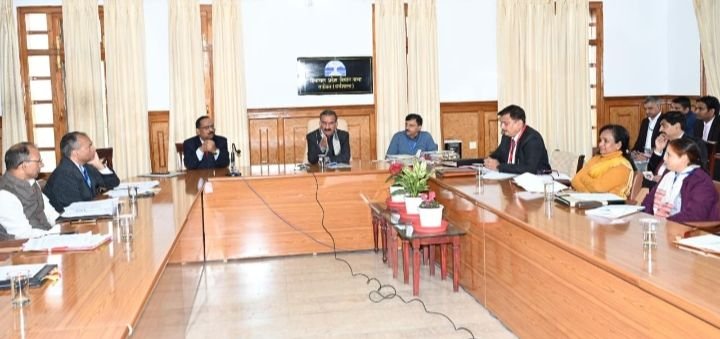
In a strong push to intensify Himachal Pradesh’s fight against narcotics, Chief Minister Thakur Sukhvinder Singh Sukhu on Monday appealed to every section of society to join a mass movement against *chitta* and other drugs. Chairing the sixth State-level meeting of the Narcotics Coordination Centre (NCORD) in Dharamshala, the Chief Minister laid out a comprehensive action plan combining strict enforcement, community participation and institutional accountability.
The meeting saw participation of senior representatives from central agencies including the Narcotics Control Bureau (NCB), Enforcement Directorate (ED), Directorate of Revenue Intelligence (DRI), Postal Department and Railway Protection Force (RPF), alongside senior state government officials.
The Chief Minister said that Himachal Pradesh cannot win the battle against drugs through policing alone; a coordinated social awakening was equally essential. He announced that 234 panchayats identified as highly sensitive to drug activities would now have special deployment of CID and police personnel, along with newly formed Anti-Drug Committees mandated to meet regularly under the NCORD framework.
In a sharp message of zero tolerance, Sukhu directed district administrations to identify properties acquired through drug proceeds and submit detailed reports by December 10. These illegally acquired assets, he said, would be demolished and the people behind them prosecuted. He revealed that 60 government employees—including 15 police personnel—were found involved in chitta trafficking. While five have already been dismissed, legal action against the others is ongoing. The Chief Minister has asked for complete details on all accused government employees by the same December deadline.
To mobilize public support, the government will soon hold Anti-Chitta Walkathons at district and sub-division levels. In addition, Himachal Pradesh is launching a “Chitta Information Reward Scheme”, under which informants will receive rewards ranging from Rs. 10,000 to Rs. 10 lakh for credible information. The Chief Minister assured that all rewards will be processed within 30 days, and information can be provided via the 112 helpline or at local police stations.
Sukhu highlighted that the state government is simultaneously strengthening rehabilitation and counseling systems for affected youth. Drug testing has been made mandatory for all government recruitments, and schools and colleges are being supported to activate Anti-Drug Clubs, Prahari Clubs and peer-led awareness initiatives.
Meanwhile, strict surveillance continues on illicit cannabis cultivation, and pharma manufacturing units are undergoing intensive inspections. The Prosecution Directorate has been tasked with accelerating NDPS appeals, reviewing acquittals and improving conviction rates. Parameters related to drug supply, demand and harm reduction will now be included in officers’ Annual Confidential Reports (ACRs), creating administrative accountability within the anti-narcotics framework.
The Chief Minister shared updated enforcement numbers, noting that in the last three years, the state has registered 5,642 NDPS cases—an increase of 28 percent—resulting in 8,216 arrests and the seizure of nearly 37 kg of chitta. Under the PIT-NDPS Act, 46 major traffickers have been detained and illegal assets worth Rs. 48 crore have been confiscated.
Himachal Pradesh is also the first state to classify panchayats into red, yellow and green categories based on drug vulnerability, identifying 12,000 individuals under this model, which is now being recognized nationally as an emerging best practice.
Recent statewide operations underscore the government’s aggressive stance. During Naka checks on November 17 and 18, over 16,000 vehicles were inspected, leading to multiple NDPS cases and substantial seizures. On November 22, coordinated raids at 121 locations crippled ten major trafficking networks. A subsequent operation on November 25 targeted zones surrounding educational institutions, culminating in inspections across 41 campuses and 598 shops, with 12 cases registered and 385 challans issued.
The meeting was attended by Chief Secretary Sanjay Gupta, Additional Chief Secretary Shyam Bhagat Negi, DGP Ashok Tiwari and senior officials of various departments. Deputy Commissioners and SPs from all districts joined virtually.
As Himachal Pradesh grapples with the growing impact of chitta on its youth, the Chief Minister’s call marks a decisive shift—transforming the anti-drug campaign from a law-enforcement-driven effort into a people-led movement.