

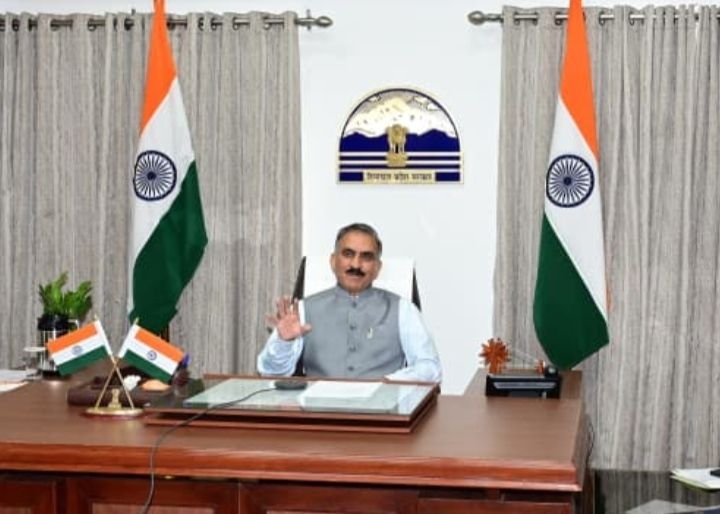
Shimla : Chief Minister Sukhvinder Singh Sukhu is looking to expand the scope of development in Himachal Pradesh by using information technology as an important instrument for improving public services and making government schemes more accessible to people.
The proposed strengthening of the ‘Him Access’ and ‘Him Pariwar’ platforms, including Aadhaar-based authentication for registration and login, is part of this broader approach. In the initial phase, around 72 government services and schemes are proposed to be brought under the upgraded system.
For the Sukhu government, the importance of the initiative goes beyond upgrading government portals. It reflects a wider development opportunity for a state where difficult terrain, scattered settlements and long travelling distances often make access to public institutions challenging for ordinary people.
The objective is to use IT not merely as a technological facility, but as a means of reducing the distance between the government and the people.
Sukhu sees IT as an instrument of development
Himachal Pradesh has traditionally measured development through roads, bridges, schools, hospitals, drinking-water schemes and other physical infrastructure. Those priorities remain critical, but the Chief Minister’s approach opens another important dimension: using IT to improve the way these facilities and government programmes reach citizens.
A well-integrated IT-based service system can reduce paperwork, simplify procedures and allow people to access a wider range of government services without making repeated visits to administrative offices.
For residents of remote areas, this can have a direct economic and social impact. A journey to a district headquarters may involve several hours of travel and significant expenditure. If an application, verification or service can be completed through an effective IT-enabled system, the benefit reaches the household directly.
72 services bring the people-centric approach into focus
The proposed inclusion of around 72 services and schemes in the initial phase gives the initiative considerable public significance.
Aadhaar-based authentication is expected to make identity verification quicker and reduce the need for repeated submission of documents in eligible services. It could also help government departments maintain more accurate beneficiary records and improve the delivery of welfare programmes.
The larger idea is straightforward: people should spend less time dealing with procedures and more time benefiting from the services for which they are eligible.
For Sukhu, this creates an opportunity to make administration more responsive, particularly for farmers, women, students, senior citizens, workers and families living in rural and difficult-to-reach parts of the state.
Rural and remote Himachal could be the biggest beneficiary
The true potential of the initiative lies outside Shimla and other urban centres.
In districts such as Chamba, Kinnaur, Lahaul-Spiti, Sirmaur, Mandi and Kangra, geographical conditions can make access to government offices particularly demanding. An IT-enabled system can help overcome some of these physical barriers.
However, the government will need to ensure that people who are not comfortable with technology are not left behind. Assisted service centres, reliable internet connectivity and support for elderly and vulnerable citizens will remain essential.
The success of the policy will therefore depend not simply on how advanced the system is, but on how easily an ordinary person can use it.
Better targeting of government benefits
The proposed integration could also strengthen the government’s ability to identify genuine beneficiaries and reduce duplication in welfare schemes.
Better coordination of information between departments can help identify inconsistencies and improve the targeting of public expenditure. This could potentially make government welfare programmes more efficient and transparent.
At the same time, strong administrative oversight will remain necessary. Technology can support accountability, but it cannot replace responsible governance, verification and an effective grievance-redressal mechanism.
Privacy and security cannot be overlooked
As more citizen information becomes part of IT-enabled government systems, data protection and cybersecurity will have to remain a priority.
The government will need strong safeguards to ensure that personal information is accessed only for authorised purposes and that the systems remain protected against cyber threats.
For a people-centric IT push to succeed, public confidence will be just as important as technical efficiency.
From physical development to smarter delivery of development
The significance of Sukhu’s approach lies in its potential to broaden the meaning of development in Himachal Pradesh.
Roads and infrastructure connect villages physically. IT-enabled government services can connect citizens with the state administration more efficiently.
That combination could become particularly important for a mountainous state where geography has historically been one of the biggest obstacles to equitable access to public services.
The proposed strengthening of Him Access and Him Pariwar therefore has the potential to become an important component of Sukhu’s wider development agenda—using IT to make government services faster, more accessible and more closely aligned with the needs of the people.
Ultimately, the measure of success will be simple: whether an ordinary Himachali, particularly someone living in a remote village, can obtain a government service with less travel, less paperwork and fewer administrative hurdles.
If that happens, Sukhu’s IT push will not merely represent a change in the way government works. It will represent a new avenue of development—one in which technology becomes a practical tool for improving the everyday lives of the people of Himachal Pradesh.