

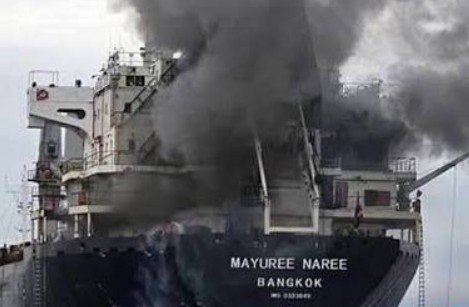
The rapidly escalating confrontation between Iran and the United States has taken a deadly turn in one of the world’s most strategically important maritime corridors, with missile strikes on two United Arab Emirates (UAE) oil tankers in the Strait of Hormuz leaving one Indian crew member dead and eight others injured. The incident has intensified concerns over the safety of commercial shipping in the Gulf and raised fresh fears of wider regional instability.
According to the UAE Ministry of Defence, the attack occurred in the southern shipping lane of the Strait of Hormuz while the vessels were navigating through Omani territorial waters. The two national tankers, identified as Mombasa and Al Bahiyah, were reportedly struck by Iranian cruise missiles, triggering fires aboard both ships. Emergency response teams managed to bring the blaze under control before the vessels were escorted to a secure location for further assessment.
The attack claimed the life of an Indian sailor serving aboard the tanker Mombasa. Eight other crew members sustained injuries, including six Indian nationals and two Ukrainian citizens. Officials said four of the injured remain in critical condition and are receiving medical treatment.
The UAE strongly condemned the strike, describing it as a serious breach of international law and a direct threat to regional peace and the security of international maritime trade. In its official statement, the Ministry of Defence said the country reserves the right to respond to any action that undermines its sovereignty, national security or strategic interests.
The latest incident comes against the backdrop of an increasingly volatile military confrontation between Tehran and Washington. Over recent days, both sides have intensified military operations in and around the Gulf, with the Strait of Hormuz emerging once again as the focal point of the crisis. The narrow waterway carries a significant share of the world’s crude oil and liquefied natural gas exports, making any disruption there a matter of global economic concern.
Shipping companies and maritime security agencies have been monitoring the region closely as attacks on commercial vessels become more frequent. Industry experts warn that continued hostilities could force shipping operators to alter routes, increase insurance premiums and delay cargo movement, potentially affecting global energy markets and international trade.
For India, the tragedy underscores the growing risks faced by its merchant navy personnel, who form one of the largest seafaring workforces in the world. Thousands of Indian sailors serve on international commercial vessels operating through conflict-prone waters, making their safety an increasing concern as geopolitical tensions intensify.
The latest strike also follows earlier attacks on merchant vessels in the Gulf, highlighting the deteriorating security environment in the region. With military exchanges between Iran and the United States showing little sign of easing, analysts fear that commercial shipping could remain vulnerable to further attacks unless diplomatic efforts succeed in reducing tensions.
The Strait of Hormuz has long been regarded as one of the world’s most sensitive maritime chokepoints. Any disruption to navigation through the narrow passage has immediate implications not only for Gulf nations but also for major energy-importing economies across Asia, Europe and beyond. As international attention turns once again to the region, governments are expected to closely monitor developments while weighing additional measures to safeguard commercial shipping and civilian crews operating in the Gulf.
This is a web-generated news report based on publicly available information and has been independently rewritten for originality, editorial clarity and a premium news presentation.