
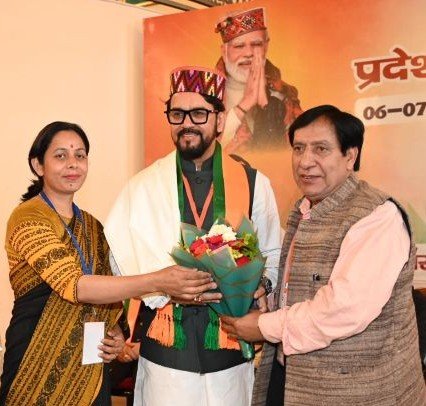
The two-day state executive meeting of the Bharatiya Janata Party in Mandi district concluded with a clear political message: the party is gearing up aggressively for the 2027 Vidhan Sabha elections in Himachal Pradesh. The conclave brought together senior leadership, who collectively projected confidence about returning to power while sharpening their attack on the ruling Congress government.
Among the key voices at the event was senior BJP leader and former Union Minister Anurag Thakur, who framed the political contest within a broader national narrative. He credited Prime Minister Narendra Modi with steering India through what he described as a transformative decade marked by development and enhanced global standing. Thakur emphasized that governance under the current central leadership has strengthened India’s international image while focusing on national interest, contrasting it with what he alleged was a weaker global posture during previous Congress-led governments.
The meeting, however, remained firmly anchored in state politics, with BJP leaders outlining a comprehensive roadmap to challenge the Congress government led by Chief Minister Sukhvinder Singh Sukhu. Party leaders repeatedly asserted that public dissatisfaction with the current administration is growing and could translate into electoral gains for the BJP.
BJP national vice-president Saudan Singh stressed the importance of organisational strength, stating that the party is focused on rebuilding a “double engine government” in the state. He highlighted a strategy centered on grassroots mobilisation, aiming to strengthen the party’s presence from the पंचायत level up to the विधानसभा, ensuring a coordinated electoral push across all tiers.
Reinforcing the party’s confidence, national general secretary Tarun Chugh declared that the political “countdown” for the Congress government has begun, predicting a decisive shift in power within the next electoral cycle. He criticised the ruling party for failing to deliver on its promises, arguing that governance over the past three-and-a-half years has not met public expectations.
Echoing similar sentiments, BJP state in-charge Shrikant Sharma suggested that the ruling leadership itself lacks confidence about returning to power. He set an ambitious organisational goal, aiming for a sweeping electoral performance across thousands of polling booths, indicating the party’s intent to fight the election at a micro-management level.
Campaign strategy also emerged as a central theme during the conclave. BJP co-incharge Sanjay Tandon highlighted the growing importance of digital platforms in shaping voter perception. He outlined plans for an aggressive social media campaign across platforms such as Facebook, Instagram, and X, aimed at countering the Congress narrative and amplifying the BJP’s messaging on governance and accountability.
Former Chief Minister Jairam Thakur delivered a pointed critique of the state government’s policies, alleging financial mismanagement, rising debt, and administrative inefficiencies. He argued that the promise of systemic reform has instead resulted in increased fiscal pressure and weakened welfare delivery.
The absence of Mandi MP Kangana Ranaut from the meeting was noted, though it did not overshadow the broader political messaging of the event. The conclave remained focused on consolidating party unity and preparing a structured campaign for the upcoming electoral contest.
Overall, the Mandi meeting underscored the BJP’s dual strategy—leveraging national leadership narratives while intensifying state-specific criticism of the Congress government. With the 2027 elections still some distance away, the party appears to be laying the groundwork early, combining organisational strengthening, digital outreach, and targeted political messaging.
As Himachal Pradesh gradually moves towards the next electoral cycle, the outcomes of such strategic gatherings are likely to play a crucial role in shaping the political landscape. The BJP’s assertive posture at Mandi signals that the contest for power is already taking shape, with leaders like Anurag Thakur positioning the party as both a national and regional alternative to the current regime.