

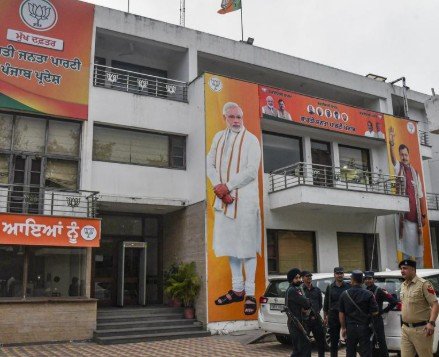
The investigation into the grenade attack on the Punjab unit office of Bharatiya Janata Party in Chandigarh has entered a more critical phase, with police intensifying efforts to reconstruct the conspiracy, trace movement patterns of the accused, and examine possible wider links behind the attack.
In a significant development, nine accused were produced before a district court, where custodial interrogation of three key suspects—identified as Amanpreet, Gurtej and Hajan Deep—was extended for two days, while six others were remanded to judicial custody. Investigators are expected to use the extended custody to deepen questioning, reconstruct the crime scene, and verify the sequence of events before, during and after the attack.
The case has drawn heightened attention because of disclosures suggesting the attack may have been executed under instructions from handlers linked to Babbar Khalsa International, while broader reporting has also pointed investigators toward foreign-based handlers in Europe and alleged cross-border terror linkages. (Hindustan Times)
According to the investigation so far, police are examining how the accused entered Chandigarh, what route they used, whether reconnaissance was conducted before the strike, and whether other locations may also have been under consideration. Officials are also probing the alleged escape route used after the attack, including the claim that public transport may have been used to facilitate movement after the incident.
A major line of inquiry concerns the digital trail. Investigators are scrutinizing claims that video footage of the attack was recorded and transmitted through social media channels to an overseas handler. If verified through forensic analysis, that aspect could become central to establishing command links, operational planning and the role of foreign-based coordinators.
The attack itself had already raised serious security concerns. The explosion outside the party office in Sector 37 caused damage but did not result in casualties, a factor many security analysts have described as fortunate given the location’s political sensitivity and surrounding civilian presence. Early reports had indicated the involvement of two assailants, and subsequent arrests widened the scope of the case. (www.ndtv.com)
Investigators are now believed to be looking beyond the immediate perpetrators and focusing on the architecture of the alleged module: logistics, financing, communications, procurement of explosives, and possible support networks. The mention of possible foreign handlers has added a national security dimension to what initially appeared to be a targeted attack on a political office.
Security experts say the extension of police remand often signals that investigators believe further actionable intelligence can still be obtained, particularly in cases involving organized conspiracies or suspected terror networks. Crime scene recreation, if undertaken, could help verify statements made during interrogation and test whether the accused accounts align with forensic and surveillance evidence.
The case also carries broader implications for security preparedness in politically sensitive urban centers. Questions are likely to persist over surveillance gaps, response mechanisms, and whether this attack was intended as a standalone act or part of a wider strategy to create disruption.
For now, the investigation remains active and evolving. With custodial questioning continuing and multiple leads under examination, authorities appear focused not only on prosecuting those arrested, but on determining whether the Chandigarh grenade attack was the visible tip of a deeper and more coordinated operation.