

Mandi
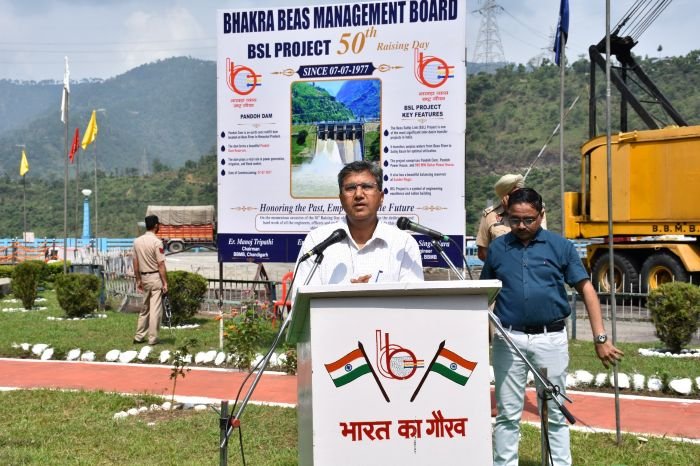
The Bhakra Beas Management Board (BBMB) marked the 50th Foundation Day of the Beas–Sutlej Link (BSL) Project with a commemorative ceremony at the Pandoh Dam in Himachal Pradesh, celebrating five decades of one of northern India’s most significant river-linking and hydropower initiatives while outlining a renewed focus on technological modernisation, environmental sustainability and long-term water management.
The event brought together BBMB Chairman Er. Manoj Tripathi, Member (Irrigation), senior officials and project personnel, who paid homage to the engineers, workers and staff who lost their lives during the construction of the landmark project. Floral tributes were offered at the Martyrs’ Memorial, followed by a traditional havan and prayers at the dam site, recognising the sacrifices that helped shape one of India’s major multipurpose river valley projects.
Addressing the gathering, Chairman Manoj Tripathi said the changing environmental landscape and increasing operational challenges demand the adoption of modern technology to strengthen the efficiency and resilience of critical water infrastructure. He stressed that upgrading the operation and maintenance systems at Pandoh Dam has become essential to ensure its long-term reliability and performance.
As part of the ongoing modernisation programme, BBMB is introducing advanced Log Boom Barriers and automated Trash Rack Cleaning Machines to improve the management of floating debris carried by rivers during heavy rainfall and flood conditions. These systems are expected to enhance operational safety, reduce maintenance delays and ensure uninterrupted functioning of the dam and associated hydroelectric facilities.
Tripathi also announced that the Dehar Power House, one of the key components of the Beas–Sutlej Link Project, is undergoing modernisation to improve operational efficiency and strengthen power generation capabilities. The upgrade is aimed at ensuring that the ageing infrastructure continues to meet the growing energy requirements of northern India.
Highlighting BBMB’s broader role beyond hydroelectric power generation and water regulation, the Chairman said the organisation remains committed to supporting social development across the region. He noted that the Board continues to contribute to strengthening healthcare, education and other public infrastructure as part of its social responsibility initiatives, benefiting communities associated with the project.
Referring to the Union Government’s proposed plan to divert water from the Chenab River into the Beas basin, Tripathi described the proposal as a strategic initiative with the potential to significantly improve water availability in northern India. He said the project could strengthen irrigation, support industrial growth and enhance water security for millions of people, particularly in states such as Himachal Pradesh, Punjab and Haryana, which depend heavily on the Beas-Sutlej river system.
The Beas–Sutlej Link Project remains a critical component of the region’s integrated water and power infrastructure, facilitating hydroelectric generation while supporting irrigation networks that sustain agriculture across Punjab, Haryana and Rajasthan.
The Foundation Day celebrations concluded with the Chairman planting a sapling at the BBMB Guest House in Pandoh, symbolising the organisation’s commitment to environmental conservation and sustainable development. The gesture underscored the growing emphasis on balancing infrastructure development with ecological responsibility as BBMB enters the next phase of the project’s evolution.