

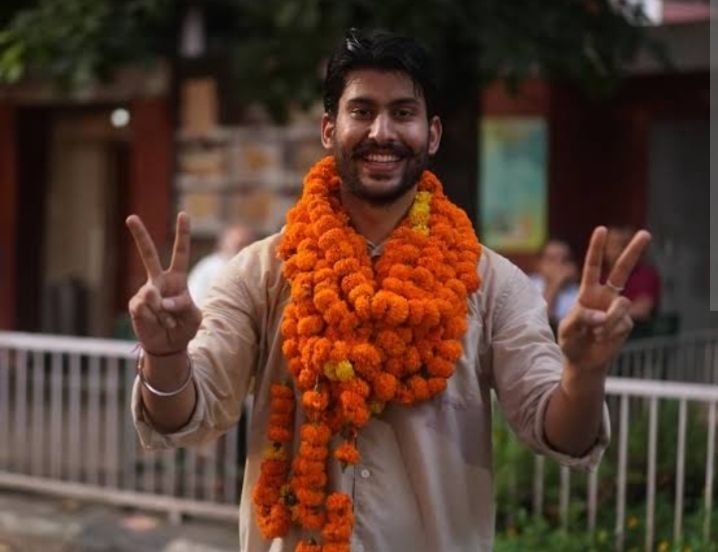
The Akhil Bharatiya Vidyarthi Parishad (ABVP) has retained the president’s post in the Panjab University Campus Students’ Council election, securing the top position for a second consecutive term — an outcome that marks a first in the history of the university’s student politics.
ABVP-backed Ankit Bidhan emerged victorious in a closely watched four-way contest for president, defeating candidates representing three competing student groups. Bidhan secured 3,149 votes, finishing ahead of Aadil Bir Singh of the AAP-backed Association of Students for Alternative Politics (ASAP), who polled 2,637 votes.
NSUI candidate Gurman Singh Sidhu finished third with 2,263 votes, while Darshpreet Singh of Sath received 1,387 votes. A total of 174 students opted for NOTA.
The result gives ABVP an important foothold in Panjab University’s student politics at a time when campus elections remain a significant platform for young people to debate issues ranging from education and employment to student welfare, fee structures and campus representation.
A four-way contest for the top student post
The presidential election attracted candidates from four prominent student organisations, making it one of the more competitive contests on campus.
Ankit Bidhan represented ABVP, which is backed by the BJP. Gurman Singh Sidhu contested on the ticket of the National Students’ Union of India (NSUI), the student wing of the Congress party. Aadil Bir Singh represented ASAP, which had the backing of the Aam Aadmi Party, while Darshpreet Singh contested from Sath.
The four-way contest meant that no single organisation could take the outcome for granted. The final numbers showed a clear lead for Bidhan, but the sizeable vote shares secured by the other three candidates demonstrated the diversity of political preferences among students.
Bidhan’s margin over Aadil Bir Singh was 512 votes, giving the ABVP candidate a relatively comfortable victory in the final count.
For students, however, the election was about more than the contest between political organisations. Campus elections traditionally provide students with an opportunity to raise concerns that directly affect their academic and everyday lives.
Issues such as hostel facilities, scholarships, examination schedules, fee-related concerns, transportation, library access, placements, campus infrastructure and opportunities for extracurricular activities frequently form the backdrop to student politics.
The new council will therefore face expectations to move beyond election campaigning and address practical problems on campus.
Voting takes place under tight security
Polling began at 9.30am amid a heavy deployment of police personnel. Voting continued until 11.30am, after which the counting process began at noon.
The security arrangements reflected the importance attached to student elections at Panjab University, where campus politics has historically attracted significant attention.
With multiple organisations competing for key posts, maintaining a peaceful voting environment was an important part of the process. The relatively short polling window also meant that students had to organise their participation within a limited period.
The election included contests for the posts of president, vice-president, secretary and joint secretary, along with elections for department representatives.
A total of 16 candidates contested the election, including the four candidates competing for the presidency.
While the presidential race naturally attracted the greatest attention, the other positions are also important because members of the students’ council are expected to represent different sections of the university community.
Department representatives, in particular, provide a direct channel through which academic and departmental concerns can reach the elected student body.
ABVP’s consecutive victory changes the campus political equation
ABVP’s second successive win for the president’s post is significant because of the organisation’s growing presence in Panjab University student politics.
Winning once can reflect a successful campaign, candidate appeal or the political mood of a particular year. Repeating that victory suggests that the organisation has established a stronger electoral base among sections of the student population.
However, the result should not automatically be interpreted as a reflection of wider political preferences outside the university.
Student elections have their own dynamics. Personal relationships, campus issues, candidate credibility, organisational networks and local student concerns can all influence voting behaviour.
For the winning candidate, the challenge now is to translate electoral support into effective representation.
Students who voted for Bidhan will expect him to articulate their concerns before the university administration and other authorities. Those who voted for rival candidates will also expect the elected council to represent them fairly.
What students will expect from the new council
The post-election period often brings a shift from political campaigning to governance.
The new students’ council will face questions about how effectively it can engage with the university administration on issues affecting students.
Employment and career opportunities are likely to remain particularly important. For many students, the university experience is increasingly judged not only by academic standards but also by access to internships, placements, skill development and opportunities beyond graduation.
Campus infrastructure is another area where student representatives can play a significant role. Hostels, classrooms, laboratories, libraries, sports facilities, internet connectivity and transportation can directly influence students’ academic experience.
There is also a growing expectation that student politics should remain inclusive and issue-driven.
The participation of candidates backed by organisations with different political affiliations — from ABVP and NSUI to AAP-backed ASAP and Sath — reflects the diversity of political ideas present on campus.
That diversity can be constructive if the elected representatives focus on debate, accountability and student welfare.
A mandate that comes with responsibility
Ankit Bidhan’s 3,149 votes have secured him the presidency, but the more important test begins after the election.
A student leader’s influence ultimately depends on what happens between election cycles — whether promises are pursued, grievances are taken up, dialogue with the administration is maintained and students feel that their representatives remain accessible.
For Panjab University, the consecutive ABVP victory is undoubtedly a notable moment in the history of its student elections.
For the students themselves, however, the significance of the result will be measured less by the political label of the winner and more by whether the new council can make student voices heard.
The election has given the new leadership a mandate. The next challenge is to turn that mandate into representation, accountability and tangible improvements in campus life.